HRW says Israel strike that killed 3 Lebanon journalists ‘apparent war crime’

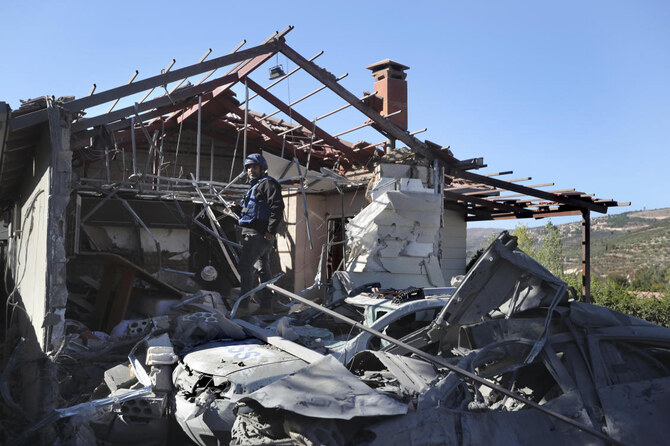
A journalist observes the site where an Israeli airstrike hit a compound housing journalists, killing three media staffers from two different news agencies according to Lebanon's state-run National News Agency, in Hasbaya village, southeast Lebanon, Friday, Oct. 25, 2024. (AP)
Short Url
Updated 25 November 2024
Follow

HRW says Israel strike that killed 3 Lebanon journalists ‘apparent war crime’

BEIRUT: Human Rights Watch said on Monday an Israeli air strike that killed three journalists in Lebanon last month was an “apparent war crime” and used a bomb equipped with a US-made guidance kit.
The October 25 strike hit a tourism complex in the Druze-majority south Lebanon town of Hasbaya where more than a dozen journalists working for Lebanese and Arab media outlets were sleeping.
The Israeli army has said it targeted Hezbollah militants and that the strike was “under review.”
HRW said the strike, relatively far from the Israel-Hezbollah war’s main flashpoints, “was most likely a deliberate attack on civilians and an apparent war crime.”
“Information Human Rights Watch reviewed indicates that the Israeli military knew or should have known that journalists were staying in the area and in the targeted building,” the watchdog said in a statement.
HRW “found no evidence of fighting, military forces, or military activity in the immediate area at the time of the attack,” it added.
The strike killed cameraman Ghassan Najjar and broadcast engineer Mohammad Reda from pro-Iran, Beirut-based broadcaster Al-Mayadeen and video journalist Wissam Qassem from Hezbollah’s Al-Manar television.
The watchdog said it verified images of Najjar’s casket wrapped in a Hezbollah flag and buried in a cemetery alongside fighters from the militant group.
But a spokesperson for the militant group said he “had no involvement whatsoever in any military activities.”
HRW said the bomb dropped by Israeli forces was equipped with a United States-produced Joint Direct Attack Munition (JDAM) guidance kit.
The JDAM is “affixed to air-dropped bombs and allows them to be guided to a target by using satellite coordinates,” the statement said.
It said remnants from the site were consistent with a JDAM kit “assembled and sold by the US company Boeing.”
One remnant “bore a numerical code identifying it as having been manufactured by Woodard, a US company that makes components for guidance systems on munitions,” it added.
The watchdog said it contacted Boeing and Woodard but received no response.
In October last year, Reuters journalist Issam Abdallah was killed by Israeli shellfire while he was covering southern Lebanon, and six other journalists were wounded, including AFP’s Dylan Collins and Christina Assi, who had to have her right leg amputated.
In November last year, Israeli bombardment killed Al-Mayadeen correspondent Farah Omar and cameraman Rabih Maamari, the channel said.
Lebanese rights groups have said five more journalists and photographers working for local media have been killed in Israeli strikes on the country’s south and Beirut’s southern suburbs.


Family of Palestinian-American shot dead by Israeli settler demand accountability

Updated 21 February 2026
Follow

Family of Palestinian-American shot dead by Israeli settler demand accountability

  • Relatives say Abu Siyam was among about 30 residents from the village of Mukhmas who confronted armed settlers attempting to steal goats from the community

LONDON: The family of a 19-year-old Palestinian-American man reportedly shot dead by an Israeli settler in the occupied West Bank have demanded accountability, amid mounting scrutiny over a surge in settler violence and a lack of prosecutions.

Nasrallah Abu Siyam, a US citizen born in Philadelphia, was killed near the city of Ramallah on Wednesday, becoming at least the sixth American citizen to die in incidents involving Israeli settlers or soldiers in the territory in the past two years.

Relatives say Abu Siyam was among about 30 residents from the village of Mukhmas who confronted armed settlers attempting to steal goats from the community. Witnesses said that stones were thrown by both sides before settlers opened fire, wounding at least three villagers.

Abu Siyam was struck and later died of his injuries.

Abdulhamid Siyam, the victim’s cousin, said the killing reflected a wider pattern of impunity.

“A young man of 19 shot and killed in cold blood, and no responsibility,” he told the BBC. “Impunity completely.”

The US State Department said that it was aware of the death of a US citizen and was “carefully monitoring the situation,” while the Trump administration said that it stood ready to provide consular assistance.

The Israeli embassy in Washington said the incident was under review and that an operational inquiry “must be completed as soon as possible.”

A spokesperson for the Israeli Defense Forces said troops were deployed to the scene and used “riot dispersal means to restore order,” adding that no IDF gunfire was reported.

The military confirmed that the incident remained under review and said that a continued presence would be maintained in the area to prevent further unrest.

Palestinians and human rights organizations say such reviews rarely lead to criminal accountability, arguing that Israeli authorities routinely fail to prosecute settlers accused of violence.

A US embassy spokesperson later said that Washington “condemns this violence,” as international concern continues to grow over conditions in the occupied West Bank.

Palestinians and human rights groups say Israeli authorities routinely fail to investigate or prosecute settlers accused of violence against civilians.

Those concerns were echoed this week by the UN, which warned that Israel’s actions in the occupied West Bank may amount to ethnic cleansing.

A UN human rights office report on Thursday said that Israeli settlement expansion, settler attacks and military operations have increasingly displaced Palestinian communities, with dozens of villages reportedly emptied since the start of the Gaza war.

The report also criticized Israeli military tactics in the northern West Bank, saying that they resembled warfare and led to mass displacement, while noting abuses by Palestinian security forces, including the use of unnecessary lethal force and the intimidation of critics.

Neither Israel’s foreign ministry nor the Palestinian Authority has commented on the findings.