Pakistan president calls for education, financial freedom to combat violence against women

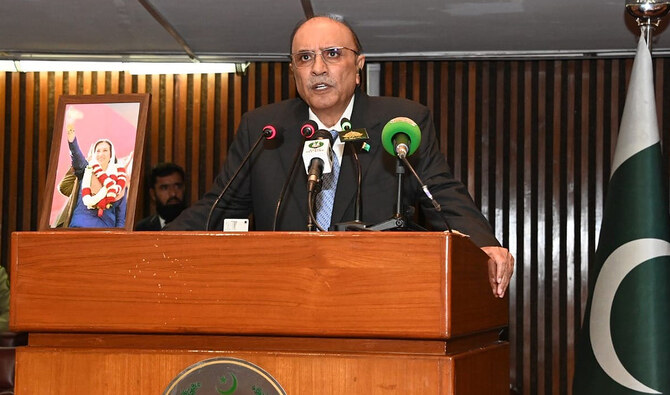
In this file photograph, taken and released by the Press Information Department on April 18, 2024, Pakistan President Asif Ali Zardari speaks the Joint Session of the Parliament in Islamabad. (PID/File)
Short Url
Updated 25 November 2024
Follow

Pakistan president calls for education, financial freedom to combat violence against women

  • Zardari urges ‘systematic reforms’ on International Day to End Violence Against Women
  • Pakistan has introduced laws to protect women, but their implementation is inadequate

ISLAMABAD: President Asif Ali Zardari on Monday called for intensified efforts to eliminate violence against women, emphasizing education and financial independence as essential tools to empower women and ensure their safety.
Zardari issued the statement on the International Day for the Elimination of Violence against Women, observed annually on November 25, to highlight the global issue of gender-based violence, which affects one in three women worldwide, according to the United Nations.
In Pakistan, the problem is compounded by deeply rooted patriarchal norms, with incidents of domestic abuse, honor killings and workplace harassment remaining widespread despite existing laws.
“Today, we renew our commitment to protecting women’s rights, providing a safe and supportive environment and eradicating violence,” the president said in a statement. “It is essential to provide women with education and skills and ensure their financial independence.”
“Every year, thousands of women lose their lives due to violence,” he added. “To prevent violence against women, strategies and systemic reforms must be implemented.”
Pakistan has introduced several laws to protect women, including legislation against sexual violence and workplace harassment. However, human rights organizations point to significant gaps in enforcement and the persistence of discriminatory attitudes that undermine women’s safety.
The president described violence against women as a “major human rights issue,” stressing the importance of raising awareness about women’s rights and the urgent need for collective action to create a safer society.
“Through collective efforts, we can create a safer, violence-free environment for women,” he said.
The president also recalled how Pakistan’s only female prime minister, his late wife Benazir Bhutto, emphasized economic freedom and social equality to improve the quality of life for women in the country.
He said she aspired to create a society free from exploitation and mistreatment of women.
“I am pleased that meaningful efforts are being made in Pakistan to eliminate violence against women,” he added. “Through collective efforts, we can create a safer, violence-free environment for women.”


Pakistan raises India's suspension of water-sharing treaty with UNGA president, seeks action

Updated 7 sec ago
Follow

Pakistan raises India's suspension of water-sharing treaty with UNGA president, seeks action

  • New Delhi said in April last year it was holding the treaty in abeyance after a gun attack in Indian-administered Kashmir
  • Official says such actions threaten lives of 240 million Pakistanis, particularly at a time of climate stress, water scarcity

ISLAMABAD: Pakistan has taken up India’s suspension of a decades-old water-sharing treaty with the president of the United Nations General Assembly (UNGA), urging action over the move that Islamabad said sets "dangerous precedents."

The Indus Waters Treaty (IWT) divides control of the Indus basin rivers between the two nuclear-armed neighbors. India said in April last year it would hold the treaty “in abeyance” after a gun attack in Indian-administered Kashmir killed more than 26 tourists. New Delhi blamed the assault on Pakistan, Islamabad denied it.

The attack led to a four-day military conflict between the neighbors last May that say them attack each other with fighter jets, missiles, drones and artillery before the United States-brokered a ceasefire. Tensions have remained high between the nuclear-armed neighbors.

During a meeting on the sidelines of the Inter-Parliamentary Union (IPU) annual hearing, Pakistan Senate Chairman Yusuf Raza Gilani told UNGA President Annalena Baerbock that India's unlawful action constituted a blatant violation of the treaty’s provisions and principles of customary international law.

"Such actions threaten the lives and livelihoods of over 240 million Pakistanis and set dangerous precedents, particularly at a time when climate stress and water scarcity demand cooperation and strict respect for international agreements," he was quoted as saying by the Pakistani information ministry.

The treaty, mediated by the World Bank, grants Pakistan rights to the Indus basin’s western rivers — Indus, Jhelum, and Chenab — for irrigation, drinking, and non-consumptive uses like hydropower, while India controls the eastern rivers — Ravi, Beas, and Sutlej — for unrestricted use but must not significantly alter their flow.

Highlighting the adverse impacts of climate change, Gilani said countries like Pakistan remain among the most severely affected and underscored the urgency of collective action, climate justice and strengthened international cooperation.

"The United Nations provides an indispensable platform for addressing these interconnected challenges," he said at the meeting.

Gilani, who was leading a six-member parliamentary delegation, this week delivered the national statement at the IPU annual hearing at the UN headquarters, calling for democratic, transparent, and accountable decision-making in order to enhance the UN’s credibility, according to the Senate of Pakistan.

“Parliaments are indispensable partners in ensuring national ownership of international commitments,” he was quoted as saying by the Senate. “Reform is essential. But it must be ‘Reform for All, Privilege for None’.”

The Senate chairman highlighted the continuing importance of the United Nations as the cornerstone of multilateral cooperation, stressing that the organization’s universal membership and Charter-based mandate remain central to promoting global peace and security.