


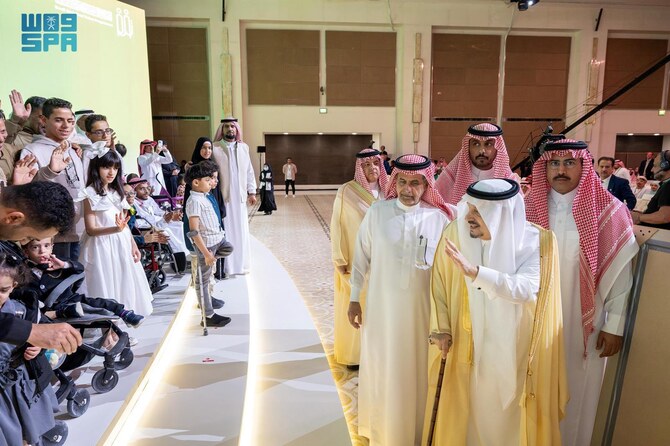

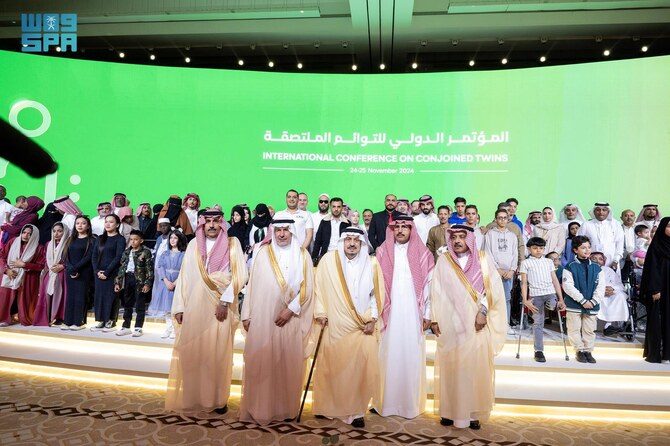
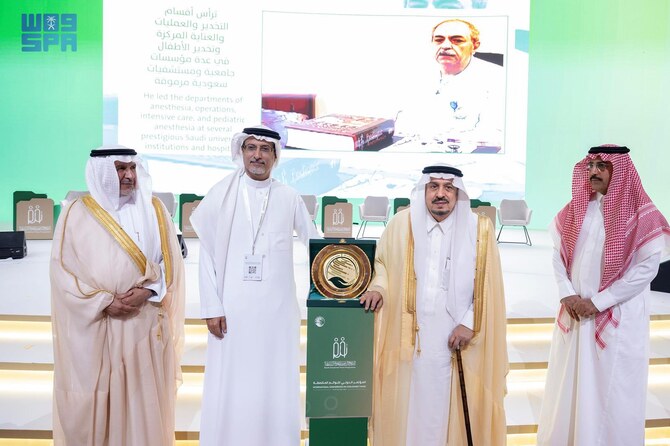


RIYADH: The inaugural International Conference on Conjoined Twins kicked off in Riyadh on Sunday.
The event unites leading medical experts, humanitarian organizations, and families from around the globe to share vital insights, discuss innovative separation techniques, and forge collaborative pathways in the pursuit of improved lives for conjoined twins.
Riyadh Gov. Prince Faisal bin Bandar delivered a speech on behalf of King Salman celebrating the achievements of the Saudi Conjoined Twins Program, which has become a global leader in the field.
“Since 1990, 143 cases of twins from 26 countries have been reviewed by my dear colleagues, who have successfully separated a total of 61 pairs of twins to date,” he said.
Prince Faisal added that it is the only program globally specializing in separating conjoined twins, making it one of the largest humanitarian medical programs in the world.
He also highlighted a recent milestone: the UN General Assembly is considering an initiative by Saudi Arabia to designate Nov. 24 as the annual World Conjoined Twins Day.
In a video address, Dr. Tedros Adhanom Ghebreyesus, director general of the World Health Organization, congratulated Saudi Arabia on its leadership in organizing the conference.
“I commend Saudi Arabia for its leadership in organizing this important World Conjoined Twins Day Conference,” he said.
This recognition would honor the medical and humanitarian efforts in this field and highlight the challenges faced by conjoined twins and their families.
Ghebreyesus praised the initiative as a model for global collaboration in rare and complex medical cases.
“The conference provides critical insights, from surgical innovations to long-term strategies, shaping rare initiatives. A broader platform and registry for congenital anomalies would benefit low and middle-income countries,” he said.
A keynote address was delivered by Dr. Abdullah Al-Rabeeah, advisor to the Royal Court and supervisor-general of Saudi aid agency KSrelief.
As the head of the multidisciplinary team for the Saudi Conjoined Twins Program, Al-Rabeeah provided insights into the occurrence and challenges associated with conjoined twins.
The history of conjoined twin separation reveals both the challenges and progress in medical science.
“The first successful separation was by Johannes Fatio back in 1689 by using a constricting band for a set of Omphalopagus twins or those sharing liver and gastrointestinal organs,” he said.
With a 0.5 percent incidence rate, this early success involved “presumably, a small joining in the skin, probably a little bit of the liver,” said Al-Rabeeah.
He added that a major breakthrough came in 1957 with the first successful separation of Craniopagus, or twins sharing one brain.
Al-Rabeeah said that the epidemiology shows distinct patterns: “In Western countries, it’s been estimated that we get one conjoined twins in every 50 to 200,000 births.”
He added that, however, it is more prevalent in Southeast Asia and Africa, “presumably because identical twinning and twinning is (found) more in dark-skinned people in Africa and also in Southeast Asia, increasing the incidence.”
The survival statistics, Al-Rabeeah reported, entail that “60 percent of conjoined twins are stillborn, and those who live 40 percent of them will die in the first few days of life, and 70 percent of those who would survive will be females.”
He emphasized that the reasons behind this regional disparity remain unknown and require further research.
Throughout the conference, leading medical professionals presented their expertise on various aspects of caring for and separating conjoined twins. Topics included embryology, multidisciplinary team-building, antenatal care, and labor management.
Dr. Nadia Al-Ghilan, from the maternal-fetal medicine department at King Abdulaziz Medical City, gave a presentation titled “Caring for Conjoined Twins: A Prenatal Journey,” describing the complex process of managing pregnancies involving conjoined twins.
She said that caring for conjoined twins is a complex and delicate process as it requires meticulous prenatal planning and a dedicated medical team.
Al-Ghilan said that “this journey is filled with unique challenges, ethical considerations, and the utmost care to ensure the best possible outcomes for the twins and their family.”
Early diagnosis, she stressed, is critical for effective prenatal referral, counseling, and planning for delivery and postnatal care.
Al-Ghilan also underscored the importance of genetic testing in understanding the chromosomal health of conjoined twins.
“Techniques like amniocentesis and chorionic villus sampling can help identify genetic abnormalities, providing valuable information for developing treatment strategies.”
The conference not only serves as a platform for scientific exchange but also fosters dialogue on building global partnerships to support conjoined twins and their families, particularly in low and middle income countries. The conference emphasized the importance of comprehensive care, from prenatal counseling to post-separation rehabilitation.
For over 30 years, the Saudi Conjoined Twins Program has stood as a beacon of hope for families worldwide. The inaugural International Conference on Conjoined Twins is set to continue this legacy, inspiring further advancements in the care and treatment of conjoined twins globally.


