



WASHINGTON: As a former and potentially future president, Donald Trump hailed what would become Project 2025 as a road map for “exactly what our movement will do” with another crack at the White House.
As the blueprint for a hard-right turn in America became a liability during the 2024 campaign, Trump pulled an about-face. He denied knowing anything about the “ridiculous and abysmal” plans written in part by his first-term aides and allies.
Now, after being elected the 47th president on Nov. 5, Trump is stocking his second administration with key players in the detailed effort he temporarily shunned. Most notably, Trump has tapped Russell Vought for an encore as director of the Office of Management and Budget; Tom Homan, his former immigration chief, as “border czar;” and immigration hard-liner Stephen Miller as deputy chief of policy.
Those moves have accelerated criticisms from Democrats who warn that Trump’s election hands government reins to movement conservatives who spent years envisioning how to concentrate power in the West Wing and impose a starkly rightward shift across the US government and society.
Trump and his aides maintain that he won a mandate to overhaul Washington. But they maintain the specifics are his alone.
“President Trump never had anything to do with Project 2025,” said Trump spokeswoman Karoline Leavitt in a statement. “All of President Trumps’ Cabinet nominees and appointments are whole-heartedly committed to President Trump’s agenda, not the agenda of outside groups.”
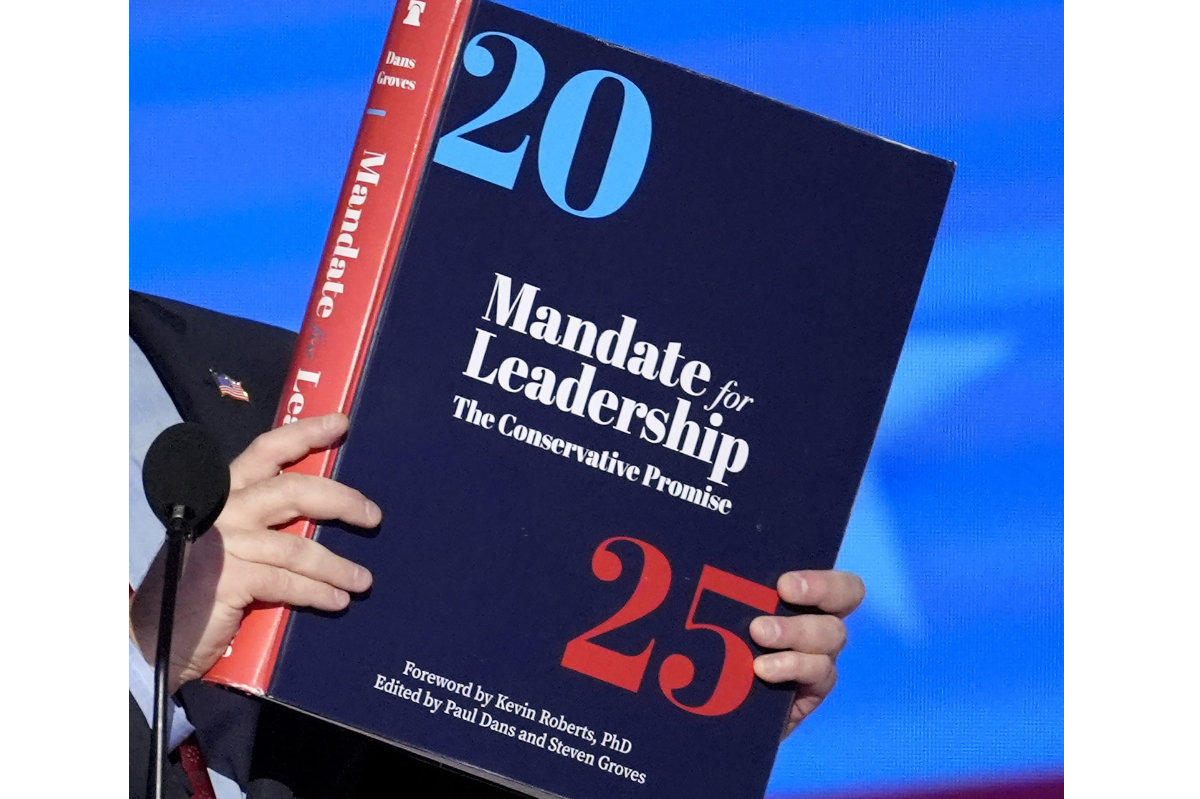
A copy of Project 2025, Trump's blue print for reforming the government, is shown during the Democratic National Convention on Aug. 21, 2024, in Chicago. (AP/File)
Here is a look at what some of Trump’s choices portend for his second presidency.
As budget chief, Vought envisions a sweeping, powerful perch
The Office of Management and Budget director, a role Vought held under Trump previously and requires Senate confirmation, prepares a president’s proposed budget and is generally responsible for implementing the administration’s agenda across agencies.
The job is influential but Vought made clear as author of a Project 2025 chapter on presidential authority that he wants the post to wield more direct power.
“The Director must view his job as the best, most comprehensive approximation of the President’s mind,” Vought wrote. The OMB, he wrote, “is a President’s air-traffic control system” and should be “involved in all aspects of the White House policy process,” becoming “powerful enough to override implementing agencies’ bureaucracies.”
Trump did not go into such details when naming Vought but implicitly endorsed aggressive action. Vought, the president-elect said, “knows exactly how to dismantle the Deep State” — Trump’s catch-all for federal bureaucracy — and would help “restore fiscal sanity.”
In June, speaking on former Trump aide Steve Bannon’s “War Room” podcast, Vought relished the potential tension: “We’re not going to save our country without a little confrontation.”
Vought could help Musk and Trump remake government’s role and scope
The strategy of further concentrating federal authority in the presidency permeates Project 2025’s and Trump’s campaign proposals. Vought’s vision is especially striking when paired with Trump’s proposals to dramatically expand the president’s control over federal workers and government purse strings — ideas intertwined with the president-elect tapping mega-billionaire Elon Musk and venture capitalist Vivek Ramaswamy to lead a “Department of Government Efficiency.”
Trump in his first term sought to remake the federal civil service by reclassifying tens of thousands of federal civil service workers — who have job protection through changes in administration — as political appointees, making them easier to fire and replace with loyalists. Currently, only about 4,000 of the federal government’s roughly 2 million workers are political appointees. President Joe Biden rescinded Trump’s changes. Trump can now reinstate them.
Meanwhile, Musk’s and Ramaswamy’s sweeping “efficiency” mandates from Trump could turn on an old, defunct constitutional theory that the president — not Congress — is the real gatekeeper of federal spending. In his “Agenda 47,” Trump endorsed so-called “impoundment,” which holds that when lawmakers pass appropriations bills, they simply set a spending ceiling, but not a floor. The president, the theory holds, can simply decide not to spend money on anything he deems unnecessary.
Vought did not venture into impoundment in his Project 2025 chapter. But, he wrote, “The President should use every possible tool to propose and impose fiscal discipline on the federal government. Anything short of that would constitute abject failure.”
Trump’s choice immediately sparked backlash.
“Russ Vought is a far-right ideologue who has tried to break the law to give President Trump unilateral authority he does not possess to override the spending decisions of Congress (and) who has and will again fight to give Trump the ability to summarily fire tens of thousands of civil servants,” said Sen. Patty Murray of Washington, a Democrat and outgoing Senate Appropriations chairwoman.
Reps. Jamie Raskin of Maryland and Melanie Stansbury of New Mexico, leading Democrats on the House Committee on Oversight and Accountability, said Vought wants to “dismantle the expert federal workforce” to the detriment of Americans who depend on everything from veterans’ health care to Social Security benefits.
“Pain itself is the agenda,” they said.
Homan and Miller reflect Trump’s and Project 2025’s immigration overlap
Trump’s protests about Project 2025 always glossed over overlaps in the two agendas. Both want to reimpose Trump-era immigration limits. Project 2025 includes a litany of detailed proposals for various US immigration statutes, executive branch rules and agreements with other countries — reducing the number of refugees, work visa recipients and asylum seekers, for example.
Miller is one of Trump’s longest-serving advisers and architect of his immigration ideas, including his promise of the largest deportation force in US history. As deputy policy chief, which is not subject to Senate confirmation, Miller would remain in Trump’s West Wing inner circle.
“America is for Americans and Americans only,” Miller said at Trump’s Madison Square Garden rally on Oct. 27.
“America First Legal,” Miller’s organization founded as an ideological counter to the American Civil Liberties Union, was listed as an advisory group to Project 2025 until Miller asked that the name be removed because of negative attention.
Homan, a Project 2025 named contributor, was an acting US Immigration and Customs Enforcement director during Trump’s first presidency, playing a key role in what became known as Trump’s “family separation policy.”
Previewing Trump 2.0 earlier this year, Homan said: “No one’s off the table. If you’re here illegally, you better be looking over your shoulder.”
Project 2025 contributors slated for CIA and Federal Communications chiefs
John Ratcliffe, Trump’s pick to lead the CIA, was previously one of Trump’s directors of national intelligence. He is a Project 2025 contributor. The document’s chapter on US intelligence was written by Dustin Carmack, Ratcliffe’s chief of staff in the first Trump administration.
Reflecting Ratcliffe’s and Trump’s approach, Carmack declared the intelligence establishment too cautious. Ratcliffe, like the chapter attributed to Carmack, is hawkish toward China. Throughout the Project 2025 document, Beijing is framed as a US adversary that cannot be trusted.
Brendan Carr, the senior Republican on the Federal Communications Commission, wrote Project 2025’s FCC chapter and is now Trump’s pick to chair the panel. Carr wrote that the FCC chairman “is empowered with significant authority that is not shared” with other FCC members. He called for the FCC to address “threats to individual liberty posed by corporations that are abusing dominant positions in the market,” specifically “Big Tech and its attempts to drive diverse political viewpoints from the digital town square.”
He called for more stringent transparency rules for social media platforms like Facebook and YouTube and “empower consumers to choose their own content filters and fact checkers, if any.”
Carr and Ratcliffe would require Senate confirmation for their posts.


