

Mozambique opposition leader Mondlane sets conditions for post-election talks

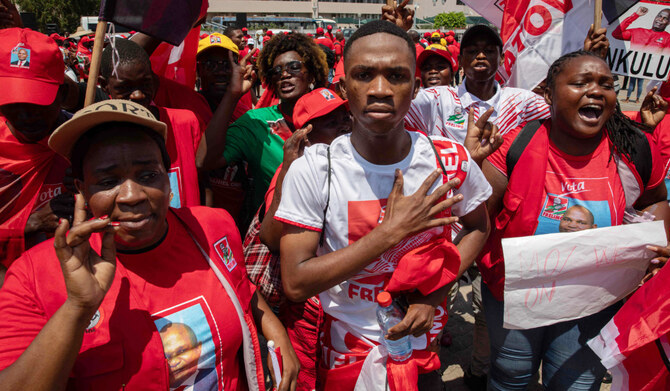
Supporters of the ruling Mozambique Liberation Front (FRELIMO) presidential candidate, Daniel Chapo, chant slogans during a march to celebrate the party's claimed electoral victory following weeks of protests in downtown Maputo on November 23, 2024. (AFP)
Short Url
Updated 23 November 2024
Follow

Mozambique opposition leader Mondlane sets conditions for post-election talks

  • We are open to dialogue. It has to be a genuine dialogue. It cannot be full of traps

MAPUTO: Mozambique’s opposition leader said he would accept the president’s offer of talks after deadly post-election unrest on terms including their being held virtually and legal proceedings against him being dropped.
President Filipe Nyusi invited Venancio Mondlane to his office in Maputo on Nov. 26 after the killing of dozens of people in a police crackdown on demonstrations against the results of the Oct. 9 election.
Mondlane, who says the election was rigged in favor of Nyusi’s Frelimo party, is believed to have left the country for fear of arrest or attack, but his whereabouts are unknown.
“We are open to dialogue,” Mondlane said in a Facebook live address. “It has to be a genuine dialogue. It cannot be full of traps.”
A written reply to Nyusi’s invitation lists as one condition for the meeting: “That the participation of the elected candidate Venancio Mondlane is virtual.”
Authorities have laid criminal and civil charges against him, including for damages caused during protests by his supporters, which has led to his bank accounts being frozen.
Another condition in the document made public by Mondlane’s office is that “the judicial proceedings in question must be immediately terminated.” It also lays out 20 points that Mondlane wants on the agenda for talks, including “restoring electoral truth” and prosecuting anyone involved in vote-rigging.
Others are a public apology and compensation for the deaths during the demonstrations, as well as constitutional, economic, and electoral reforms.
Rights groups have accused Mozambique authorities of using live ammunition on demonstrators in the country, which has been governed since independence from Portugal in 1975 by Frelimo.
The Center for Democracy and Human Rights civil society group says around 65 people have been killed. Mondlane on Friday gave a toll of more than 60.
Nyusi said Tuesday 19 people had died, including five police officers.
The president is meant to hand over to Frelimo candidate Daniel Chapo in January, whom the election authority says won 71 percent of votes against 20 percent for Mondlane.
The unrest was discussed Wednesday by regional leaders at a summit of the 16-nation Southern Africa grouping Southern African Development Community, or SADC, which said in a statement afterward that it “extended condolences to the government and people” for the lives lost.
Human Rights Watch criticized the SADC, for failing to denounce Mozambique for excessive use of force.
“SADC has squandered an opportunity to condemn human rights abuses against post-election protesters in Mozambique publicly,” it said in a statement.
The rights watchdog urged the grouping to tell Nyusi’s government to respect the right to peaceful protest and cease using unnecessary and excessive force.


Kremlin welcomes US sanctions waiver says US and Russia share interest in stable energy markets

Updated 6 sec ago
Follow

Kremlin welcomes US sanctions waiver says US and Russia share interest in stable energy markets

DUBAI: Russia sees ​a U.S. sanctions waiver on its oil as ‌an ‌attempt ​by ‌Washington ⁠to stabilise ​global energy ⁠markets, and the two countries ⁠have a shared ‌interest ‌in ​this, ‌Kremlin ‌spokesman Dmitry Peskov said on Friday.

"We see ‌actions by the United States aimed ‌at trying to stabilise energy markets. In this respect, our interests coincide," he said.

US Treasury Secretary Scott Bessent announced a temporary authorisation allowing countries around the world to purchase Russian oil currently stranded at sea on Thursday extending a measure that had previously been granted only to Indian refiners.

Bessent stressed in a post on X that the authorisation would not provide significant financial benefit to the Russian government. 

“This narrowly tailored, short-term measure applies only to oil already in transit and will not provide significant financial benefit to the Russian government, which derives the majority of its energy revenue from taxes assessed at the point of extraction,” Bessent said on a post on X. 

However, the measure received mix reviews in European capitals, with many fearing it could help replenish Russia's assualt on Ukraine. 

"I am concerned that we are further filling Putin's war chest," German Economy Minister Katherina Reiche said in Berlin on Friday.

Reiche said that she saw both sides to the United States' decision to issue ‌a 30-day ‌waiver ​for ‌the purchase ⁠of ​Russian oil ⁠products, understanding the increasing ecnomic and political turnout from the oil crisis, particurlarly in South Korea and Japan. 

"It seems to me that domestic political pressure in the United ⁠States is very, ‌very ‌high," ​Reiche said.

German ​Chancellor Friedrich Merz was more direct, saying on Friday that it was ‌wrong to ‌ease ​sanctions against ‌Russia ⁠for ​whatever reason. The sentiment was echoed by Norway’s Prime Minister, who also said sanctions should not be eased. 

Oil prices held gains above $100 Friday and most equity markets dropped after Iran's leader called for the blocking of the crucial Strait of Hormuz and the opening up of new fronts in the war against the United States and Israel.

With the conflict heading towards its third week and showing no signs of ending, investors are growing increasingly worried about an extended crisis that could fan inflation and hammer the global economy.