

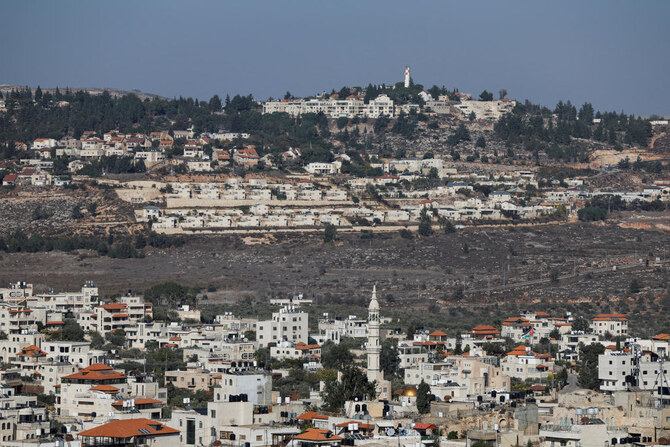

SHILO, West Bank: After a record expansion of Israeli settlement activity, some settler advocates in the occupied West Bank are looking to Donald Trump to fulfil a dream of imposing sovereignty over the area seen by Palestinians as the heart of a future state. The West Bank has been transformed by the rapid growth of Jewish settlements since Prime Minister Benjamin Netanyahu returned at the head of a far-right nationalist coalition two years ago. During that time, an explosion in settler violence that has led to US sanctions.
In recent weeks, Israeli flags have sprouted on hilltops claimed by some settlers in the West Bank’s Jordan Valley, adding to worries among many local Palestinians of greater control of those areas. Some settlers prayed for Trump’s victory before the election.
“We have high hopes. We’re even buoyant to a certain extent,” said Yisrael Medad, an activist and writer who supports Israel absorbing the West Bank, speaking to Reuters about Trump’s victory in the house he has lived in for more than four decades in the West Bank settlement of Shilo. Settlers have celebrated Trump’s nomination of a clutch of officials known for pro-Israel views, among them ambassador Mike Huckabee, an evangelical Christian who has said the West Bank is not under occupation and prefers the term “communities” to “settlements.” And over the past month, Israeli government ministers and settler advocates who have cultivated ties with the US Christian right have increasingly pushed the once fringe idea of “restoring sovereignty” over the West Bank in public comments. The Netanyahu government has not announced any official decision on the matter. A spokesperson at Netanyahu’s office declined to comment for this story. It is by no means certain Trump will give backing to a move that puts at risk Washington’s strategic ambition of a wider deal under the Abraham Accords to normalize Israel’s ties with Saudi Arabia, which, like most countries in the world, rejects Israeli sovereignty in the West Bank.
“Trump’s desire for expansion of the Abraham Accords will be a top priority,” Dennis Ross, a former Middle East negotiator for Democratic and Republican administrations said, based on his own assessment of Trump’s foreign policy considerations.
“There’s no way the Saudis will think seriously about joining if Israel formally absorbs the West Bank,” he said. Annexation would bury any hope of a two-state solution that creates an independent Palestine and also complicate efforts to resolve more than a year of war in Gaza that has spilled over into neighboring Lebanon. In his first term, Trump moved the US embassy in Israel to Jerusalem and ended Washington’s long-held position that the settlements are illegal. But, in 2020, his plan to create a rump of a Palestinian state along existing boundaries derailed efforts by Netanyahu for Israeli sovereignty over the area.
The president-elect has not revealed his plans for the region. Trump transition spokeswoman Karoline Leavitt did not answer questions about policy, saying only that he would “restore peace through strength around the world.” Nonetheless, Israeli Finance Minister Bezalel Smotrich, one of the most prominent pro-settler ministers in the government, said last week he hoped Israel could absorb the West Bank as early as next year with the support of the Trump administration.
Israel Ganz, the head of the Yesha Council, an umbrella group of West Bank Jewish municipalities, said in an interview that he hoped the Trump administration would “let” Israel’s government move ahead.
Ganz led a prayer session for a Trump victory in the ruins of an old Byzantine basilica in Shilo before the Nov. 5 election.
“We prayed that God will lead to better days for the people of the United States of America and for Israel,” he said. Shilo has been a popular stop for visiting US politicians, including both Huckabee and Pete Hegseth, Trump’s nominee for Secretary of Defense.
Last week, Huckabee told Arutz Sheva, an Israeli news outlet aligned with Smotrich’s Religious Zionism movement, that any decision on annexation would be a matter for the Israeli government. Huckabee did not immediately respond to a request for comment.
Senior Palestine Liberation Organization official Wasel Abu Yousef said any such action by the Israeli government “will not change the truth that this is Palestinian land.”
SURROUNDED
Together with the neighboring settlement of Eli, Shilo sits near the center of the West Bank, an hour from Jerusalem along Route 60, a smooth motorway that contrasts sharply with the potholed roads that connect the area’s Palestinian cities.
Bashar Al-Qaryouti, a Palestinian activist from the nearby village of Qaryut, said the expansion of Shilo and Eli had left Palestinian villages in the central West Bank surrounded.
Al-Qaryouti described an increase in settlers constructing without waiting for formal paperwork from the Israeli government, a trend also noted by Peace Now, an Israeli activist group that tracks settlement issues.
“This is happening on the ground,” Al-Qaryouti told Reuters by phone. “Areas across the center of the West Bank are under the control of settlers now.”
The West Bank, which many in Israel call Judea and Samaria after the old Biblical terms for the area, is a kidney shaped region about 100 km (60 miles) long and 50 km (30 miles) wide that has been at the heart of the Israeli-Palestinian conflict since it was captured by Israel in the 1967 Middle East war. Most countries consider the area as occupied territory and deem the settlements illegal under international law, a position upheld by the UN’s top court in July.
Around 750,000 Palestinians were displaced with the creation of Israel in 1948, according to UN estimates. The West Bank is claimed by Palestinians as the nucleus of a future independent state, along with the Mediterranean enclave of Gaza to the south.
But the spread of Jewish settlements, which have mushroomed across the West Bank since the Oslo interim peace accords 30 years ago, has transformed the area.
Revered as the site of the tabernacle set up by the ancient Israelites after they returned from exile in Egypt and kept there for 300 years, modern Shilo was established in the 1970s and has the air of a gated community of quiet streets and neat suburban homes. Its population in 2022 was around 5,000 people.
For supporters of Jewish settlements, the Biblical connection is what gives them the right to be there, whatever international law may say.
“Even if the Byzantines, the Romans, the Mameluks and Ottomans ruled it, it was our land,” said Medad.
As such, settler advocates reject the term “annexation,” which they say suggests taking a foreign territory. Settlement construction in the West Bank reached record levels in 2023. Since the war started in Gaza last October, a spate of new roads and ground works have changed the appearance of hillsides across the area visibly.
Criticism from the Biden administration has done nothing to stop it. At the same time, violence by Jewish settlers against Palestinians in the West Bank has spiralled, including around Shilo, drawing international condemnation and US and European sanctions, as recently as this week, against individuals deemed to have taken a prominent part.
Settler leaders including Ganz say violence has no place in their movement. The settler movement has argued that they provide security for the rest of Israel with their presence in areas near Palestinian towns and cities.
“IRREVERSIBLE FACT”
A series of steps have been taken to consolidate Israel’s position in the West Bank since Netanyahu’s government came to power with a coalition agreement stating “The Jewish people have a natural right to the Land of Israel.”
“We’re changing a lot of things on the ground to make it a fact that Israel is in Judea and Samaria as well,” said Ohad Tal, chairman of Smotrich’s parliamentary faction, speaking beside a red Trump MAGA hat on a shelf in his Knesset office.
A whole mechanism has been built “to effectively apply sovereignty in Judea and Samaria, to make it an irreversible fact that Jewish presence is there and to stay.”
Many functions relating to settlements previously handled by the military have been handed to the Settlement Administration, a civilian body answerable directly to finance minister Smotrich, who has an additional defense ministry portfolio that puts him in charge of running the West Bank.
In 2024, nearly 6,000 acres (2,400 hectares) have been declared Israeli state land, a classification that makes it easier to build settlements, the biggest annual growth on record and accounting for half of all areas declared state land in the past three decades, Peace Now said in a report in October.
At least 43 new settler outposts have been established over the past year, compared with an average of under 7 a year since 1996, according to a separate analysis from Peace Now.
The outposts, often satellites of existing settlements on nearby hilltops that allow the original location to expand, have been served with kilometers of new roads and other infrastructure. Often built illegally according to Israeli law, the Yesha Council has said almost 70 were extended government support this year.
“It’s clever because it’s boring looking,” said Ziv Stahl, a director of Yesh Din, another Israeli group that tracks settlements. “They are not legislating now, saying ‘We are annexing the West Bank’, they are just doing it.”


