Pakistan, Malaysia agree to enhance military cooperation with focus on air force training

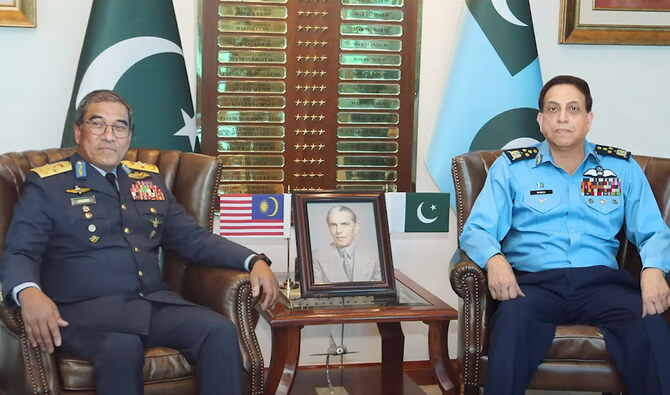
Pakistan Air Force (PAF) Chief Air Chief Marshal Zaheer Ahmed Baber Sidhu poses for a picture in a meeting with Royal Malaysian Air Force Chief General Tan Sri Dato’ Sri Mohd Asghar Khan bin Goriman Khan at Air Headquarters in Islamabad, on November 21, 2024. (PAF)
Short Url
Updated 22 November 2024
Follow

Pakistan, Malaysia agree to enhance military cooperation with focus on air force training

  • Malaysian air chief praises PAF’s advancements in indigenization on his first Pakistan visit
  • His Pakistani counterpart reaffirms commitment to training Malaysian Air Force personnel

ISLAMABAD: Pakistan and Malaysia have agreed to deepen bilateral military cooperation, with a particular emphasis on joint training and air power collaboration, Pakistan’s military said on Friday.
The understanding was reached during a meeting between Pakistan Air Force (PAF) Chief Air Chief Marshal Zaheer Ahmed Baber Sidhu and Royal Malaysian Air Force Chief General Tan Sri Dato’ Sri Mohd Asghar Khan bin Goriman Khan at Air Headquarters in Islamabad.
“The [Pakistan] Air Chief reaffirmed his commitment to enhancing military partnership between the two Air Forces through joint training initiatives, particularly within the realm of air power,” the Inter-Services Public Relations (ISPR) said in a statement. “These initiatives will encompass provisioning of both basic and tactical level training for personnel of the Malaysian Air Force.”
The Malaysian air chief, making his first visit to Pakistan, praised the PAF’s advancements in indigenization and technological innovation. He also expressed interest in bolstering ties through enhanced collaboration in training, maintenance and operational excellence.
The meeting included discussions on defense cooperation, joint exercises and technology sharing, ISPR said, highlighting the robust defense relationship between the two nations.
During his visit, the Malaysian official toured the National Aerospace Science & Technology Park Silicon and the PAF Cyber Command, where he was briefed on Pakistan’s advanced operational capabilities.
He also lauded the innovative projects displayed at the ongoing International Defense Exhibition IDEAS-2024 in Karachi.
Earlier, the Malaysian air chief was presented with a guard of honor upon his arrival, ISPR added.


How do Pakistan and Taliban Afghan militaries stack up as tensions flare?

Updated 7 sec ago
Follow

How do Pakistan and Taliban Afghan militaries stack up as tensions flare?

  • Pakistan fields 660,000 active troops, 465 combat aircraft and 170 nuclear warheads, dwarfing Taliban forces
  • Afghan Taliban command about 172,000 personnel with limited air capability and no nuclear arsenal

Cross-border fighting between Pakistan and Afghanistan intensified ‌overnight, with both sides claiming heavy losses and the Pakistani defense minister saying his country was in an “open war” with its neighbor.

As tensions ​persist, here is a look at how Pakistan dwarfs Afghanistan’s military forces and arsenals, according to data from the London-based International Institute for Strategic Studies.

OVERVIEW
Pakistan’s armed forces benefit from good recruitment and retention, bolstered by equipment from its main defense partner China. Islamabad continues to invest in its military nuclear programs and is also modernizing its navy and air ‌force.

The capability of ‌the Afghan Taliban’s armed forces, meanwhile, ​is ‌declining, ⁠with ​a fall ⁠in their ability to use foreign equipment that the Islamist group seized when it returned to power in the landlocked country in 2021.
A lack of international recognition for the Taliban administration has also hurt military modernization.

PERSONNEL
Pakistan has 660,000 active personnel in its defense forces, of whom 560,000 are in the ⁠army, 70,000 are in the air force, and 30,000 ‌are in the navy.

The ‌strength of the Afghan Taliban’s military ​is thinner, with only 172,000 active ‌personnel. The group has, however, announced plans to expand ‌its armed forces to 200,000 personnel.

FIGHTING VEHICLES AND ARTILLERY
Pakistan has more than 6,000 armored fighting vehicles, and over 4,600 pieces of artillery.

The Afghan forces also possess armored fighting vehicles, including Soviet-era main battle tanks, ‌armored personnel carriers and autonomous underwater vehicles, but their exact number is unknown.

The precise number of ⁠artillery they ⁠possess, which is of at least three different types, is similarly not known.

AIR FORCE
Pakistan has a fleet of 465 combat aircraft and more than 260 helicopters that include multi-role, attack and transport choppers.

Afghanistan has no fighter jets and no real air force to speak of. It is known to possess at least six aircraft — some of them dating back again to the Soviet era — and 23 helicopters, although it is not possible to assess how many are ​in flying condition.

NUCLEAR ARSENAL
While Pakistan ​is a nuclear-armed country and has 170 warheads, Afghanistan does not have a nuclear arsenal.