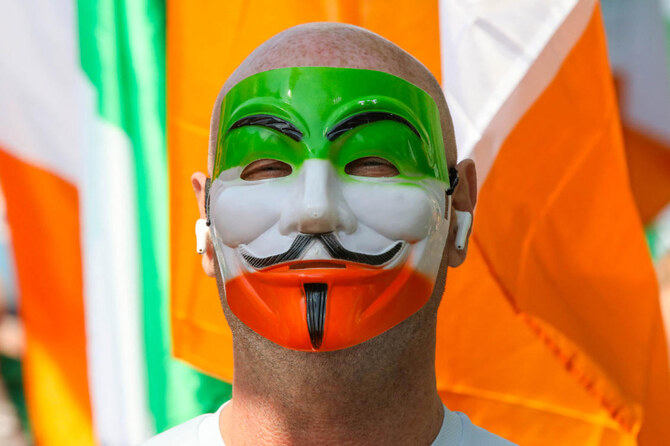
Dublin: The Dublin office of lawyer Malachy Steenson doubles as his election campaign headquarters. Outside is an Irish tricolor and a sign reading: “Take back our nation.”
Inside, Steenson summarised his platform for the November 29 vote. “We need to close the borders and stop any more migrants coming in,” he told AFP.
Ireland is one of the few European Union members without any large established far-right party. But for the first time, immigration has become a frontline election issue.
Steenson, white-haired and 61, is part of an emerging group of ultra-nationalist politicians who performed well at local elections this year and now aim to gain a foothold in parliament.
Elected to Dublin City Council in June, he is running as an independent in the inner-city Dublin Central constituency that is now one of Ireland’s most ethnically diverse.
Most mainstream parties have spent much of the campaign bickering over solutions to Ireland’s acute housing shortage.
But for Steenson, migrants and asylum-seekers are exacerbating that crisis.
“If you import people who are going to sit around on welfare in accommodation that should be available to Irish nationals you’re just creating a bigger problem,” he said.
Ireland’s economy has attracted immigrants since the 1990s when eye-popping growth earned it the “Celtic Tiger” moniker.
After recession and economic slowdown from 2008, immigration surged again following the coronavirus pandemic, plugging job vacancies in booming tech, construction, and hospitality sectors, as well as health care.
Some 20 percent of Ireland’s 5.4-million population is now foreign-born. Official data showed a population increase fueled by migration of around 100,000 in the year to April 2024 — the largest since 2007.
But rapid demographic growth has heaped pressure on housing, services and infrastructure strained by lack of investment, fanning anti-migrant sentiment and hitting still largely favorable attitudes to immigration.
“Immigration is on everyone’s minds,” said Caroline Alwright, a fruit and vegetable stall-owner on Moore Street, a historic city-center market which has become a multicultural meeting place for different nationalities.
“A lot of people will vote for independent candidates, they see what is going on in this country,” said Alwright, 62, a veteran trader nicknamed by customers the “Queen of Moore Street.”
“This street has gone downhill, the country is being robbed blind with money given to people doing nothing on welfare,” she added, gesturing toward a group of Eastern European Romani.
In Kennedy’s pub across the constituency several punters also murmured discontent.
“The buses are full of foreigners, I would vote for anyone saying ‘Ireland is full’ and promising to do something about it,” said Mick Fanning, 74.
Around 110,000 Ukrainians have arrived in Ireland since Russia’s full-scale invasion in 2022, one of the highest numbers per head of population in the EU.
Meanwhile asylum applications have surged to record levels since 2022, with this year’s figures driven by a fourfold increase in people arriving from Nigeria.
The large inflow and the housing crisis has prompted the government to stop providing accommodation to all asylum seekers last year.
That forced hundreds of single male applicants to sleep rough in tents, sparking hostile reactions from some anti-migrant locals.
Ireland has also seen a spike in arson attacks on buildings rumored or earmarked to provide reception centers for asylum seekers.
Last year the largest riot seen in Dublin for decades was triggered by a knife attack on children by an Irish national of immigrant origin.
At the other end of the ward, students at Dublin City University were supportive of immigration.
“We are not full, that’s a closed mindset,” said Carla Keogh, 19, a teaching student.
“If we look into our own past, Irish people left to find help and support in other places, as humans we need to open ourselves up.”
The ultra-nationalist vote is fragmented by micro parties and independents, with few, if any, expected to make an electoral breakthrough.
Anti-immigration votes will rather channel toward moderate independents “who are more outspoken on migration” than more radical options, said political scientist Eoin O’Malley, from Dublin City University.
Most mainstream parties have also pledged to tighten up the asylum system.
The number of arrivals from Ukraine dropped this year after the government slashed allowances and accommodation benefits for newly arrived refugees.
“We were called fascists, racists, far-right, when we proposed the same things two years ago, when in fact we are none of those things,” said Steenson who self-describes as a nationalist.

Ireland’s anti-immigration right eyes election gains
Short Url
https://arab.news/6cdrc
Ireland’s anti-immigration right eyes election gains
- After recession and economic slowdown from 2008, immigration surged again following the coronavirus pandemic
- Some 20 percent of Ireland’s 5.4-million population is now foreign-born
Backlash as Australia kills dingoes after backpacker death
- The euthanization program has stirred debate about how to manage the local population of dingoes
- Wildlife experts said killing the animals was the wrong response and may threaten the island’s dingo population
SYDNEY: Australian authorities have sparked a backlash by killing a group of dingoes linked to the death of a young Canadian woman on an island in the country’s east.
The Queensland government said six animals were put down after 19-year-old backpacker Piper James’s body was found on January 19 at a beach on the World Heritage-listed island of K’gari.
The euthanization program has stirred debate about how to manage the local population of dingoes, a sandy-colored canine believed to have first arrived in Australia 4,000 to 5,000 years ago.
An autopsy conducted on James’ body found evidence “consistent with drowning” but also detected injuries corresponding to dingo bites.
“Pre-mortem dingo bite marks are not likely to have caused immediate death,” said a spokesperson for the Coroners Court of Queensland.
The coroner’s investigation into the cause of death was expected to take several weeks.
In response, the Queensland government said a pack of 10 dingoes involved would be euthanized after rangers had observed some “aggressive behavior.”
Six of the dingoes had already been euthanized, the state’s environment minister, Andrew Powell, told reporters Sunday.
“Obviously, the operation will continue,” he said.
The traditional owners of K’gari, the Butchulla people, said the state’s failure to consult with them before euthanizing the dingoes — or wongari in their language — was “unexpected and disappointing.”
“Once again, it feels as though economic priorities are being placed above the voices of the people and traditional owners, which is frustrating and difficult to accept,” the Butchulla Aboriginal Corporation said in a statement to Australian media this week.
‘You are food’
Wildlife experts said killing the animals was the wrong response and may threaten the island’s dingo population, estimated at just 70-200 animals.
Given their small numbers, killing a pack of 10 animals would harm the population’s genetic diversity, said Mathew Crowther, professor of quantitative conservation biology at the University of Sydney.
“There’s no moral from the dingoes’ point of view. They’re just being wild animals, doing wild things,” Crowther said.
Dingoes tend to lose their fear of people as they interact with tourists, some of whom defy advice against feeding the animals.
“That’s the worst thing you can do to a wild animal,” Crowther said.
“They just relate humans to food, and if you don’t give them food, well, you are food — that’s basically how it is.”
Dingoes are wild, predatory animals and need to be treated with respect, said Bill Bateman, associate professor in the school of molecular and life sciences at Curtin University.
The canines are more likely to attack children or people who are alone, and may be triggered when people turn their backs or run, he said.
“These are important animals, and therefore we need to change the way we deal with them, otherwise we’re just going to keep reacting to these attacks and driving the population of dingoes down,” Bateman said.
Wildlife managers, rangers, Indigenous people and tourism operators need to work together so that humans and dingoes can coexist on the island, he said.
Todd James, the father of Piper, has described on social media how his family’s hearts were “shattered” by her death.
News of the dingoes’ euthanization was “heart-wrenching,” he told Australian media, adding however that he recognized it may be necessary for safety because of the pack’s behavior.
The Queensland government said six animals were put down after 19-year-old backpacker Piper James’s body was found on January 19 at a beach on the World Heritage-listed island of K’gari.
The euthanization program has stirred debate about how to manage the local population of dingoes, a sandy-colored canine believed to have first arrived in Australia 4,000 to 5,000 years ago.
An autopsy conducted on James’ body found evidence “consistent with drowning” but also detected injuries corresponding to dingo bites.
“Pre-mortem dingo bite marks are not likely to have caused immediate death,” said a spokesperson for the Coroners Court of Queensland.
The coroner’s investigation into the cause of death was expected to take several weeks.
In response, the Queensland government said a pack of 10 dingoes involved would be euthanized after rangers had observed some “aggressive behavior.”
Six of the dingoes had already been euthanized, the state’s environment minister, Andrew Powell, told reporters Sunday.
“Obviously, the operation will continue,” he said.
The traditional owners of K’gari, the Butchulla people, said the state’s failure to consult with them before euthanizing the dingoes — or wongari in their language — was “unexpected and disappointing.”
“Once again, it feels as though economic priorities are being placed above the voices of the people and traditional owners, which is frustrating and difficult to accept,” the Butchulla Aboriginal Corporation said in a statement to Australian media this week.
‘You are food’
Wildlife experts said killing the animals was the wrong response and may threaten the island’s dingo population, estimated at just 70-200 animals.
Given their small numbers, killing a pack of 10 animals would harm the population’s genetic diversity, said Mathew Crowther, professor of quantitative conservation biology at the University of Sydney.
“There’s no moral from the dingoes’ point of view. They’re just being wild animals, doing wild things,” Crowther said.
Dingoes tend to lose their fear of people as they interact with tourists, some of whom defy advice against feeding the animals.
“That’s the worst thing you can do to a wild animal,” Crowther said.
“They just relate humans to food, and if you don’t give them food, well, you are food — that’s basically how it is.”
Dingoes are wild, predatory animals and need to be treated with respect, said Bill Bateman, associate professor in the school of molecular and life sciences at Curtin University.
The canines are more likely to attack children or people who are alone, and may be triggered when people turn their backs or run, he said.
“These are important animals, and therefore we need to change the way we deal with them, otherwise we’re just going to keep reacting to these attacks and driving the population of dingoes down,” Bateman said.
Wildlife managers, rangers, Indigenous people and tourism operators need to work together so that humans and dingoes can coexist on the island, he said.
Todd James, the father of Piper, has described on social media how his family’s hearts were “shattered” by her death.
News of the dingoes’ euthanization was “heart-wrenching,” he told Australian media, adding however that he recognized it may be necessary for safety because of the pack’s behavior.
© 2026 SAUDI RESEARCH & PUBLISHING COMPANY, All Rights Reserved And subject to Terms of Use Agreement.


