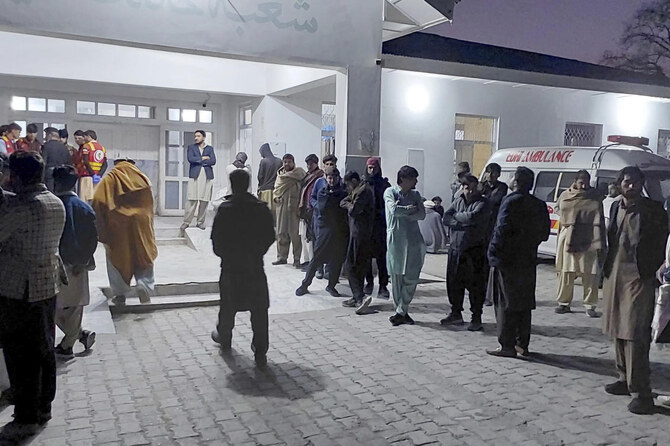
PESHAWAR, Pakistan: Gunmen opened fire on vehicles carrying Shiite Muslims in Pakistan’s restive northwest on Thursday, killing at least 42 people, including six women, and wounding 20 others in one of the region’s deadliest such attacks in recent years, police said.
The attack happened in Kurram, a district in Khyber Pakhtunkhwa province where sectarian clashes between majority Sunni Muslims and minority Shiites have killed dozens of people in recent months.
No one immediately claimed responsibility for the latest attack. It came a week after authorities reopened a key highway in the region that had been closed for weeks following deadly clashes.
Local police official Azmat Ali said several vehicles were traveling in a convoy from the city of Parachinar to Peshawar, the capital of Khyber Pakhtunkhwa, when gunmen opened fire. He said at least 10 passengers were in critical condition at a hospital.
Aftab Alam, a provincial minister, said 42 people were killed in the attack, and that officers were investigating to determine who was behind it.
Interior Minister Mohsin Naqvi called the shootings a “terrorist attack.” Prime Minister Shehbaz Sharif and President Asif Ali Zardari condemned the attack, and Sharif said those behind the killing of innocent civilians will not go unpunished.
Kurram resident Mir Hussain, 35, said he saw four gunmen emerge from a vehicle and open fire on buses and cars.
“I think other people were also firing at the convoy of vehicles from nearby open farm field,” he said. “The firing continued for about 40 minutes.” He said he hid until the attackers fled.
“I heard cries of women, and people were shouting for the help,” he said.
Ibne Ali Bangash, a relative of one of the victims, described the convoy attack as the saddest day in Kurram’s history.
“More than 40 people from our community have been martyred,” he said. “It’s a shameful matter for the government.”
Baqir Haideri, a local Shiite leader, denounced the assault and said the death toll was likely to rise. He accused local authorities of not providing adequate security for the convoy of more than 100 vehicles despite fears of possible attacks by militants who had recently threatened to target Shiites in Kurram.
Shop owners in Parachinar announced a strike on Friday to protest the attack.
Shiite Muslims make up about 15 percent of the 240 million population of Sunni-majority Pakistan, which has a history of sectarian animosity between the communities.
Although the two groups generally live together peacefully, tensions have existed for decades in some areas, especially in parts of Kurram, where Shiites are the majority.
Dozens of people from both sides have been killed since July when a land dispute erupted in Kurram that later turned into general sectarian violence.
Pakistan is tackling violence in the northwest and southwest, where militants and separatists often target police, troops and civilians. Violence in the northwest has been blamed on the Pakistani Taliban, a militant group that is separate from Afghanistan’s Taliban but linked to them. Violence in southwestern Balochistan province has been blamed on members of the outlawed Baloch Liberation Army.

Gunmen fire on vehicles carrying Shiites in northwest Pakistan, killing at least 42
https://arab.news/zyz4m
Gunmen fire on vehicles carrying Shiites in northwest Pakistan, killing at least 42
- No one immediately claimed responsibility for the latest attack
- Interior Minister Mohsin Naqvi said at least 38 people were killed in the “terrorist attack“
Afghanistan says it thwarted Pakistani airstrike on Bagram Air Base as fighting enters fourth day
- The fighting has been the most severe between the neighbors for years
- Pakistan accuses Taliban government of harboring militant groups that stage attacks against it
KABUL: Afghanistan thwarted attempted airstrikes on Bagram Air Base, the former US military base north of Kabul, authorities said Sunday, while cross-border fighting between Pakistan and Afghanistan stretched into a fourth day.
The fighting has been the most severe between the neighbors for years, with Pakistan declaring that it’s in “open war” with Afghanistan.
The conflict has alarmed the international community, particularly as the area is one where other militant organizations, including Al-Qaeda and the Daesh group, still have a presence and have been trying to resurface.
Pakistan accuses Afghanistan’s Taliban government of harboring militant groups that stage attacks against it and also of allying with its archrival India.
Border clashes in October killed dozens of soldiers, civilians and suspected militants until a Qatari-mediated ceasefire ended the intense fighting. But several rounds of peace talks in Turkiye in November failed to produce a lasting agreement, and the two sides have occasionally traded fire since then.
On Sunday, the police headquarters of Parwan province, where Bagram is located, said in a statement that several Pakistani military jets had entered Afghan airspace “and attempted to bomb Bagram Air Base” at around 5 a.m.
The statement said Afghan forces responded with “anti-aircraft and missile defense systems” and had managed to thwart the attack.
There was no immediate response from Pakistan’s military or government regarding Kabul’s claim of attempted airstrikes on Bagram or the ongoing fighting.
Bagram was the United States’ largest military base in Afghanistan. It was taken over by the Taliban as they swept across the country and took control in the wake of the chaotic US withdrawal from the country in 2021. Last year, US President Donald Trump suggested he wanted to reestablish a US presence at the base.
The current fighting began when Afghanistan launched a broad cross-border attack on Thursday night, saying it was in retaliation for Pakistani airstrikes the previous Sunday.
Pakistan had said its airstrike had targeted the outlawed Pakistani Taliban, also known as Tehreek-e-Taliban Pakistan, or TTP. Afghanistan had said only civilians were killed.
The TTP militant group, which is separate but closely allied with Afghanistan’s ruling Taliban, operates inside Pakistan, where it has been blamed for hundreds of deaths in bombings and other attacks over the years.
Pakistan accuses Afghanistan’s Taliban government of providing a safe haven within Afghanistan for the TTP, an accusation that Afghanistan denies.
After Thursday’s Afghan attack, Pakistani Defense Minister Khawaja Mohammad Asif declared that “our patience has now run out. Now it is open war between us.”
In the ongoing fighting, each side claims to have killed hundreds of the other side’s forces — and both governments put their own casualties at drastically lower numbers.
Two Pakistani security officials said that Pakistani ground forces were still in control on Sunday of a key Afghan post and a 32-square-kilometer area in the southern Zhob sector near Kandahar province, after having seized it during fighting Friday. The captured post and surrounding area remain under Pakistani control, they added. The officials spoke on condition of anonymity, because they weren’t authorized to speak publicly.
In Kabul, the Afghan government rejected Pakistan’s claims. Deputy government spokesman Hamdullah Fitrat called the reports “baseless.”
Afghan officials said that fighting had continued overnight and into Sunday in the border areas.
The police command spokesman for Nangarhar province, Said Tayyeb Hammad, said that anti-aircraft missiles were used from the provincial capital, Jalalabad, and surrounding areas on Pakistani fighter jets flying overhead Sunday morning.
Defense Ministry spokesman Enayatulah Khowarazmi said that Afghan forces had launched counterattacks with snipers across the border from Nangarhar, Paktia, Khost and Kandahar provinces overnight. He said that two Pakistani drones had been shot down and dozens of Pakistani soldiers had been killed.
Fitrat said that Pakistani drone attacks hit civilian homes in Nangarhar province late Saturday, killing a woman and a child, while mortar fire killed another civilian when it hit a home in Paktia province.
There was no immediate response to the claims from Pakistani officials.


