

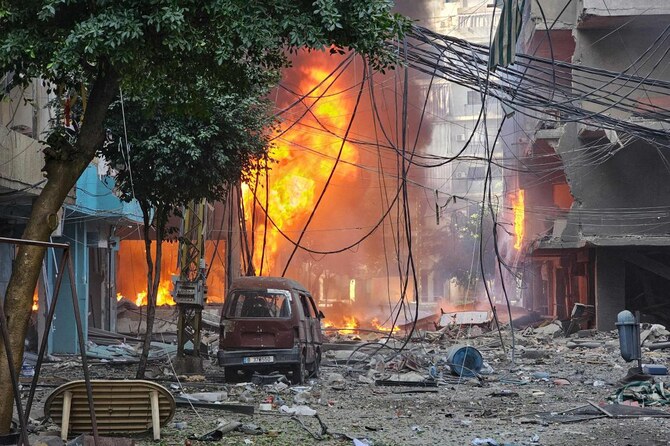

BEIRUT: Fierce battles between the Israeli army and Hezbollah erupted in the town of Khiam and on the outskirts of the town of Biyyadah in Lebanon on Thursday.
Israeli resumed intense airstrikes in the morning on Beirut’s southern suburbs and villages in the Baalbek-Hermel governorate, following a pause that coincided with US envoy Amos Hochstein’s 48-hour visit to Beirut before heading to Tel Aviv.
Hezbollah continued its attacks on northern Israel, with rockets reaching Nahariya. According to medics and doctors with Magen David Adom, these attacks “killed a 30-year-old man due to rocket fire.”
Lebanon has been hit by large-scale Israeli attacks since Sept. 23.
Israel has been targeting Hezbollah headquarters, civilian homes in southern villages, pursuing displaced persons to their new locations, and destroying entire neighborhoods in Beirut’s southern suburbs, the southern border region, towns deep in the south, and villages in Baalbek-Hermel.
The attacks have also struck Beirut multiple times. The total death toll since the start of the confrontations has surpassed 3,520, with 14,940 injured.
The clashes in the south have been concentrated between the town of Chamaa and the coastal town of Biyyadah, following the capture of Chamaa.
Hezbollah said that its members “repelled a new Israeli force’s advance attempt at the southern outskirts of Chamaa toward Biyyadah.”
A fierce battle also raged in Khiam, amid reports on Wednesday night suggesting that the town had fallen to the Israeli army. However, Hezbollah reported “ongoing battles on four fronts, employing all types of weapons.”
Security reports indicated that the Israeli army “is conducting large-scale demolitions in Khiam, blowing up houses and residential buildings during its incursion into the town.”
Controlling Khiam is significant, as it is a strategic city located on top of the Al-Hamames Hill, 500 meters above sea level. Khiam is also one of the biggest cities in southern Lebanon in area, which allows the Israeli army to oversee northern Israel on one side and the Golan Heights on the other.
An Israeli raid on the Khardali road, which connects Nabatieh to Marjaayoun and is considered a Hezbollah supply road, blocked it completely.
Meanwhile, Israeli warplanes carried out destructive aerial strikes in stages against Beirut’s southern suburbs on Thursday morning.
The strikes were preceded by a series of evacuation warnings issued to the residents of Ghobeiri, Hadath, Haret Hreik, Bir Abed and Kafaat.
The raids destroyed a significant number of residential buildings and commercial shops. They also reached a building adjacent to a special needs school in Kafaat.
The Israeli army claimed that it “targeted Hezbollah command headquarters and infrastructure in Beirut’s southern suburbs.”
Raids on Younin, northern Bekaa, killed at least four people after they targeted an inhabited house without prior warning.
The Israeli raids included Brital, Makneh, Nahleh, Chaat in the Anti-Lebanon mountains, and Bouday in the western mountain range.
Dozens of citizens received mysterious calls on Wednesday night instructing them to evacuate their homes in Beirut’s neighborhoods and Mount Lebanon, including Mazraat Yachouh in Metn, where there is no Hezbollah presence.
The calls caused confusion, as residents of entire neighborhoods waited on the streets for officials confirmations. The calls were seen as “part of a psychological warfare.”
On the eve of Lebanon’s 81st Independence Day, army chief Joseph Aoun said that “Lebanon will always revolt against its enemies and those who mess with its safety and sovereignty, notably the Israeli enemy.”
Aoun said that the anniversary came amid a destructive and brutal war waged by the Israeli enemy for more than a year, resulting in thousands being wounded, and the displacement of people from their villages and towns in the south, the Bekaa and Beirut.
“As the enemy persists in its daily violations and aggressions, efforts are intensifying to reach a ceasefire that would bring calm to our country, paving the way for the return of our people in the south to their land and the rest of the displaced to their homes.”
Aoun said that the army was “still deployed in the south, where soldiers make sacrifices and give their lives for Lebanon. We will not abandon it because it is an integral part of national sovereignty, and it operates in coordination with UNIFIL under the framework of Resolution 1701. The army also stands by its people and citizens, fulfilling its national duty and continuing its missions despite challenges and dangers.”
He said that “there is no turning back, and there is no fear for the army, which will remain steadfast by the side of the Lebanese despite all circumstances, protecting Lebanon and defending its security, stability and sovereignty. The army will continue to embrace all Lebanese from different backgrounds, standing equally by each one of them.”


