

Pakistan says 30% of its vehicles will be electric by 2030

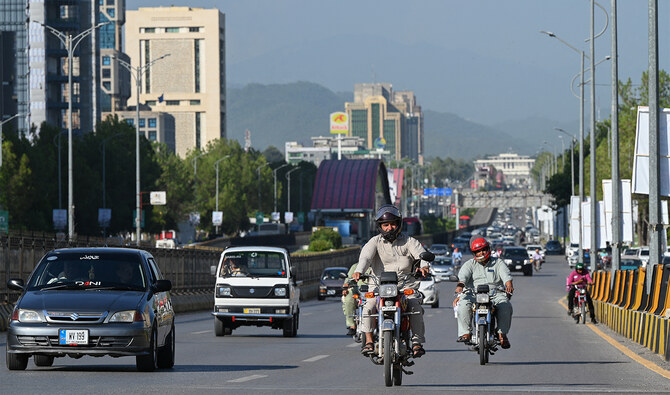
People commute on a road in Islamabad on July 11, 2023. (AFP/File)
Short Url
Updated 21 November 2024
Follow

Pakistan says 30% of its vehicles will be electric by 2030

  • Hybrid electric vehicle sales in Pakistan have more than doubled in past year
  • Global EV giant BYD Group has obtained manufacturing license in Pakistan

ISLAMABAD: Privatization Minister Abdul Aleem Khan said on Thursday 30% of vehicles in Pakistan would be converted to electric by 2030, state media widely reported, as the South Asian country takes step to combat air pollution and other climate change effects. 

The minister was echoing the government’s New Energy Vehicle (NEV) policy released on Wednesday, which is aimed at transitioning 30 percent of all new vehicles — imported and locally manufactured — to electric power by 2030.

Hybrid electric vehicle sales in Pakistan have more than doubled in the past year. BYD Pakistan, a partnership between China’s BYD and Pakistani car group Mega Motors, said in September up to 50 percent of all vehicles bought in Pakistan by 2030 will be electrified in some form in line with global targets.

Warren Buffett-backed Chinese electric vehicle giant BYD announced its entry into Pakistan in August, making the nation of 250 million people one of its newest markets.

“Pakistan aims to convert thirty percent of its vehicles to electric by 2030,” Khan said as he addressed the “Transport and Digital Middle Corridor and Beyond” session at the ongoing UN COP29 summit in Baku.

“Significant steps are underway to support the widespread adoption of electric vehicles in Pakistan … the government is actively working on infrastructure development for EVs, including the installation of charging stations.”

Local media reported in August that standards for EV charging stations had been drafted by the power ministry, with the government considering offering them affordable electricity.

Under the new EV policy, the government has introduced subsidies of Rs50,000 for electric motorcycles and Rs200,000 for three-wheelers like rickshaws, with a total allocation of Rs4 billion. These subsidies will be distributed through auctions. So far, two companies have been granted licenses, and 31 more applications are under review.

The policy also incorporates a reduction in the policy rate from 22 to 15 percent, with financing available at a 3 percent Kibor (Karachi Interbank Offered Rate) and the government covering the financial cost. Consumers will pay monthly installments of around Rs9,000 over two years, an amount lower than their projected fuel savings.

A Credit Loss Guarantee managed by the Finance Division will ensure no financial burden on the Ministry of Industries or consumers.

Additional initiatives include offering free electric bikes or scooters to 120 high-achieving students and reducing duties on EV components to encourage local manufacturing. The government is also set to establish a New Energy Fund and a New Energy Vehicle Center to support these measures.

BYD Pakistan is collaborating with two oil marketing companies to establish a charging infrastructure network and aims to establish 20 to 30 charging stations within the initial phases concurrent with the rollout of its cars.

BYD Pakistan will initially sell fully assembled vehicles, which are subject to higher import charges than vehicles shipped in parts and assembled locally. Dewan Motors is also set to launch its EVs under the completely knocked down (CKD) license.


Pakistan terms climate change, demographic pressures as ‘pressing existential risks’

Updated 06 December 2025
Follow

Pakistan terms climate change, demographic pressures as ‘pressing existential risks’

  • Pakistan has suffered frequent climate change-induced disasters, including floods this year that killed over 1,000
  • Pakistan finmin highlights stabilization measures at Doha Forum, discusses economic cooperation with Qatar 

ISLAMABAD: Pakistan’s Finance Minister Muhammad Aurangzeb on Saturday described climate change and demographic pressures as “pressing existential risks” facing the country, calling for urgent climate financing. 

The finance minister was speaking as a member of a high-level panel at the 23rd edition of the Doha Forum, which is being held from Dec. 6–7 in the Qatari capital. Aurangzeb was invited as a speaker on the discussion titled: ‘Global Trade Tensions: Economic Impact and Policy Responses in MENA.’

“He reaffirmed that while Pakistan remained vigilant in the face of geopolitical uncertainty, the more pressing existential risks were climate change and demographic pressures,” the Finance Division said. 

Pakistan has suffered repeated climate disasters in recent years, most notably the 2022 super-floods that submerged one-third of the country, displaced millions and caused an estimated $30 billion in losses. 

This year’s floods killed over 1,000 people and caused at least $2.9 billion in damages to agriculture and infrastructure. Scientists say Pakistan remains among the world’s most climate-vulnerable nations despite contributing less than 1 percent of global greenhouse-gas emissions.

Aurangzeb has previously said climate change and Pakistan’s fast-rising population are the only two factors that can hinder the South Asian country’s efforts to become a $3 trillion economy in the future. 

The finance minister noted that this year’s floods in Pakistan had shaved at least 0.5 percent off GDP growth, calling for urgent climate financing and investment in resilient infrastructure. 

When asked about Pakistan’s fiscal resilience and capability to absorb external shocks, Aurangzeb said Islamabad had rebuilt fiscal buffers. He pointed out that both the primary fiscal balance and current account had returned to surplus, supported significantly by strong remittance inflows of $18–20 billion annually from the Middle East and North Africa (MENA) and Gulf Cooperation Council (GCC) regions. 

Separately, Aurangzeb met his Qatari counterpart Ali Bin Ahmed Al Kuwari to discuss bilateral cooperation. 

“Both sides reaffirmed their commitment to strengthening economic ties, particularly by maximizing opportunities created through the newly concluded GCC–Pakistan Free Trade Agreement, expanding trade flows, and deepening energy cooperation, including long-term LNG collaboration,” the finance ministry said. 

The two also discussed collaboration on digital infrastructure, skills development and regulatory reform. They agreed to establish structured mechanisms to continue joint work in trade diversification, technology, climate resilience, and investment facilitation, the finance ministry said.