

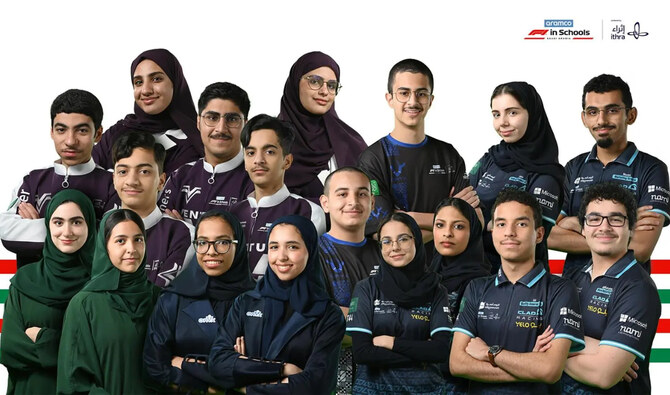
Saudi students gear up for global Formula 1 in Schools challenge

The competition, in its third round, will take place from Nov. 23 to 26 at Dhahran Expo, marking Saudi Arabia’s debut as host of this event. (SPA)
Short Url
Updated 20 November 2024
Follow

Saudi students gear up for global Formula 1 in Schools challenge

  • The Saudi teams will compete alongside 55 teams from 62 countries, representing 28,000 schools globally, in a high-stakes challenge to design and manufacture miniature racing cars

Four Saudi teams, comprising 24 male and female students, are preparing to compete in the Formula 1 in Schools World Final, the Saudi Press Agency reported.

The competition, in its third round, will take place from Nov. 23 to 26 at Dhahran Expo, marking Saudi Arabia’s debut as host of this event.

The Saudi teams will compete alongside 55 teams from 62 countries, representing 28,000 schools globally, in a high-stakes challenge to design and manufacture miniature racing cars.

Ithra, King Abdulaziz Center for World Culture, has overseen the teams’ preparation through a nine-month training program.

The initiative, led by 37 local and international experts across six specialized centers, focused on equipping students with advanced skills in engineering, design and teamwork.

Noura Al-Zamil, programs manager at Ithra, said: “We are proud to offer programs that reflect the scientific progress witnessed by the Kingdom on multiple fronts.

“Our goal is to empower youth in all cognitive and creative fields, nurture ambitious national talent in science, design and innovation, and showcase the capabilities of Saudi students on the global stage. They are the future leaders of the Kingdom’s creative industries.”

Al-Zamil said that the Formula 1 in Schools program transcended competition, offering a transformative educational experience.

“Students develop teamwork, leadership and problem-solving skills in a dynamic and creative environment. The program fosters innovation and aligns with Saudi Vision 2030, which aims to enhance youth capabilities and prepare them for leadership in the industries of the future,” she said.


Saudi wildlife center records rare sighting of critically endangered leatherback turtle in Red Sea

Updated 05 February 2026
Follow

Saudi wildlife center records rare sighting of critically endangered leatherback turtle in Red Sea

  • NCW says the leatherback traveled thousands of kilometers to reach the Red Sea
  • The closest known nesting grounds are located in India’s Andaman Islands, some 6,500 km distant

RIYADH: Saudi Arabia's National Center for Wildlife (NCW) has documented a rare sighting of a leatherback sea turtle in the Red Sea, marking a significant biological record for one of the planet's most critically endangered marine species.

The sighting occurred approximately 30 kilometers off the coast of Al-Qunfudhah within the Blue Holes Protected Area, a newly established marine reserve, according to the Saudi Press Agency.

The NCW confirmed that the presence of a leatherback in these waters is an exceptional event. Recognized as the largest turtle species on Earth, the leatherback can weigh up to 900 kilograms. It is easily identified by its unique leathery, black carapace—distinguished by five longitudinal ridges rather than a hard bony shell—and its ability to dive to depths exceeding 1,000 meters.

Shutterstock image

Noting the species' migratory nature, the center explained that leatherbacks travel thousands of kilometers foraging for jellyfish. The specimen likely navigated through the Bab el-Mandeb Strait in search of food. 

This is considered a remarkable journey, the NCW said, noting that the nearest known populations reside in the Indian Ocean, spanning waters from South Africa to Sri Lanka (roughly 7,000 to 8,000 kilometers away). The closest known nesting grounds are located in India’s Andaman Islands, approximately 6,500 kilometers distant. No nesting activity has been recorded in the Red Sea.

According to the IUCN Red List, the leatherback is Critically Endangered in the Indian Ocean. While data for the Red Sea and Arabian Gulf is scarce, recent isolated sightings include a juvenile recorded in Jordan in December 2025 and another off Djibouti in 2019.

The NCW emphasized that these rare appearances highlight the ecological importance of the Kingdom's marine conservation efforts in the Red Sea. The center pointed to the Farasan Islands Marine Protected Area, along with the new Blue Holes and Ras Hatiba reserves, as critical sanctuaries that could support the potential expansion of such endangered species' ranges.