Jordanian king and UAE president discuss ceasefire efforts in Gaza and Lebanon

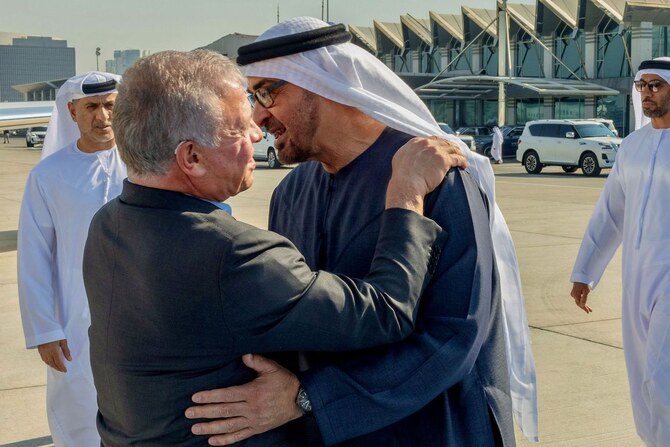
UAE President Sheikh Mohamed bin Zayed welcomes King Abdullah II of Jordan in Abu Dhabi on Wednesday. (Jordan Royal Palace/AFP)
Short Url
Updated 20 November 2024
Follow

Jordanian king and UAE president discuss ceasefire efforts in Gaza and Lebanon

  • King Abdullah II and Sheikh Mohamed bin Zayed hold talks in Abu Dhabi 
  • Leaders discuss concern over conflict spreading in Middle East

DUBAI: Jordan’s King Abdullah II and the UAE President Sheikh Mohamed bin Zayed held talks on Wednesday, which included international efforts to secure ceasefires in Gaza and Lebanon.

The two leaders met in Abu Dhabi as the US vetoed a UN Security Council resolution to halt Israel’s war on Gaza and as diplomats shuttled between Jerusalem and Beirut to try to end Israel’s offensive in Lebanon.

Sheikh Mohamed and King Abdullah “underscored the importance of intensifying efforts to secure a ceasefire in Gaza and Lebanon, ensuring full protection for civilians in accordance with international humanitarian law, and providing humanitarian support to those affected,” the UAE’s state news agency WAM reported.

They also said that the UAE and Jordan were both “steadfast in supporting Lebanon’s unity, sovereignty, and territorial integrity while expressing solidarity with the Lebanese people.”

Nearly 44,000 people have been killed in Gaza since Israel launched its assault there after Hamas attacked southern Israel on Oct. 7 last year, killing about 1,200.

The conflict escalated to a war in Lebanon in September, where Israeli bombing against Hamas ally Hezbollah has killed more than 3,500 people.

The UAE and Jordan both have relations with Israel but have been fiercely critical of Israel’s military offensives and the human suffering that they have caused.

During their meeting, Sheikh Mohamed and King Abdullah spoke about widespread concern that the conflict could spread to other countries in the region.

“The leaders emphasized the need to prevent conflict in the Middle East from escalating further, as it poses a threat to the region’s security and stability,” WAM reported.

“They also stressed the importance of establishing a clear path toward a just, comprehensive, and lasting peace based on a two-state solution that guarantees security and stability for all.”

King Abdullah flew to Abu Dhabi on Wednesday morning for the meeting, along with Jordan’s Prime Minister Jafar Hassan and Foreign Minister Ayman Safadi, who also attended the meeting.

The UAE and Jordan have both mobilized large aid operations to help alleviate suffering in Gaza and Lebanon.

Last week, four convoys of trucks carrying 605 tonnes of aid from the UAE made it to Gaza through the Rafah crossing with Egypt. 

On Wednesday, eight Jordanian helicopters flew food, medicine and supplies for children, landing directly in Gaza for the first time since the fighting began.


Morocco to secure 60% of water needs from desalination

Nizar Baraka
Updated 14 sec ago
Follow

Morocco to secure 60% of water needs from desalination

  • Rabat boosts investment in facilities powered by renewable energy, minister tells Marrakech conference

MARRAKECH: Morocco, which has endured seven years of drought, plans to supply 60 percent of its drinking water from treated seawater by 2030, up from 25 percent, its water minister said, as Rabat accelerates investment in desalination plants powered by renewable energy.

The push is crucial to ensure a steady water supply and to maintain Morocco’s status as a key producer and exporter of fresh produce amid climate change, as droughts have dried up some of its main water reservoirs and depleted underground resources.

FASTFACT

The plant will have a capacity of 350 million cubic meters and will supply urban centers in Morocco’s food basket as well as farmlands.

The North African country plans to produce 1.7 billion cubic meters of desalinated water annually by 2030 from projects under construction and plants for which it will hold tenders starting next year, Nizar Baraka said on the sidelines of the World Water Congress in Marrakech.
The largest plant — with planned investment of about 10 billion dirhams ($1 billion) — will be located near Tiznit, 615 km south of the capital Rabat. 
It will have a capacity of 350 million cubic meters and will supply urban centers in the country’s food basket as well as farmlands, he said.
“Studies are underway as part of preparations for the plant’s tender, to be announced by mid next year,” Baraka said.
Besides the northern cities of Nador and Tangier, plants are also planned in Rabat in partnership with the French group Veolia, as well as in Tantan, where the government is considering building a port dedicated to green hydrogen and ammonia exports, Baraka said.
Morocco currently operates 17 desalination plants producing 345 million cubic meters annually. 
Four additional plants are under construction with a combined capacity of 540 million cubic meters, scheduled to be ready by 2027, including a major facility in Casablanca, the country’s most populous city.
“All new desalination plants will be powered by renewable energy,” Baraka said.
Morocco has also faced rising temperatures and worsening evaporation in dams. 
To counter this, it installed floating solar panels on a dam near Tangier to reduce evaporation, which accounts for 30 percent of the country’s surface water loss, according to the minister.
“The experiment will be expanded to include dams in the south and mountainous regions,” Baraka said.