London: The funeral of former One Direction singer Liam Payne who died last month after falling from his Buenos Aires hotel room will be held later Wednesday, UK media reported.
Payne was found dead on October 16 after falling from the balcony of his third-floor room at the Casa Sur Hotel in the Argentinian capital.
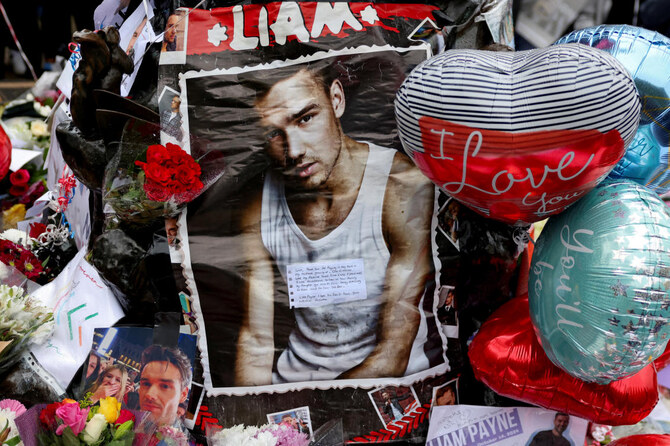
His death, aged 31, prompted a global outpouring of grief from family, former bandmates, fans and others, with thousands gathering in cities around the world to offer their condolences.
Payne’s family, friends and other One Direction members were expected to attend the private funeral in southern England on Wednesday afternoon, multiple media outlets reported.
He shot to stardom alongside Harry Styles, Louis Tomlinson, Zayn Malik and Niall Horan after the band were formed on hit UK talent show “The X Factor” in 2010.
Payne had spoken publicly about struggles with substance abuse and coping with fame from an early age.
He died from “multiple traumas” and “internal and external haemorrhaging” after the fall from the hotel, a post-mortem examination found.
Hotel staff had called emergency services twice to report a guest “overwhelmed by drugs and alcohol” who was “destroying” a hotel room.

Singer Liam Payne’s funeral to be held Wednesday: UK media
Short Url
https://arab.news/n6n2s
Singer Liam Payne’s funeral to be held Wednesday: UK media
- Payne was found dead on October 16 after falling from the balcony of his third-floor room at the Casa Sur Hotel in the Argentinian capital
Taiwan to send team to assess US rare earth deposits
TAIPEI: Taiwan plans to send officials to assess US rare earths deposits with a goal to have such minerals refined on the island, Economy Minister Kung Ming-hsin said on Wednesday.
President Donald Trump’s administration has stepped up efforts to secure US supplies of critical minerals after China rattled senior officials and global markets last year by withholding rare earths required by American automakers and other industrial manufacturers.
Trump last week launched a US strategic stockpile of critical minerals, called Project Vault, backed by $10 billion in seed funding from the US Export-Import Bank and $2 billion in private funding.
While semiconductor powerhouse Taiwan is not formally part of that scheme, it has previously held talks with the United States on how it can help, given Taipei’s concerns about over-reliance on a China-centric supply chain.
China views Taiwan as its own territory and has stepped up its military threats.
Speaking to reporters in Taipei, Kung said the ministry’s Geological Survey and Mining Management Agency would go to the United States to assess rare earths deposits there.
“Specifically, what rare-earth elements they contain and whether they are suitable. In other words, whether those are the rare earths we actually need. So we still need to investigate,” he said.
Given Taiwan does not mine such elements itself, it can instead play a role in refining the materials from other countries, Kung added.
“The technology is not an issue; the next step is scaling up,” he said.
Taiwan consumes 1,500 metric tons of rare earth annually, a figure projected to rise to 2,000 metric tons given economic growth, Kung added.
“Our goal is to expand production capacity to meet half of our demand by then, strengthening the supply chain.
President Donald Trump’s administration has stepped up efforts to secure US supplies of critical minerals after China rattled senior officials and global markets last year by withholding rare earths required by American automakers and other industrial manufacturers.
Trump last week launched a US strategic stockpile of critical minerals, called Project Vault, backed by $10 billion in seed funding from the US Export-Import Bank and $2 billion in private funding.
While semiconductor powerhouse Taiwan is not formally part of that scheme, it has previously held talks with the United States on how it can help, given Taipei’s concerns about over-reliance on a China-centric supply chain.
China views Taiwan as its own territory and has stepped up its military threats.
Speaking to reporters in Taipei, Kung said the ministry’s Geological Survey and Mining Management Agency would go to the United States to assess rare earths deposits there.
“Specifically, what rare-earth elements they contain and whether they are suitable. In other words, whether those are the rare earths we actually need. So we still need to investigate,” he said.
Given Taiwan does not mine such elements itself, it can instead play a role in refining the materials from other countries, Kung added.
“The technology is not an issue; the next step is scaling up,” he said.
Taiwan consumes 1,500 metric tons of rare earth annually, a figure projected to rise to 2,000 metric tons given economic growth, Kung added.
“Our goal is to expand production capacity to meet half of our demand by then, strengthening the supply chain.
© 2026 SAUDI RESEARCH & PUBLISHING COMPANY, All Rights Reserved And subject to Terms of Use Agreement.


