

40 killed in central Sudan paramilitary attack on village

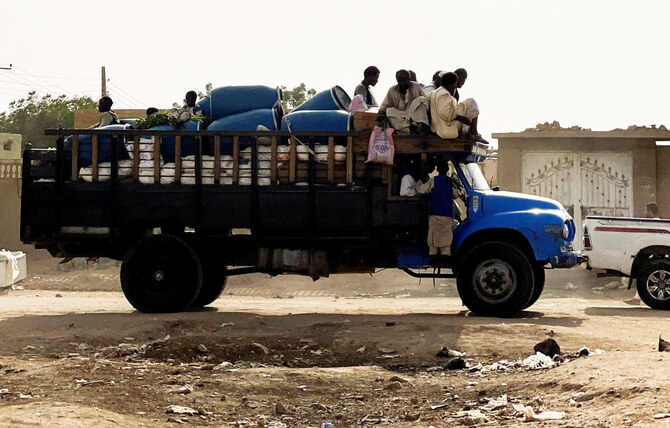
Families flee RSF advances in Sudan's Al Jazira state, on Sennar Road in the city of al-Dinder, Sennar state, Sudan, July 18, 2024. (REUTERS/File Photo)
Short Url
Updated 21 November 2024
Follow

40 killed in central Sudan paramilitary attack on village

  • UN says over 340,000 people have been displaced from their homes in Sudan’s breadbasket state of Al-Jazira state
  • The 19-month Sudan army-RSF war has uprooted over 11 million people and killed tens of thousands, mostly civilians

PORT SUDAN: An attack by paramilitary forces that began Tuesday evening has left 40 people dead, a medic told AFP from a central Sudan village, following a month of escalating violence in Al-Jazira state.
“All 40 people suffered direct gunshot wounds,” the medic said from Wad Rawah Hospital, just north of Wad Oshaib village, requesting anonymity for their own protection after repeated attacks on medical personnel.
The paramilitary Rapid Support Forces (RSF), at war with the army since mid-April 2023, first attacked the village, located 100 kilometers north of Al-Jazira’s capital Wad Madani, on Tuesday evening, eyewitnesses said.
“The attack resumed this morning,” one eyewitness told AFP by phone on Wednesday, adding that fighters were “looting property.”
It is the latest in a month-long series of attacks on Al-Jazira villages by the RSF following the defection of a key paramilitary commander to the army’s side last month.
According to the United Nations, over 340,000 people have been displaced from their homes in the state, a key agricultural region that was formerly considered Sudan’s breadbasket.
The UN Secretary-General’s spokesperson Stephane Dujarric said on Friday that the violence in Al-Jazira “is putting the lives of tens of thousands of people at risk.”
The war between the army, led by Sudan’s de facto leader Abdel Fattah Al-Burhan, and the RSF, commanded by his former deputy Mohamed Hamdan Dagalo, has already killed tens of thousands of people across the country.
It has also uprooted over 11 million people, more than 3 million of whom have fled across Sudan’s borders.


Sudan's Ambassador to the UN Al-Harith Idriss Al-Harith Mohamed addresses the UN Security Council meeting on the situation on Sudan and South Sudan, at UN headquarters in New York City, on Nov. 18, 2024. (REUTERS)

The brutal war has seen both sides accused of war crimes, with RSF fighters accused of laying siege to entire villages, carrying out summary executions and systematically looting civilian property.
Eyewitnesses, rights groups and the UN have reported villages in eastern Al-Jazira coming under total siege in recent weeks, causing compounding humanitarian crises.
In the village of Al-Hilaliya, residents have been cut off from essential supplies, with dozens falling sick “allegedly due to poisoned food.”
The UN’s Dujarric said on Friday that many of the displaced arriving in neighboring states “had walked for days and arrived with nothing but the clothes on their backs.”
Even in areas safe from the fighting, hundreds of thousands of displaced people are facing epidemics including cholera, decimated infrastructure and a looming famine.
“They are now sheltering in the open, including children, women, older persons and people who are sick,” Dujarric added.
According to health officials and the UN, the conflict has forced 80 percent of health facilities in conflict-affected areas to shut down.
Sudan is currently facing what the UN has called one of the worst humanitarian crises in recent memory, with 26 million people suffering from acute hunger.


First responders enter devastated Aleppo neighborhood after days of deadly fighting

Updated 12 January 2026
Follow

First responders enter devastated Aleppo neighborhood after days of deadly fighting

  • The US-backed SDF, which have played a key role in combating the Daesh group in large swaths of eastern Syria, are the largest force yet to be absorbed into Syria’s national army

ALEPPO, Syria: First responders on Sunday entered a contested neighborhood in Syria’ s northern city of Aleppo after days of deadly clashes between government forces and Kurdish-led forces. Syrian state media said the military was deployed in large numbers.
The clashes broke out Tuesday in the predominantly Kurdish neighborhoods of Sheikh Maqsoud, Achrafieh and Bani Zaid after the government and the Syrian Democratic Forces, the main Kurdish-led force in the country, failed to make progress on how to merge the SDF into the national army. Security forces captured Achrafieh and Bani Zaid.
The fighting between the two sides was the most intense since the fall of then-President Bashar Assad to insurgents in December 2024. At least 23 people were killed in five days of clashes and more than 140,000 were displaced amid shelling and drone strikes.
The US-backed SDF, which have played a key role in combating the Daesh group in large swaths of eastern Syria, are the largest force yet to be absorbed into Syria’s national army. Some of the factions that make up the army, however, were previously Turkish-backed insurgent groups that have a long history of clashing with Kurdish forces.
The Kurdish fighters have now evacuated from the Sheikh Maqsoud neighborhood to northeastern Syria, which is under the control of the SDF. However, they said in a statement they will continue to fight now that the wounded and civilians have been evacuated, in what they called a “partial ceasefire.”
The neighborhood appeared calm Sunday. The United Nations said it was trying to dispatch more convoys to the neighborhoods with food, fuel, blankets and other urgent supplies.
Government security forces brought journalists to tour the devastated area, showing them the damaged Khalid Al-Fajer Hospital and a military position belonging to the SDF’s security forces that government forces had targeted.
The SDF statement accused the government of targeting the hospital “dozens of times” before patients were evacuated. Damascus accused the Kurdish-led group of using the hospital and other civilian facilities as military positions.
On one street, Syrian Red Crescent first responders spoke to a resident surrounded by charred cars and badly damaged residential buildings.
Some residents told The Associated Press that SDF forces did not allow their cars through checkpoints to leave.
“We lived a night of horror. I still cannot believe that I am right here standing on my own two feet,” said Ahmad Shaikho. “So far the situation has been calm. There hasn’t been any gunfire.”
Syrian Civil Defense first responders have been disarming improvised mines that they say were left by the Kurdish forces as booby traps.
Residents who fled are not being allowed back into the neighborhood until all the mines are cleared. Some were reminded of the displacement during Syria’s long civil war.
“I want to go back to my home, I beg you,” said Hoda Alnasiri.