Japan, Saudi medical centers unite to revolutionize stem cell therapy

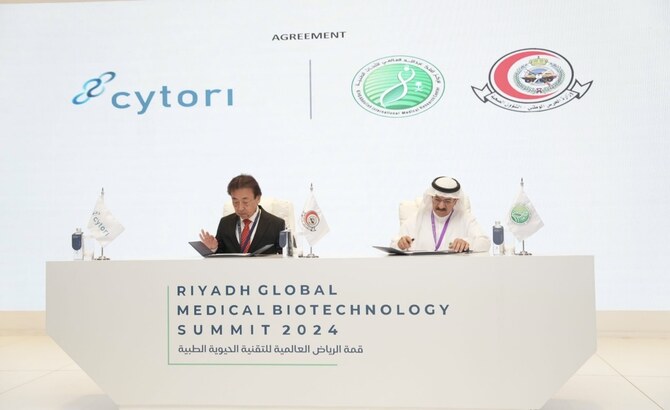
The two organizations will collaborate on fundamental research, clinical trials and other areas of mutual interest, including projects in biomedical R&D, preclinical studies and clinical trials (Supplied)
Short Url
Updated 20 November 2024
Follow

Japan, Saudi medical centers unite to revolutionize stem cell therapy

  • Cytori Therapeutics K.K., has been a pioneer in the stem cell therapy business

TOKYO:  Cytori Therapeutics Japan and the King Abdullah International Medical Research Center have signed a Memorandum of Understanding to strengthen research and training initiatives in the field of cell therapy. 

The signing ceremony took place between Dr. Ahmed Alaskar, executive director of KAIMRC, and Hoshino Yoshihiro, president and CEO of Cytori Therapeutics K.K., during the Riyadh Global Medical Biotechnology Summit 2024.

The partnership underscores the potential of regenerative medicine in treating chronic diseases such as diabetes, liver cirrhosis, critical limb ischemia, chronic wounds, knee osteoarthritis and other aging-related conditions. The aim of combining Cytori’s cutting-edge stem cell technology with KAIMRC’s expertise in translational research is to develop groundbreaking treatments for these critical health issues.

The two organizations will collaborate on fundamental research, clinical trials and other areas of mutual interest, including projects in biomedical R&D, preclinical studies and clinical trials, as well as training and development for staff in health-related and engineering fields.

Cytori Therapeutics K.K., has been a pioneer in the stem cell therapy business, specializing in cell therapy services and the development of adipose-derived regenerative cells from human subcutaneous fat tissues for therapeutic use. The company also develops, manufactures, and exports medical devices. 

This article is also available on Arab News Japan


IMF raises Saudi Arabia’s 2026 growth forecast to 4.5% 

Updated 4 sec ago
Follow

IMF raises Saudi Arabia’s 2026 growth forecast to 4.5% 

RIYADH: The International Monetary Fund raised its 2026 growth forecast for Saudi Arabia to 4.5 percent, citing higher oil output, resilient domestic demand, and continued economic reforms across the region. 

The revised projection marks a 0.5 percentage point upgrade from the IMF’s October report, according to the fund’s latest World Economic Outlook Update. Saudi Arabia’s economy is expected to have grown 4.3 percent in 2025, with expansion set to ease to 3.6 percent in 2027. 

This comes as the World Bank said earlier this month that Saudi Arabia’s gross domestic product is expected to grow by 4.3 percent in 2026 and 4.4 percent in 2027, up from an estimated 3.8 percent in 2025. 

The IMF expects growth momentum to build across the broader Middle East and North Africa and the Gulf Cooperation Council region. 

In its latest report, the IMF stated: “In the Middle East and Central Asia, growth is projected to accelerate from 3.7 percent in 2025 to 3.9 percent in 2026 and to 4.0 percent in 2027, supported by higher oil output, resilient local demand, and ongoing reforms.” 

Similarly, the Middle East and North Africa region is forecast to see growth rise from 3.4 percent in 2025 to 3.9 percent in 2026 and 4 percent in 2027. 

The broader report underscores a global economy holding steady at 3.3 percent growth in 2026, but noted this stability rests on a “narrow base of drivers,” primarily technology investment and fiscal support, making growth vulnerable.

Key risks include a potential reevaluation of artificial intelligence productivity gains, escalating trade tensions, and geopolitical flare-ups. 

“Headwinds from shifting trade policies are offset by tailwinds from surging investment related to technology, including artificial intelligence, more so in North America and Asia than in other regions, as well as fiscal and monetary support, broadly accommodative financial conditions, and adaptability of the private sector,” the IMF stated in its report. 

For energy commodities, a factor critical to regional revenues, the IMF expects prices to fall about 7 percent in 2026 due to “tepid global demand growth and strong supply growth,” but noted a soft floor is provided by higher-cost producers and strategic stockpiling. 

On inflation, the IMF projects a continued decline worldwide. Global headline inflation is expected to fall from an estimated 4.1 percent in 2025 to 3.8 percent in 2026 and further to 3.4 percent in 2027. The report stated that “overarching trends of softening demand and lower energy prices” are expected to remain intact. 

The IMF also provided updated growth forecasts for other major economies. Among advanced economies, the US is projected to grow by 2.4 percent in 2026, while the euro area is expected to expand by 1.3 percent. Japan’s growth is forecast to moderate to 0.7 percent.

For key emerging markets, China’s growth is projected at 4.5 percent in 2026, and India is expected to grow by 6.4 percent. 

The IMF’s policy advice emphasized rebuilding fiscal buffers, maintaining central bank independence, and reducing policy uncertainty to foster sustainable medium-term growth, advice particularly relevant for commodity-exporting regions navigating energy transition and diversification.