

Pakistan approves winter power package to spur demand, cut gas use

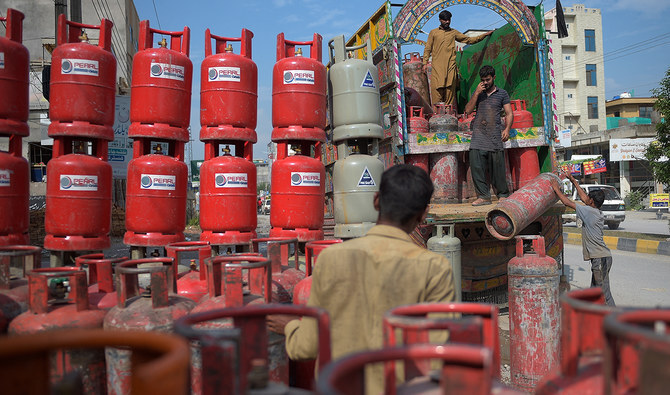
Labourers unload gas calendar from a truck at a market on the outskirts of Islamabad on September 2, 2020. (AFP/File)
Short Url
Updated 20 November 2024
Follow

Pakistan approves winter power package to spur demand, cut gas use

  • Move to provide relief to businesses and citizens after steep increases in electricity tariffs following energy reforms pushed by IMF
  • Utilities in Pakistan, many of which have had to curtail or completely cease operations in winter months, will also benefit 

ISLAMABAD: The Eco­nomic Coordination Com­m­i­ttee (ECC) of the Pakistan government on Tuesday formally approved subsidy-neutral discounted electricity rates during winter in a bid to boost consumption and cut the use of natural gas for heating, the finance ministry said. 

The move is expected to provide relief to businesses and citizens, who have suffered from steep and sudden increases in electricity tariffs following energy sector reforms suggested by the International Monetary Fund (IMF). Utilities in Pakistan, many of which have had to curtail or even completely cease operations in winter months due to demand dropping by up to 60 percent from peak summer levels, will also benefit from the move.

Pakistan relies heavily on expensive natural gas and burning wood for heating during winter. Power consumption in Pakistan has declined 8-10 percent year on year over the past three quarters, according to energy ministry figures. 

The new winter package, which will apply between Dec. 2024 to Feb. 2025, has been approved for the industrial, domestic, commercial and general services consumers of state distribution companies (discos) and K-Electric, the main utility in the port city of Karachi, “to enable optimum use of system generation capacity besides reducing gas demand due to shifting of favorabe demand toward electricity.”

“The ECC discussed the proposal and approved it, calling the subsidy-neutral interim relief initiative worked out by the Power Division as being timely and relevant in view of recent surge in electricity tariffs and the reduced demand across various consumer categories,” the finance division statement added. 

The package would apply to incremental consumption over the past years and includes 18-50 percent discounts depending on various consumer categories and consumption slabs. 

Incremental consumption will be calculated using a weighted average formula based on the last three years’ usage.

According to the power division, the base rate for domestic consumers is a minimum of Rs37.49 per unit and a maximum of Rs52.07 per unit, but additional consumption would be charged at Rs26.07 per unit for both categories. This would be 30 percent cheaper (Rs11.42 per unit) compared to a minimum rate of Rs37.49 and 50 percent (Rs26 per unit) compared to the maximum rate.

The energy ministry has previously said the move to slash winter tariffs will help industries reduce electricity costs by 7-8 percent at an optimal level, while stimulating industrial growth in the process.


Pakistan’s Balochistan establishes threat assessment center amid surge in militant attacks

Updated 14 sec ago
Follow

Pakistan’s Balochistan establishes threat assessment center amid surge in militant attacks

  • Provincial Intelligence Fusion and Threat Assessment Center brings police, CTD, intelligence agencies together on one platform, says official
  • Says center helps disrupt terror financing, narcotics trafficking, organized crime and enables action against unregulated communication networks

ISLAMABAD: The government in Pakistan’s southwestern Balochistan province has established a state-of-the-art threat assessment center to strengthen early warning and prevention against “terrorism” incidents, a senior official said on Monday amid a surge in militant attacks recently. 

Balochistan Additional Chief Secretary Hamza Shafqaat wrote on social media platform X that the Provincial Intelligence Fusion and Threat Assessment Center (PIFTAC Balochistan) brings police, the counter-terrorism department (CTD), intelligence agencies and civil administration together on one platform for real-time information sharing and joint analysis. 

“PIFTAC strengthens early warning and prevention against terrorism, helps disrupt terror financing, narcotics trafficking, and organized crime, and enables coordinated action against illegal spectrum and unregulated communication networks,” he wrote.

“Information that was once scattered is now shared and acted upon in time, allowing the state to move from reacting after incidents to preventing them before they occur.”

https://x.com/beyondfiles/status/2010444397163532547

The development takes place amid a steep rise in combat-related deaths in Pakistan during 2025. According to statistics released by the Pakistan Institute for Conflict and Security Studies (PICSS) last month, combat-related deaths in 2025 rose 73 percent to 3,387.

These deaths included 2,115 militants, 664 security forces personnel, 580 civilians and 28 members of pro-government peace committees, the local think tank said. 

Pakistan military spokesperson Lt. Gen. Ahmed Sharif Chaudhry last week highlighted Pakistan’s counter-terrorism efforts in 2025, saying that security forces had conducted 75,175 intelligence-based operations (IBOs) and killed 2,597 militants last year. He also said Pakistan reported 5,397 “terrorism incidents” last year. 

Pakistan frequently accuses Afghanistan of allowing militant groups, including the Tehreek-e-Taliban Pakistan (TTP) and the separatist Balochistan Liberation Army (BLA) to operate from its soil, charges Kabul has repeatedly denied.

Islamabad also accuses India of backing these militant groups against Pakistan. New Delhi rejects the allegations.