

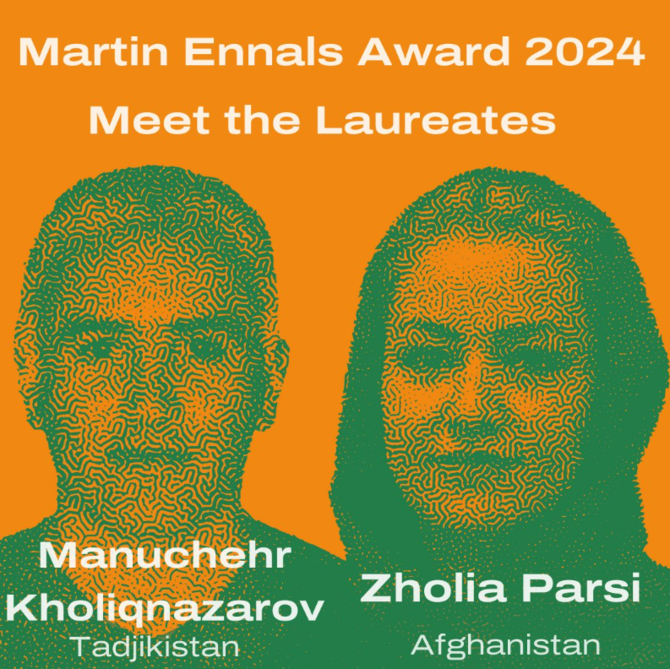

GENEVA: An Afghan teacher and a jailed lawyer from Tajikistan on Tuesday won the Martin Ennals Award, one of the world’s most prestigious rights prizes, with the jury hailing their “exceptional courage.”
Zholia Parsi, a teacher from Kabul who began protesting for women’s rights after the Taliban returned to power three years ago, shared the prize with lawyer Manuchehr Kholiqnazarov, who is serving a 16-year prison sentence in connection with his human rights work.
The chairman of the prize jury, Hans Thoolen, said the pair were “exceptional laureates” who had “paid too big a price for justice and equality to be respected in Afghanistan and Tajikistan, and the international community must support their efforts instead of battling geostrategic interests in the region.”
Parsi began her activism after losing her career and seeing her daughters deprived of their education in the wake of the Taliban takeover in August 2021.
She founded the Spontaneous Movement of Afghan Women (SMAW), which has mobilized communities in various provinces to resist the Taliban’s policies and practices, the jury said.
Parsi had “displayed remarkable leadership and resilience in organizing numerous public protests despite the risks involved,” it added.
She was arrested in the street by armed Taliban in September 2023 and detained along with her son, it said, adding that she was only released “after three months of torture and ill-treatment... which further strengthened her resolve to resist Taliban oppression and repression.”
Kholiqnazarov is a human rights lawyer belonging to the Pamiri ethnic group from the Gorno-Badakhshan Autonomous Oblast (GBAO) region in eastern Tadjikistan.
He headed the Lawyers Association of Pamir, and lobbied among other things for minority rights and the incorporation of international human rights standards into domestic law and practice.
He played a key role in investigating the November 2021 death of youth leader Gulbiddin Ziyobekov.
That investigation turned up critical evidence indicating the young man may have been the victim of an extrajudicial execution, the jury’s statement said.
It also pointed to unlawful use of force in the violent repression of the mass protest in the regional capital Khorog that followed Ziyobekov’s death, resulting in two deaths, 17 people injured and hundreds detained, it added.
Kholiqnazarov himself was arrested on May 28, 2022 “amid a widespread crackdown on local informal leadership and residents of the GBAO,” the prize jury said.
The Martin Ennals Award, named after the first secretary general of Amnesty International, was first given in 1994.
The jury comprises representatives from 10 leading human rights organizations, including Amnesty and Human Rights Watch.
The award ceremony will take place in Geneva on Thursday.


