

Donald Trump expected to consider recognizing Somaliland independence, former UK defense minister says

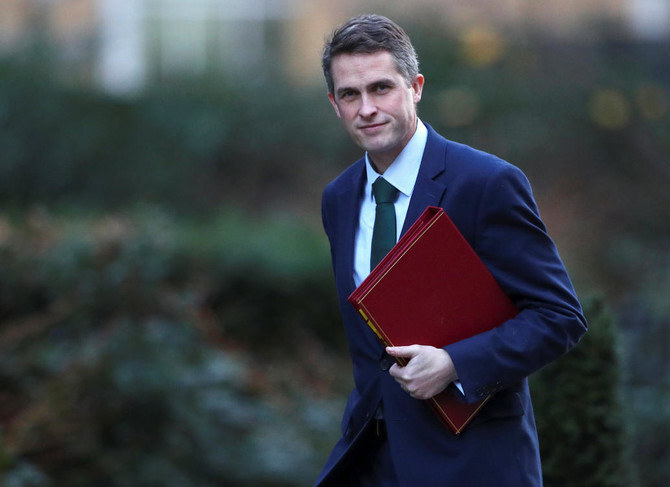
Britain’s former defense secretary Sir Gavin Williamson has also previously urged Foreign Secretary David Lammy to listen to calls for the UK to recognize Somaliland as a sovereign nation. (Reuters/File Photo)
Short Url
Updated 19 November 2024
Follow

Donald Trump expected to consider recognizing Somaliland independence, former UK defense minister says

  • Gavin Williamson has reportedly been lobbying Trump’s team for recognition of former British protectorate

LONDON: Donald Trump is expected to consider recognizing Somaliland as an independent country once he assumes office, according to the former UK defense secretary, it was reported on Tuesday.

Gavin Williamson, who served as Britain’s defense minister from 2017 to 2019, has reportedly been lobbying Trump’s team for the recognition of the former British protectorate.

Somaliland declared independence from Somalia in 1991 but its status remains unrecognized by every country except Ethiopia, and it remains contentious, with Somalia claiming the territory.

Williamson, a vocal advocate for Somaliland’s recognition, has expressed optimism about progress once Trump assumes office in January, and noted that Trump’s opposition to Biden’s policies in Somalia might play a role in influencing the decision, The Independent reported.

“They should agree to it, though when he assumes office it will probably all take a little longer than we hope, but had really good meetings with his policy leads so fingers crossed,” Williamson said.

“One of Trump’s last orders as president was to withdraw troops from Somalia but then Biden countermanded that order. There is nothing that Trump hates more than someone overruling him so I used that to push the argument,” he said.

Sources in Washington told The Independent that the US State Department had “warmed up” to supporting Somaliland’s claim in the days following Trump’s victory.

Somaliland opposition leader, Abdirahman Cirro, defeated incumbent president, Muse Bihi Abdi, in an election last week, setting up a handover of power as the region continues its push for global recognition.

“I am sure this will be up for review after the inauguration. Similarly, a smooth election in Somaliland will, in addition to its other achievements, undoubtedly strengthen its case in an overall policy review,” said Peter Pham, a senior adviser in Trump’s first administration and a former US special envoy to the Sahel region.

The Trump administration previously considered recognition during his first term, and a move to do so now would increase pressure on the UK and other nations to follow suit, according to reports.

A Foreign, Commonwealth and Development Office source said: “It would be wrong to speculate on any policy decisions that the incoming administration of President-elect Trump may make.”

The source added: “The UK, alongside others in the international community, does not recognize Somaliland’s unilateral declaration of independence. It is for authorities in Mogadishu and Hargeisa to resolve Somaliland’s status through dialogue and broad consultation.”


From AI to Starlink: how drone tech is reshaping war in Ukraine

Updated 4 sec ago
Follow

From AI to Starlink: how drone tech is reshaping war in Ukraine

KYIV: As the war in Ukraine drags into its fifth year, drones have come to completely dominate the front line — a transformation in modern warfare that is being watched around the world.
Here is a look at the technology that is reshaping the war, four years after Russia launched its full-scale invasion by pouring tanks and men over the border:

- Kill zone -

Ranging from cheap commercial devices designed for civilian use to explosive-packed miniature aircraft, drones are responsible for up to 80 percent of battlefield damage, Ukraine’s Defense Minister Mykhailo Fedorov has said.
“Modern warfare is now impossible without drones,” Koleso, a Ukrainian infantry soldier, told AFP in eastern Ukraine.
The front line has been transformed into a “kill zone” stretching up to 20 kilometers (12 miles) deep — “an area between two sides where nothing can survive because it’s constantly monitored by drones,” military expert Kateryna Bondar explained.
Soldiers can only operate there in small groups, moving fast and with their eyes fixed to the sky, hoping to stay undetected.
Heavy pieces of artillery, as well as sluggish tanks and armored vehicles, are too slow and visible — making them easy targets for both sides.
Unwilling to send more men that necessary into the kill zone, Ukrainian troops use ground drones to ferry supplies to dangerous areas and to evacuate wounded soldiers.

- Fibre optics -

Maintaining a stable connection between the drone and its operator, controlling it remotely, is a crucial task.
“That’s where the real race is happening — communications and connections,” Bondar said.
Initially, most drones operated on a radio connection.
But they proved vulnerable to electronic warfare — the practice of jamming and intercepting enemy craft, causing them to drop out of the sky or lose connection to the operator.
Russia has turned to drones controlled by ultra-thin fiber-optic cables, largely immune to electronic jamming.
In scenes that resemble a dystopian sci-fi movie, their widespread use has left swathes of frontline cities and fields entombed in webs of cable.

- Starlink -

In another alternative to radio control, Ukrainians have begun attaching Starlink terminals to drones.
This allows them to fly using a satellite Internet connection.
“We need to fly far away with a stable video signal and stable control,” said Phoenix, a commander from Ukraine’s Lasar Group, a pioneer in the use of Starlink.
Russian troops soon started copying, until Ukraine pushed Elon Musk last month to disable unauthorized Russian terminals.
The move disrupted both Russian and Ukrainian systems, military observers said.
The US-based Institute for the Study of War said the switch-off likely helped enable a localized, but rapid, Ukrainian advance in the southern Zaporizhzhia region in early February.

- Air defenses -

The spread of drones has forced a revamp of air defense systems.
Firing advanced missiles — which can cost millions — to down drones worth just a fraction of that is too expensive a response.
Alongside jamming, Ukraine has also developed cheap interceptor drones built specially to destroy other craft mid-air.
“We opened the chapter of the war of drones with drones,” said Marko Kushnir of General Cherry, a leading interceptor drone maker.
Roads near the front have been equipped with protective nets attempting to stop attacking drones, while trucks fitted with anti-drone cages and drone jammers speed along them.
Machine guns are also a last resort to shoot down drones from the sky.
Ukraine’s Western allies have increasingly looked to Kyiv’s experience after Russian drones made repeat incursions into European airspace in recent months.

- AI -

Engineers are racing to equip drones with artificial intelligence to improve their performance.
Ukrainian firms such as The Fourth Law (TFL) say they have developed so-called terminal guidance, which allows AI to take control of a device in the final moments before impact.
This is meant to improve the accuracy of strikes, especially as connection is typically lost in the final moments before a hit.
“Russia and China are also developing such technologies, and if our countries don’t... we will lose,” said TFL’s Maksym Savanevskyi.
But full autonomy remains some way off.
“AI is performing a helping function rather than substituting human,” said Bondar, the military expert.
“I thought they could simply remove people from battle equipment, that it could be fully automated. That’s a naive view,” said former Google CEO Eric Schmidt, now head of SwiftBeat, a company that supplies AI drones to Ukraine’s army.
“For the foreseeable future, you’ll have drones first, people second,” he told a conference in Kyiv.
All the way on the eastern front, Koleso said foot soldiers would always remain relevant.
“Until you plant the flag yourself, with your own hands, and take the position, it cannot be considered yours,” he said.