

Spain royals to visit flood epicenter after chaotic trip: media

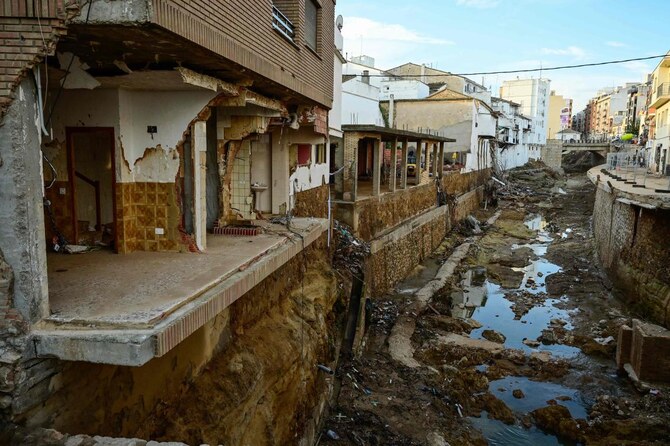
Flood damaged homes line the river in Chiva, in the region of Valencia, eastern Spain, in the aftermath of catastrophic deadly floods on November 19, 2024. October's catastrophic floods left at least 226 people dead, according to officials. (AFP)
Short Url
Updated 19 November 2024
Follow

Spain royals to visit flood epicenter after chaotic trip: media

CHIVA, Spain: Spain’s royals will make a highly anticipated return to the epicenter of catastrophic floods on Tuesday after a chaotic trip where survivors hurled mud and insults at them, local media said.
The European country is reeling from the October 29 disaster that has killed 227 people and sparked widespread fury at the governing class for their perceived mishandling of the crisis.
That outrage boiled over in the ground-zero town of Paiporta in the eastern Valencia region when King Felipe VI and Queen Letizia visited on November 3, in extraordinary scenes that stunned the world.
Furious residents chanting “murderers” pelted them with mud and projectiles as they struggled to wade through the crowds, while Prime Minister Pedro Sanchez was hastily evacuated.
The monarchs have since pledged to return to the Valencia region after another trip to the devastated town of Chiva was canceled that day.
The royal palace told AFP it would give details later Tuesday for the visit.
Felipe and Letizia are returning to keep their promise and console survivors in Chiva where the floods ripped away lives and homes, said Vicente Garrido, professor of constitutional law at the University of Valencia.
Residents will be more welcoming on this occasion because “minds are calmer” despite “the enormous pain,” and royal visits are “an honor” for any town, he told AFP.

Public anger
Whereas Sanchez and the Valencia region’s leader Carlos Mazon left early last time, the mud-spattered royal couple braved the popular anger to speak with victims.
That gesture was “viewed very positively by everyone” and will afford them “a reception befitting who they are” this week, said Garrido.
Their willingness to travel and risk personal harm earlier this month “strengthens the image” of the monarchy, Garrido said.
Popular ire has instead targeted elected politicians, particularly Mazon because the regions manage the response to natural disasters in Spain’s decentralized state.
Local authorities in many cases warned residents of the impending catastrophe too late and stricken towns depended on volunteers for essential supplies for days in the absence of the state.
The conservative Mazon admitted “mistakes” and apologized in the regional parliament on Friday but refused to resign and vowed to lead Valencia’s gigantic reconstruction effort.
Sanchez is due to appear in parliament this month to explain the left-wing central government’s handling of the floods.


Two high-speed trains derail in Spain, police sources say 21 people killed

Updated 19 January 2026
Follow

Two high-speed trains derail in Spain, police sources say 21 people killed

  • The accident happened near Adamuz, in Cordoba province. So far, 21 people ​have been confirmed dead by police

MADRID: A high-speed train derailed and smashed into another oncoming train in southern Spain on Sunday, pushing the second train off the tracks in a collision that police sources confirmed to Reuters had killed at least 21 people.
The accident happened near Adamuz, in Cordoba province. So far, 21 people ​have been confirmed dead by police, with state broadcaster Television Espanola adding that 100 people had been injured, 25 seriously. The driver of one of the trains, which was traveling from Madrid to Huelva, was among those who died, the TV station added.
“The Iryo 6189 Malaga — (to Madrid) train has derailed from the track at Adamuz, crashing onto the adjacent track. The (Madrid) to Huelva train which was traveling on the adjacent track has also derailed,” said Adif, which runs the rail network, in a social media post.
Adif said the accident happened at 6:40 p.m. (1740 GMT), about 10 minutes after the Iryo train left Cordoba heading toward Madrid.
Iryo is a private rail operator, majority-owned by Italian state-controlled railway group Ferrovie dello Stato. The train involved was a Freccia 1000 train which was traveling between ‌Malaga and Madrid, ‌a spokesperson for Ferrovie dello Stato said.
The company said in a statement that it ‌deeply ⁠regretted what ​had happened ‌and had activated all emergency protocols to work closely with the relevant authorities to manage the situation.
The second train was operated by Renfe, which also did not respond to a request for comment.
Adif has suspended all rail services between Madrid and Andalusia.

HORRIFIC SCENE
The Iryo train had more than 300 passengers on board, while the Renfe train had around 100.
Paco Carmona, Cordoba fire chief, told TVE the first train heading to Madrid from Malaga had been evacuated.
The other train’s carriages were badly damaged, he said, with twisted metal and seats. “There are still people trapped. We don’t know how many people have died and the operation is concentrating on getting people out of areas which are very narrow,” he ⁠said. “We have to remove the bodies to reach anyone who is still alive. It is proving to be a complicated task.”
Transport Minister Oscar Puente said he was following events ‌from rail operator Adif’s headquarters in Madrid.
“The latest information is very serious,” ‍he posted on X. “The impact was terrible, causing the first two ‍carriages of the Renfe train to be thrown off the track. The number of victims cannot be confirmed at this time. ‍The most important thing now is to help the victims.”
The mayor of Adamuz, Rafael Moreno, told El Pais newspaper that he had been among the first to arrive at the scene of the accident alongside the local police and saw what he believed to be a badly lacerated body several meters from the accident site.
“The scene is horrific,” he said. “I don’t think they were on the same track, but it’s not clear. Now ​the mayors and residents of the area are focused on helping the passengers.”

CALLS FOR MEDICS
Images on local television showed a reception center set up for passengers in the town of Adamuz, population 5,000, with locals coming ⁠and going with food and blankets amid nighttime temperatures of around 42 degrees Fahrenheit (6 degrees Celsius).
A woman named Carmen posted on X that she had been on board the Iryo train to Madrid. “Ten minutes after departing (from Cordoba) the train started to shake a lot, and it derailed from coach 6 behind us. The lights went out.”
Footage posted by another Iryo train passenger, also on X, showed an Iryo staffer in a fluorescent jacket instructing passengers to remain in their seats in the darkened carriages, and those with first aid training to keep watch over fellow passengers. He also urged people to maintain mobile phone batteries to be able to use their torches when they disembarked.
Salvador Jimenez, a journalist for RTVE who was on board the Iryo train, shared images showing the nose of the rear carriage of the train lying on its side, with evacuated passengers sitting on the side of the carriage facing upwards.
Jimenez told TVE by phone from beside the stricken trains that passengers had used emergency hammers to smash the windows and climb out, and they had seen two people taken ‌out of the overturned carriages on stretchers.
“There’s a certain uncertainty about when we’ll get to Madrid, where we’ll spend the night, we’ve had no message from the train company yet,” he said. “It’s very cold but here we are.”