

Hong Kong jails 45 democracy activists in landmark national security trial

After a long legal battle, dozens of Hong Kong pro-democracy activists will be sentenced later this week in a years-long subversion trial under a China-imposed national security law. (File/AFP)
Short Url
Updated 19 November 2024
Follow

Hong Kong jails 45 democracy activists in landmark national security trial

  • Activists charged with subversion over unofficial ‘primary election’
  • Organizers had faced up to life in prison under national security laws
  • US criticizes trial as politically motivated, calls for activists’ release

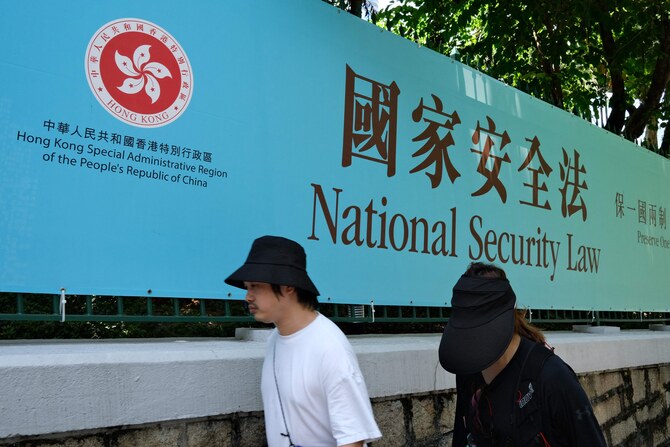
HONG KONG: Hong Kong’s High Court on Tuesday sentenced 45 pro-democracy activists to jail terms of up to 10 years in a landmark national security trial that has damaged the city’s once feisty democracy movement and drawn international condemnation.
A total of 47 pro-democracy activists were arrested and charged in 2021 with conspiracy to commit subversion under a Beijing-imposed national security law and had faced sentences of up to life in prison.
Benny Tai, a former legal scholar identified as an “organizer” of the activists, was sentenced to 10 years in jail, the longest sentence so far under the 2020 national security law.
Some Western governments have criticized the trial, with the US describing it as “politically motivated” and saying the democrats should be released as they had been “peacefully participating in political activities” that were legal.
The Chinese and Hong Kong governments say the national security laws were necessary to restore order after mass pro-democracy protests in 2019, and the democrats have been treated in accordance with local laws.

Closely watched trial
The charges related to the organizing of an unofficial “primary election” in 2020 to select the best candidates for an upcoming legislative election. The activists were accused by prosecutors of plotting to paralyze the government by engaging in potentially disruptive acts had they been elected.
After a 118 day trial, 14 of the democrats were found guilty in May, including Australian citizen Gordon Ng and activist Owen Chow, while two were acquitted. The other 31 pleaded guilty.
Sentences ranged from just over four years to 10 years.
Prominent Hong Kong activist Joshua Wong was sentenced to four years and eight months in jail, while Chow was sentenced to seven years and nine months; former journalist-turned-activist Gwyneth Ho, was sentenced to seven years.
Elsa Wu, the mother of Hendrick Lui, who was sentenced to more than four years in jail, was taken away in a police van outside the courtroom and shouted: “He’s a good person … he’s not a political prisoner … why does he have to go to jail?”
She screamed before police slammed the van door.
Hundreds of people had queued from the early hours outside the court, many holding umbrellas in light rain as they tried to secure a seat within the main courtroom and several spillover courts.
Authorities deployed a tight police presence outside the West Kowloon Magistrates Court and for several blocks in the vicinity.
“I feel such an injustice needs witnessing,” said one woman who gave her name as Margaret and had been in the queue since Sunday afternoon. “I’ve long followed their case. They (the democrats) need to know they still have public support.”
The ruling, which critics have said tarnishes Hong Kong’s role as a global financial hub, comes as the city is hosting an international financial summit to attract more business.
US President-elect Donald Trump’s nominee as secretary of state, Marco Rubio, has been a staunch critic of the trial and in an earlier open letter criticized the convictions of the 47 democrats as evidence of the national security law’s “comprehensive assault on Hong Kong’s autonomy, rule of law, and fundamental freedoms.”
Britain, which handed Hong Kong back to China in 1997, has said the 2020 security law has been used to curb dissent and freedom.


Bangladesh mourns Khaleda Zia, its first woman prime minister

Updated 3 sec ago
Follow

Bangladesh mourns Khaleda Zia, its first woman prime minister

  • Ousted ex-premier Sheikh Hasina, who imprisoned Zia in 2018, offers condolences on her death
  • Zia’s rivalry with Hasina, both multiple-term PMs, shaped Bangladeshi politics for a generation

DHAKA: Bangladesh declared three days of state mourning on Tuesday for Khaleda Zia, its first female prime minister and one of the key figures on the county’s political scene over the past four decades.

Zia entered public life as Bangladesh’s first lady when her husband, Ziaur Rahman, a 1971 Liberation War hero, became president in 1977.

Four years later, when her husband was assassinated, she took over the helm of his Bangladesh Nationalist Party and, following the 1982 military coup led by Hussain Muhammad Ershad, was at the forefront of the pro-democracy movement.

Arrested several times during protests against Ershad’s rule, she first rose to power following the victory of the BNP in the 1991 general election, becoming the second woman prime minister of a predominantly Muslim nation, after Pakistan’s Benazir Bhutto.

Zia also served as a prime minister of a short-lived government of 1996 and came to power again for a full five-year term in 2001.

She passed away at the age of 80 on Tuesday morning at a hospital in Dhaka after a long illness.

She was a “symbol of the democratic movement” and with her death “the nation has lost a great guardian,” Bangladesh’s interim leader Muhammad Yunus said in a condolence statement, as the government announced the mourning period.

“Khaleda Zia was the three-time prime minister of Bangladesh and the country’s first female prime minister. ... Her role against President Ershad, an army chief who assumed the presidency through a coup, also made her a significant figure in the country’s politics,” Prof. Amena Mohsin, a political scientist, told Arab News.

“She was a housewife when she came into politics. At that time, she just lost her husband, but it’s not that she began politics under the shadow of her husband, president Ziaur Rahman. She outgrew her husband and built her own position.”

For a generation, Bangladeshi politics was shaped by Zia’s rivalry with Sheikh Hasina, who has served as prime minister for four terms.

Both carried the legacy of the Liberation War — Zia through her husband, and Hasina through her father, Sheikh Mujibur Rahman, widely known as the “Father of the Nation,” who served as the country’s first president until his assassination in 1975.

During Hasina’s rule, Zia was convicted in corruption cases and imprisoned in 2018. From 2020, she was placed under house arrest and freed only last year, after a mass student-led uprising, known as the July Revolution, ousted Hasina, who fled to India.

In November, Hasina was sentenced to death in absentia for her deadly crackdown on student protesters and remains in self-exile.

Unlike Hasina, Zia never left Bangladesh.

“She never left the country and countrymen, and she said that Bangladesh was her only address. Ultimately, it proved true,” Mohsin said.

“Many people admire Khaleda Zia for her uncompromising stance in politics. It’s true that she was uncompromising.”

On the social media of Hasina’s Awami League party, the ousted leader also offered condolences to Zia’s family, saying that her death has caused an “irreparable loss to the current politics of Bangladesh” and the BNP leadership.

The party’s chairmanship was assumed by Zia’s eldest son, Tarique Rahman, who returned to Dhaka just last week after more than 17 years in exile.

He had been living in London since 2008, when he faced multiple convictions, including an alleged plot to assassinate Hasina. Bangladeshi courts acquitted him only recently, following Hasina’s removal from office, making his return legally possible.

He is currently a leading contender for prime minister in February’s general elections.

“We knew it for many years that Tarique Rahman would assume his current position at some point,” Mohsin said.

“He should uphold the spirit of the July Revolution of 2024, including the right to freedom of expression, a free and fair environment for democratic practices, and more.”