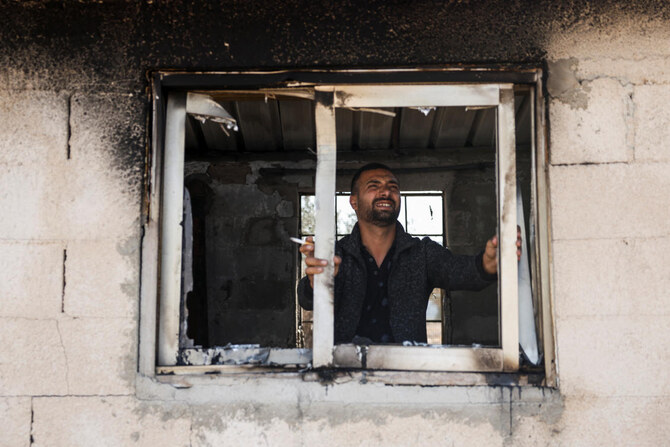
WASHINGTON: The United States imposed sanctions on Monday on an Israeli settler group it accused of helping perpetrate violence in the occupied West Bank, which has seen a rise in settler attacks on Palestinians.
The Amana settler group “a key part of the Israeli extremist settlement movement and maintains ties to various persons previously sanctioned by the US government and its partners for perpetrating violence in the West Bank,” the Treasury Department said in a statement announcing the sanctions.
The sanctions also target a subsidiary of Amana called Binyanei Bar Amana, described by Treasury as a company that builds and sell homes in Israeli settlements and settler outposts.
The sanctions block Americans from any transactions with Amana and freeze its US-held assets. The United Kingdom and Canada have also imposed sanctions on Amana.
Israel has settled the West Bank since capturing it during the 1967 Middle East war. Palestinians say the settlements have undermined the prospects for the establishment of a Palestinian state in the West Bank and the Gaza Strip with East Jerusalem as its capital.
Israel views the West Bank as the biblical Judea and Samaria, and the settlers cite biblical ties to the land.
Settler violence had been on the rise prior to the eruption of the Gaza war, and has worsened since the conflict began over a year ago.
Most countries deem the settlements illegal under international law, a position disputed by Israel which sees the territory as a security bulwark. In 2019, the then-Trump administration abandoned the long-held US position that the settlements are illegal before it was restored by President Joe Biden.
Last week, nearly 90 US lawmakers urged Biden to impose sanctions on members of members of Israeli Prime Minister Benjamin Netanyahu’s government over anti-Palestinian violence in the West Bank.

US hits Israeli settler group with sanctions over West Bank violence
https://arab.news/z24vc
US hits Israeli settler group with sanctions over West Bank violence
- Sanctions block Americans from any transactions with Amana and freeze its US-held assets
- Settler violence had been on the rise prior to the eruption of the Gaza war, and has worsened since the conflict began
Syria’s Kurds hail ‘positive impact’ of Turkiye peace talks
- “The peace initiative in Turkiye has had a direct impact on northern and eastern Syria,” said Elham Ahmad
- “We want a dialogue process with Turkiye, a dialogue that we understand as Kurds in Syria”
ISTANBUL: Efforts to broker peace between Turkiye and the Kurdish militant group PKK have had a “positive impact” on Syria’s Kurds who also want dialogue with Ankara, one of its top officials said Saturday.
Earlier this year, the Kurdistan Workers’ Party (PKK) ended its four-decade armed struggle against Turkiye at the urging of its jailed founder Abdullah Ocalan, shifting its focus to a democratic political struggle for the rights of Turkiye’s Kurdish minority.
The ongoing process has raised hopes among Kurds across the region, notably in Syria where the Kurds control swathes of territory in the north and northeast.
“The peace initiative in Turkiye has had a direct impact on northern and eastern Syria,” said Elham Ahmad, a senior official in the Kurdish administration in Syria’s northeast.
“We want a dialogue process with Turkiye, a dialogue that we understand as Kurds in Syria... We want the borders between us to be opened,” she said, speaking by video link to an Istanbul peace conference organized by Turkiye’s pro-Kurdish opposition DEM party.
Speaking in Kurdish, she hailed Turkiye for initiating the peace moves, but said releasing Ocalan — who has led the process from his cell on Imrali prison island near Istanbul where he has been serving life in solitary since 1999 — would speed things up.
“We believe that Abdullah Ocalan being released will let him play a much greater role... that this peace and resolution process will happen faster and better.”
She also hailed Ankara for its sensitive approach to dialogue with the new regime in Damascus that emerged after the ousting of Syrian strongman Bashar Assad a year ago.
“The Turkish government has a dialogue and a relationship with the Syrian government. They also have open channels with us. We see that there is a careful approach to this matter,” she said.
Turkiye has long been hostile to the Kurdish SDF force that controls swathes of northeastern Syria, seeing it as an extension of PKK, and pushing for the US-backed force to integrate into the Syrian military and security apparatus.
Although a deal was reached to that end in March, its terms were never implemented.
“In this historic process, as the Middle East is being reorganized, Turkiye has a very important role. Peace in both countries — within Turkish society, Kurdish society and Arab society.. will impact the entire Middle East,” Ahmad said.
Syria’s Kurdish community believed coexistence was “fundamental” and did not want to see the nation divided, she said.
“We do not support the division of Syria or any other country. Such divisions pave the way for new wars. That is why we advocate for peace.”


