

Pakistan compares failed PIA privatization bid to Air India, saying it sold on fifth attempt

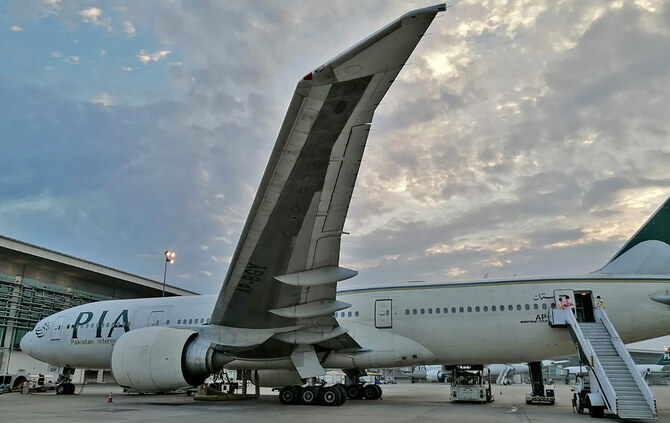
Pakistan’s national carrier PIA is pictured at Islamabad International Airport in Islamabad, Pakistan, on May 31, 2020. (@Official_PIA/File)
Short Url
Updated 18 November 2024
Follow

Pakistan compares failed PIA privatization bid to Air India, saying it sold on fifth attempt

  • It took PM Narendra Modi administration more than four years to find a buyer for Air India in 2021
  • PIA sale hit a snag last month when final bidding round attracted just one bid of $36 million 

ISLAMABAD: Pakistan’s privatization chief Abdul Aleem Khan on Monday defended a recent failed bid to sell loss-making national carrier, Pakistan International Airlines by comparing it to Air India, which was sold after multiple attempts.

Cash-strapped Pakistan was looking to offload a 51-100 percent stake in debt-ridden PIA to raise funds and reform state-owned enterprises as envisaged under a $7 billion International Monetary Fund program approved in September. The process, however, hit a snag last month when the final bidding round attracted just one bid of Rs10 billion ($36 million) for a 60 percent stake in the national flag carrier.

PIA’s existing liabilities stand at approximately Rs250 billion ($896 million).

“Khan compared PIA’s situation to Air India, which had undergone multiple failed privatization attempts before ultimately succeeding on its fifth attempt,” the privatization ministry said in a statement, quoting Khan’s remarks at a meeting of the Senate Standing Committee on Privatization on Monday. 

“Khan expressed hope that Pakistan’s national airline could follow a similar path but underscored the need for thorough reforms.”

It took Prime Minister Narendra Modi’s administration more than four years to find a buyer for Air India in 2021. For a decade before that, the Indian government had spent about $15 billion of taxpayer money on the airline, famous for its Maharaja mascot.

The Pakistan government had pre-qualified six groups for PIA’s privatization process in June, but only real-estate development company Blue World City participated in the bidding process in October, placing a bid that was below the government-set minimum price of Rs85 billion ($304 million). 

The disposal of PIA is a step former governments have steered away from, as it has been highly unpopular given the number of layoffs that would likely result from it.

Other concerns raised by potential bidders for the PIA stake included inconsistent government communication, unattractive terms and taxes on the sector, and the flag carrier’s legacy issues and reputation.

Khan also highlighted hurdles in the privatization process during Monday’s meeting, saying it would require a “fresh approach and big-hearted decisions.”

“The first consultant engaged for the task was deemed unsatisfactory, and a new consultant would be hired to help move the process forward,” Khan told the committee, adding that privatization could only take place if PIA’s financial and operational situation was “clean and attractive to potential buyers.”

“We need to ensure that PIA is clean and profitable before privatization can proceed. Without addressing these fundamental issues, investors will not show interest,” Khan said.

Losses running into billions of dollars in the power and gas sector, the main hole in the economy, were also discussed.

“The privatization process for the first three Discos [power distribution companies] is expected to be completed by January 31, 2025,” the statement said, with Khan acknowledging that privatizing Discos would be even more challenging than PIA.


‘Look ahead or look up?’: Pakistan’s police face new challenge as militants take to drone warfare

Updated 14 January 2026
Follow

‘Look ahead or look up?’: Pakistan’s police face new challenge as militants take to drone warfare

  • Officials say militants are using weapons and equipment left behind after allied forces withdrew from Afghanistan
  • Police in northwest Pakistan say electronic jammers have helped repel more than 300 drone attacks since mid-2025

BANNU, Pakistan: On a quiet morning last July, Constable Hazrat Ali had just finished his prayers at the Miryan police station in Pakistan’s volatile northwest when the shouting began.

His colleagues in Bannu district spotted a small speck in the sky. Before Ali could take cover, an explosion tore through the compound behind him. It was not a mortar or a suicide vest, but an improvised explosive dropped from a drone.

“Now should we look ahead or look up [to sky]?” said Ali, who was wounded again in a second drone strike during an operation against militants last month. He still carries shrapnel scars on his back, hand and foot, physical reminders of how the battlefield has shifted upward.

For police in the northwestern Khyber Pakhtunkhwa (KP) province, the fight against militancy has become a three-dimensional conflict. Pakistani officials say armed groups, including the Tehreek-e-Taliban Pakistan (TTP), are increasingly deploying commercial drones modified to drop explosives, alongside other weapons they say were acquired after the US military withdrawal from neighboring Afghanistan.

Security analysts say the trend mirrors a wider global pattern, where low-cost, commercially available drones are being repurposed by non-state actors from the Middle East to Eastern Europe, challenging traditional policing and counterinsurgency tactics.

The escalation comes as militant violence has surged across Pakistan. Islamabad-based Pakistan Institute for Conflict and Security Studies (PICSS) reported a 73 percent rise in combat-related deaths in 2025, with fatalities climbing to 3,387 from 1,950 a year earlier. Militants have increasingly shifted operations from northern tribal belts to southern KP districts such as Bannu, Lakki Marwat and Dera Ismail Khan.

“Bannu is an important town of southern KP, and we are feeling the heat,” said Sajjad Khan, the region’s police chief. “There has been an enormous increase in the number of incidents of terrorism… It is a mix of local militants and Afghan militants.”

In 2025 alone, Bannu police recorded 134 attacks on stations, checkpoints and personnel. At least 27 police officers were killed, while authorities say 53 militants died in the clashes. Many assaults involved coordinated, multi-pronged attacks using heavy weapons.

Drones have also added a new layer of danger. What began as reconnaissance tools have been weaponized with improvised devices that rely on gravity rather than guidance systems.

“Earlier, they used to drop [explosives] in bottles. After that, they started cutting pipes for this purpose,” said Jamshed Khan, head of the regional bomb disposal unit. “Now we have encountered a new type: a pistol hand grenade.”

When dropped from above, he explained, a metal pin ignites the charge on impact.

Deputy Superintendent of Police Raza Khan, who narrowly survived a drone strike during construction at a checkpoint, described devices packed with nails, bullets and metal fragments.

“They attach a shuttlecock-like piece on top. When they drop it from a height, its direction remains straight toward the ground,” he said.

TARGETING CIVILIANS

Officials say militants’ rapid adoption of drone technology has been fueled by access to equipment on informal markets, while police procurement remains slower.

“It is easy for militants to get such things,” Sajjad Khan said. “And for us, I mean, we have to go through certain process and procedures as per rules.”

That imbalance began to shift in mid-2025, when authorities deployed electronic anti-drone systems in the region. Before that, officers relied on snipers or improvised nets strung over police compounds.

“Initially, when we did not have that anti-drone system, their strikes were effective,” the police chief said, adding that more than 300 attempted drone attacks have since been repelled or electronically disrupted. “That was a decisive moment.”

Police say militants have also targeted civilians, killing nine people in drone attacks this year, often in communities accused of cooperating with authorities. Several police stations suffered structural damage.

Bannu’s location as a gateway between Pakistan and Afghanistan has made it a security flashpoint since colonial times. But officials say the aerial dimension of the conflict has placed unprecedented strain on local forces.

For constables like Hazrat Ali, new technology offers some protection, but resolve remains central.

“Nowadays, they have ammunition and all kinds of the most modern weapons. They also have large drones,” he said. “When we fight them, we fight with our courage and determination.”