

Pakistan compares failed PIA privatization bid to Air India, saying it sold on fifth attempt

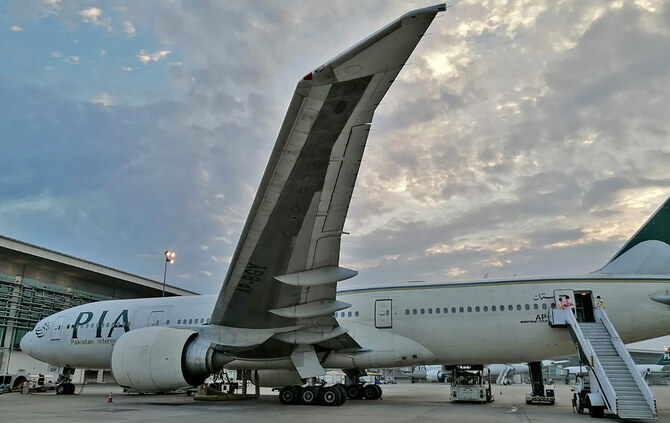
Pakistan’s national carrier PIA is pictured at Islamabad International Airport in Islamabad, Pakistan, on May 31, 2020. (@Official_PIA/File)
Short Url
Updated 18 November 2024
Follow

Pakistan compares failed PIA privatization bid to Air India, saying it sold on fifth attempt

  • It took PM Narendra Modi administration more than four years to find a buyer for Air India in 2021
  • PIA sale hit a snag last month when final bidding round attracted just one bid of $36 million 

ISLAMABAD: Pakistan’s privatization chief Abdul Aleem Khan on Monday defended a recent failed bid to sell loss-making national carrier, Pakistan International Airlines by comparing it to Air India, which was sold after multiple attempts.

Cash-strapped Pakistan was looking to offload a 51-100 percent stake in debt-ridden PIA to raise funds and reform state-owned enterprises as envisaged under a $7 billion International Monetary Fund program approved in September. The process, however, hit a snag last month when the final bidding round attracted just one bid of Rs10 billion ($36 million) for a 60 percent stake in the national flag carrier.

PIA’s existing liabilities stand at approximately Rs250 billion ($896 million).

“Khan compared PIA’s situation to Air India, which had undergone multiple failed privatization attempts before ultimately succeeding on its fifth attempt,” the privatization ministry said in a statement, quoting Khan’s remarks at a meeting of the Senate Standing Committee on Privatization on Monday. 

“Khan expressed hope that Pakistan’s national airline could follow a similar path but underscored the need for thorough reforms.”

It took Prime Minister Narendra Modi’s administration more than four years to find a buyer for Air India in 2021. For a decade before that, the Indian government had spent about $15 billion of taxpayer money on the airline, famous for its Maharaja mascot.

The Pakistan government had pre-qualified six groups for PIA’s privatization process in June, but only real-estate development company Blue World City participated in the bidding process in October, placing a bid that was below the government-set minimum price of Rs85 billion ($304 million). 

The disposal of PIA is a step former governments have steered away from, as it has been highly unpopular given the number of layoffs that would likely result from it.

Other concerns raised by potential bidders for the PIA stake included inconsistent government communication, unattractive terms and taxes on the sector, and the flag carrier’s legacy issues and reputation.

Khan also highlighted hurdles in the privatization process during Monday’s meeting, saying it would require a “fresh approach and big-hearted decisions.”

“The first consultant engaged for the task was deemed unsatisfactory, and a new consultant would be hired to help move the process forward,” Khan told the committee, adding that privatization could only take place if PIA’s financial and operational situation was “clean and attractive to potential buyers.”

“We need to ensure that PIA is clean and profitable before privatization can proceed. Without addressing these fundamental issues, investors will not show interest,” Khan said.

Losses running into billions of dollars in the power and gas sector, the main hole in the economy, were also discussed.

“The privatization process for the first three Discos [power distribution companies] is expected to be completed by January 31, 2025,” the statement said, with Khan acknowledging that privatizing Discos would be even more challenging than PIA.


In Ramadan, Pakistan mosques provide free iftar meals to poor

Updated 5 sec ago
Follow

In Ramadan, Pakistan mosques provide free iftar meals to poor

  • Pakistan has increasingly experimented with targeted subsidies and digital systems to manage food affordability during Ramadan
  • Last week, PM Shehbaz Sharif launched $136 million relief package, pledging digital cash transfers to 12.1 million low-income families

ISLAMABAD: Mosques in Pakistan’s megacities Karachi and Lahore provide free iftar meal for the poor to break the fast during Ramadan, residents said.

Fasting during the holy month of Ramadan is one of the five pillars of Islam, where Muslims abstain from food and drink from sunrise to sunset.

This is followed by the sighting of the new moon and is marked by Eid-ul-Fitr, a religious holiday and celebration that is observed by Muslims across the world.

In Karachi, hundreds of people rush to sellers of traditional snacks to break the fast.

“You have to be patient, worship Allah, and keep Allah pleased by fulfilling your duties as described by Prophet Muhammad,” said Munir Qadri, a Karachi resident.

“Yes, Allah has also allowed you to have a good iftar, but we must also think of the poor. All the people should eat equally, and may everyone receives the blessings of this Ramadan.”

Saad Sharif, another Karachi dweller, complained of higher food and commodity prices this Ramadan.

“The prices of everything are increasing,” he said.

“Petrol has become expensive, we can’t do anything about it. Flour has become expensive. Electricity, water, and gas, everything has become costly.”

Pakistan has increasingly experimented with targeted subsidies and digital systems to manage food affordability during Ramadan, when consumption rises sharply and lower-income households face pressure after years of high inflation.

Last week, Prime Minister Shehbaz Sharif launched a Rs38 billion ($136 million) Ramadan relief package, pledging direct digital cash transfers of Rs13,000 ($47) each to 12.1 million low-income families across Pakistan.

Yet hundreds of Muslims flock to the Data Darbar, a historical shrine in the eastern city of Lahore, and sit on floor as volunteers distribute free food and drinks during iftar and sehri, post-sunset and pre-dawn meals.

Qari Muhammad Younus, an elderly man in Lahore, said that collective iftar holds great importance and there is huge divine reward for the ones who offer iftar to those with no means.

“There are countless [people] here, 24 hours, day and night, and there is more than enough food from iftar till sehri,” he said.

“There is so much food here that iftar at Data Darbar is second only to iftar at Prophet’s Mosque.”

Mushtaq Ahmad, a Lahore resident, said Allah Almighty asks Muslims to “spend out of what I have provided for you as sustenance.”

“And that includes these iftar meals. May Allah Almighty incline us toward such good deeds,” he added.

- With input from AFP.