DAKAR: Senegal’s ruling party claimed it had won a comfortable victory in Sunday’s legislative elections, paving the way for it to deliver an ambitious reform agenda eight months after sweeping to power.
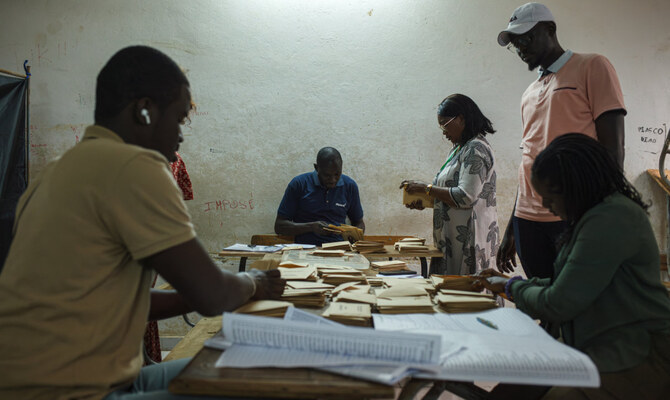
Voting took place peacefully across the West African country, where the governing Pastef party said 90 to 95 percent of ballots had already been counted.
“I pay homage to the Senegalese people for the large victory that it has given to Pastef,” government spokesman Amadou Moustapha Ndieck Sarre told TFM television.
President Bassirou Diomaye Faye’s Pastef party had emerged as the vote winner in most of the first polling stations giving their provisional results, according to media reports, beating the two main opposition parties.
Faye secured victory in March pledging economic transformation, social justice and a fight against corruption — raising hopes among a largely youthful population facing high inflation and widespread unemployment.
But an opposition-led parliament hampered the government’s first months in power, prompting Faye to dissolve the chamber in September and call snap elections as soon as the constitution allowed him to do so.
“I hope that Pastef will win the elections to gain a majority so that they can better carry out their mandate,” said Pascal Goudiaby, a 56-year-old voter in Dakar.
“The priority is unemployment, young people are facing so much unemployment,” he said.
Faye appointed his firebrand mentor Ousmane Sonko as prime minister. Sonko’s own bid to run for president had been blocked following a three-year deadly standoff with the former authorities.
The pair promised a leftist pan-African agenda, vowing to diversify political and economic partnerships, review hydrocarbon and fishing contracts and re-establish Senegal’s sovereignty, which they claimed had been sold abroad.
Mademba Ndiaye, a 20-year-old student, was voting for the first time.
“It’s one of the only ways we can really have an impact on society, and I think that if we don’t vote, we couldn’t really complain about what happens in society afterwards,” he said.
Various actors reported that the turnout on Sunday was typically lower than in the presidential election.
Senegal’s roughly 7.3 million registered voters were called to elect 165 MPs for five-year terms.
Voters have historically confirmed their presidential choice during parliamentary elections, say analysts.
“I think that whoever you gave your confidence to in the presidential election, you need to renew your confidence in him so that he can achieve what he started,” said 56-year-old voter Toure Aby.
“We want life to be less expensive for the Senegalese,” she added. “Everything’s expensive: water, electricity, food.”
Voters continued a long democratic tradition in Senegal, widely seen as a stable outlier in a coup-plagued region.
Faye and Sonko both called for calm as they cast their ballots.
“Democracy is expressed in peace and stability, and I believe that in a democracy there is no room for violence,” Sonko said in the southern city of Ziguinchor.
Reminiscent of his years as a fiery opposition leader, he had called for vengeance after attacks against his supporters, but later urged restraint.
Clashes were only sporadic in the run-up to the vote. Although some agreements have been reached between coalitions, the opposition remains fragmented.
Former president Macky Sall is leading an opposition grouping from abroad called Takku Wallu Senegal. On Sunday, it claimed the vote was marred by “massive fraud organized by Pastef,” without providing details.
Sall left power in April after triggering one of the worst crises in decades with a last-minute postponement of the presidential election.
Former prime minister and presidential runner-up Amadou Ba and Dakar Mayor Barthelemy Dias are also heading coalitions.
The opposition has accused the new government of inaction, amateurism and a desire to settle scores with the previous administration.
Unemployment stands at more than 20 percent and scores of people continue to risk their lives every month attempting to reach Europe by boat.
The government said an audit of public finances revealed a wider budget deficit than previously announced.
Moody’s downgraded Senegal’s credit rating and placed the country under observation.
The new authorities have lowered the price of household goods such as rice, oil and sugar and launched a series of reviews.
They also launched justice system reform and presented an ambitious 25-year development plan aimed at transforming the economy and public policy.


![]()

Senegal ruling party claims ‘large victory’ in elections
Short Url
https://arab.news/cttmp
Senegal ruling party claims ‘large victory’ in elections
- President Bassirou Diomaye Faye’s Pastef party had emerged as the vote winner in most of the first polling stations giving their provisional results, according to media reports, beating the two main opposition parties


Latest updates


© 2026 SAUDI RESEARCH & PUBLISHING COMPANY, All Rights Reserved And subject to Terms of Use Agreement.