

Ukraine strikes on Russia with US missiles could lead to world war, Russian lawmakers say

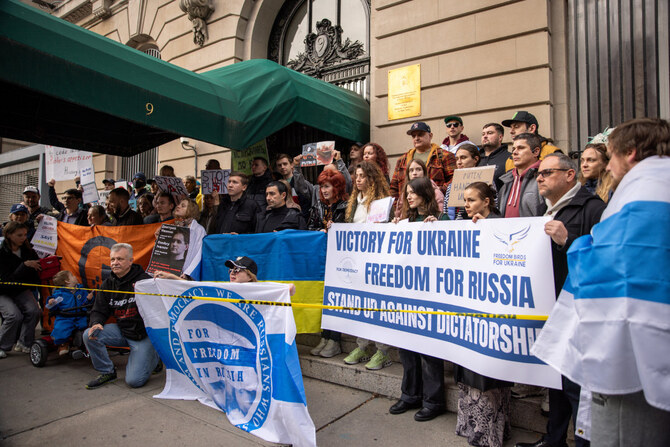
Activists protest in front of the Russian consulate in New York City on Nov. 17, 2024, as they mark the approaching 1000th day of Russia's full-scale invasion of Ukraine. (REUTERS)
Short Url
Updated 18 November 2024
Follow

Ukraine strikes on Russia with US missiles could lead to world war, Russian lawmakers say

  • “This is a very big step toward the start of World War Three,” lawmaker Vladimir Dzhabarov says
  • Poland, defending Ukraine, said missiles against Russia is “a language Putin understands”

MOSCOW: Washington’s decision to let Kyiv strike deep into Russia with long-range US missiles escalates the conflict in Ukraine and could lead to World War III, senior Russian lawmakers said on Sunday.
Two US officials and a source familiar with the decision revealed the significant reversal of Washington’s policy in the Ukraine-Russia conflict earlier on Sunday.
“The West has decided on such a level of escalation that it could end with the Ukrainian statehood in complete ruins by morning,” Andrei Klishas, a senior member of the Federation Council, Russia’s upper chamber of parliament, said on the Telegram messaging app.
Vladimir Dzhabarov, first deputy head of the Russian upper house’s international affairs committee, said that Moscow’s response will be immediate.
“This is a very big step toward the start of World War Three,” the TASS state news agency quoted Dzhabarov as saying.
President Vladimir Putin said in September that the West would be fighting Russia directly if it allowed Ukraine to strike Russian territory with Western-made long-range missiles, a move he said would alter the nature and scope of the conflict.
Russia would be forced to take what Putin called “appropriate decisions” based on the new threats.
Leonid Slutsky, chairman of the State Duma lower house’s foreign affairs committee, said that US authorization of strikes by Kyiv on Russia with US ATACMS tactical missiles would lead to the toughest response, Russian news agencies reported.
“Strikes with US missiles deep into Russian regions will inevitably entail a serious escalation, which threatens to lead to much more serious consequences,” TASS news agency quoted Slutsky as saying.

NATO member Poland welcomed Biden's decision, saying missiles against Russia is “a language Putin understands.”

“With the entry into the war of North Korea troops and (Sunday’s) massive attack of Russian missiles, President Biden responded in a language that (Russian President) V. Putin understands,” Foreign Minister Radoslaw Sikorski posted on X.
“The victim of aggression has the right to defend himself,” Sikorski added in his post. “Strength deters, weakness provokes.”
Ukrainian President Volodymyr Zelensky has long pushed for authorization from Washington to use the powerful Army Tactical Missile System, known by its initials ATACMS, to hit targets inside Russia.
Russian President Vladimir Putin has warned that approval would mean that NATO was “at war” with his country — a threat he has made previously when Ukraine’s Western backers have escalated their military assistance to Kyiv.


Trump’s Iran war violates international law, experts say

Updated 3 sec ago
Follow

Trump’s Iran war violates international law, experts say

  • Mary Ellen O’Connell, a professor at the University of Notre Dame, said the attack on Iran “had no justification under international law“
  • “The US probably could have prevented any Israeli attack on Iran by virtue of the leverage afforded by critical US military support,” said Finucane

WASHINGTON: The United States insists it attacked Iran to curb “direct threats” from the Islamic republic, but legal experts say the dangers cited by Washington do not justify war under international law.
US and Israeli forces launched a massive air campaign against Iran on February 28, with Washington saying it aimed to curb nuclear and missile threats from Tehran. Yet the war has also decapitated the country’s government, and President Donald Trump is now demanding “unconditional surrender.”
The White House laid out Washington’s justification for the war during a news conference this week.
“This decision to launch this operation was based on a cumulative effect of various direct threats that Iran posed to the United States of America, and the president’s feeling, based on fact, that Iran does pose (an) imminent and direct threat,” Press Secretary Karoline Leavitt said Wednesday.
She went on to cite Iranian sponsorship of “terrorism,” its ballistic missile program and its alleged efforts to “create nuclear weapons and nuclear bombs.”
But Mary Ellen O’Connell, a professor at the University of Notre Dame, said the attack on Iran “had no justification under international law.”
“The law is clear that international disputes are to be resolved using peaceful means — negotiation, mediation, the intervention of international organizations,” said O’Connell, an expert in international law on the use of force and international legal theory.
The Trump administration has offered “vague mentions of imminent attacks by Iran and to prevent Iran from acquiring a nuclear weapon,” while the UN Charter “requires, at the least, that evidence of a significant attack by Iran be underway,” she said.

- ‘Even less plausible’ -

“No shred of such evidence has been provided. Nor is there any right whatsoever to start a war over a weapons program.”
While Leavitt cited threats from missiles and militants, US Secretary of State Marco Rubio offered a different justification for the war earlier in the week: fears that an Israeli attack would trigger reprisals against US forces.
Brian Finucane, senior adviser for the International Crisis Group’s US Program, said there were several issues with Rubio’s explanation, including that the Trump administration has since offered other rationales for the war.
“The US probably could have prevented any Israeli attack on Iran by virtue of the leverage afforded by critical US military support,” said Finucane, who previously worked in the Office of the Legal Adviser at the US Department of State.
The Iran war is not the only legally dubious military intervention by the Trump administration.
In early September, the United States began carrying out strikes on alleged drug-smuggling boats in the Caribbean and later the eastern Pacific — a campaign that has killed more than 150 people.
The US government has yet to provide definitive evidence that the vessels it targets are involved in drug trafficking, and legal experts and rights groups say the strikes likely amount to extrajudicial killings.
Trump also ordered strikes on Iranian nuclear sites last year, and sent US forces into Caracas in early January to seize leftist Venezuelan leader Nicolas Maduro, who is now on trial in the United States.
Finucane said Trump’s Friday demand for “unconditional surrender” by Iran “further undercuts prior justifications for US military action.”
“The administration has not even bothered to argue that Operation Epic Fury complies with international law, but certainly statements like this make any such argument even less plausible,” he said, referring to the Iran operation.