MANAUS, Brazil: President Joe Biden has authorized the use of US-supplied long-range missiles by Ukraine to strike even deeper inside Russia, the latest easing of limitations meant to prevent the conflict from further spiraling, according to one US official and three people familiar with the matter.
The decision allowing Ukraine to use the Army Tactical Missile System, or ATACMs, for attacks farther into Russia comes as thousands of North Korean troops have been sent into a region along Ukraine’s northern border to help Russia retake ground and as President-elect Donald Trump has said he would bring about a swift end to the war, expressing skepticism over continued support by the United States.
Biden's decision came hours after Russia launched a massive drone and missile attack on Ukraine, described by officials as the largest in recent months, targeting energy infrastructure and killing civilians.
The attack came as fears are mounting about Moscow’s intentions to devastate Ukraine's power generation capacity ahead of the winter.
It is the second time the US has permitted the use of Western weapons inside Russian territory within limits after permitting the use of HIMARS systems, a shorter-range weapon, to stem Russia's advance in Kharkiv region in May.
President Volodymyr Zelenskyy said that Russia had launched a total of 120 missiles and 90 drones in a large-scale attack across Ukraine. Various types of drones were deployed, he said, including Iranian-made Shaheds, as well as cruise, ballistic and aircraft-launched ballistic missiles.
Ukrainian defenses shot down 144 out of a total of 210 air targets, Ukraine's air force reported later on Sunday.
Zelensky and many of his Western supporters have been pressing Biden for months to allow Ukraine to strike military targets deeper inside Russia with Western-supplied missiles, saying the US ban had made it impossible for Ukraine to try to stop Russian attacks on its cities and electrical grids.
Some supporters have argued that this and other US constraints could cost Ukraine the war. The debate has become a source of disagreement among Ukraine’s NATO allies.
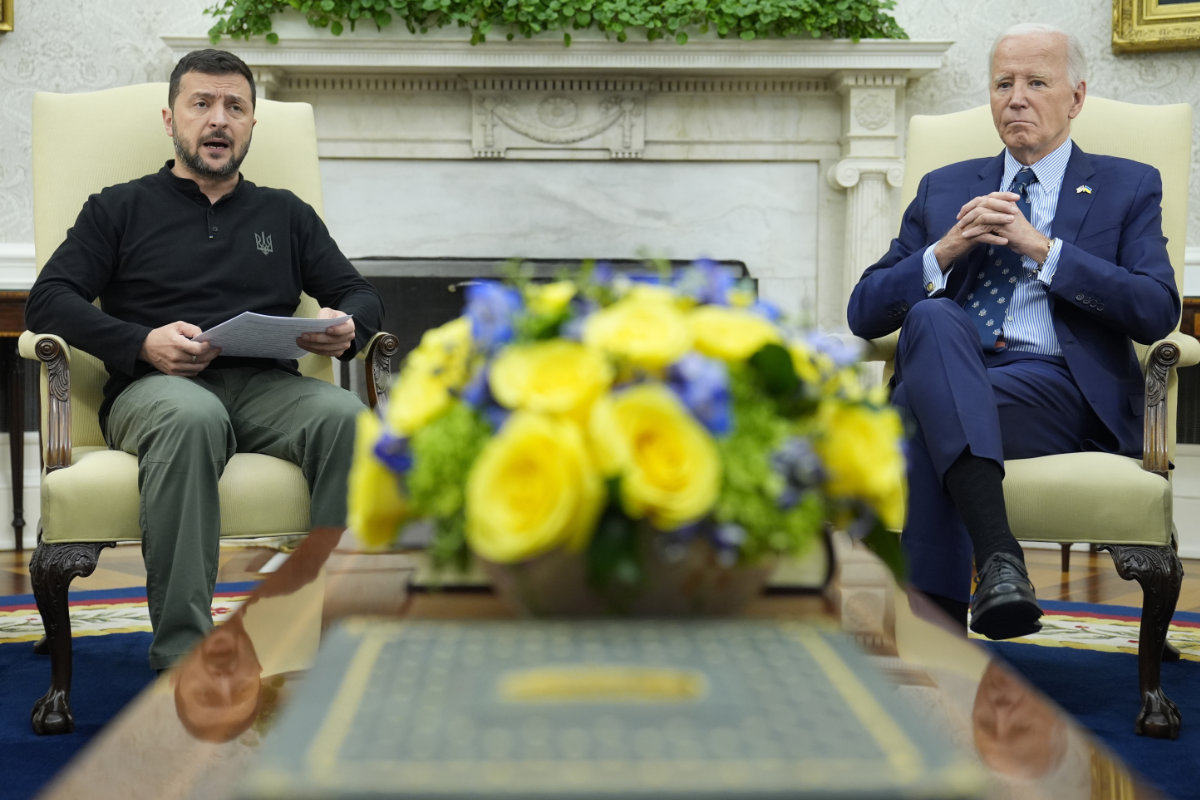
President Joe Biden meets with Ukraine's President Volodymyr Zelenskyy at the White House in Washington, D.C., Sept. 26, 2024. (AP/File)
Biden had remained opposed, determined to hold the line against any escalation that he felt could draw the US and other NATO members into direct conflict with Russia.
But North Korea has deployed thousands of troops to Russia to help Moscow try to claw back land in the Kursk border region that Ukraine seized this year. The introduction of North Korean troops to the conflict comes as Moscow has seen a favorable shift in momentum. Trump has signaled that he could push Ukraine to agree to give up some land seized by Russia to find an end to the conflict.
As many as 12,000 North Korean troops have been sent to Russia, according to US, South Korean and Ukrainian assessments. US and South Korean intelligence officials say North Korea also has provided Russia with significant amounts of munitions to replenish its dwindling weapons stockpiles.
Trump, who takes office in January, spoke for months as a candidate about wanting Russia’s war in Ukraine to be over, but he mostly ducked questions about whether he wanted US ally Ukraine to win.
He also repeatedly slammed the Biden administration for giving Kyiv tens of billions of dollars in aid. His election victory has Ukraine’s international backers worrying that any rushed settlement would mostly benefit Putin.
America is Ukraine’s most valuable ally in the war, providing more than $56.2 billion in security assistance since Russian forces invaded in February 2022.
Worried about Russia’s response, however, the Biden administration repeatedly has delayed providing some specific advanced weapons sought by Ukraine, only agreeing under pressure from Ukraine and in consultation with allies, after long denying such a request.
That includes initially refusing Zelensky’s pleas for advanced tanks, Patriot air defense systems, F-16 fighter jets, among other systems.
The White House agreed in May to allow Ukraine to use ATACMS for limited strikes just across the border with Russia.
Ukrainian drones strike Russia
A local journalist died Sunday as Ukrainian drones struck Russia's embattled Kursk region, its Gov. Aleksei Smirnov reported.
Moscow’s forces have for months strained to dislodge Ukrainian troops from the southern province after a bold incursion in August that constituted the largest attack on Russia since World War II and saw battle-hardened Ukrainian units swiftly take hundreds of square miles (kilometers) of territory.
In Russia’s Belgorod province, near Ukraine, a man died on the spot after a Ukrainian drone dropped explosives on his car, local Gov. Vyacheslav Gladkov reported.
Another Ukrainian drone on Sunday targeted a drone factory in Izhevsk, deep inside Russia, according to anti-Kremlin Russian news channels on the Telegram messaging app. The regional leader, Aleksandr Brechalov, reported that a drone exploded near a factory in the city, blowing out windows but causing no serious damage. A man was briefly hospitalized with a head injury, Brechalov said.