Pakistan’s IT minister calls for bridging gender digital divide in address to Qatar conference

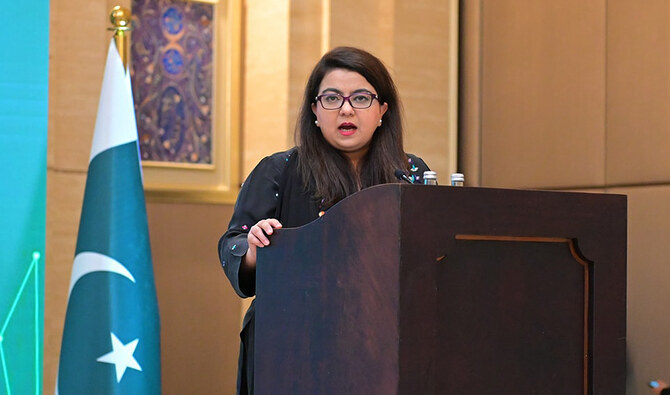
In this file photo, released by Pakistan’s Press Information Department on May 23, 2024, Pakistan’s State Minister for Information Technology Shaza Fatima Khawaja speaks during a UAE-Pakistan Tech Collaboration’s Round- Table Session in Abu Dhabi. (PID/File)
Short Url
Updated 17 November 2024
Follow

Pakistan’s IT minister calls for bridging gender digital divide in address to Qatar conference

  • Shaza Fatima says access to technology and Internet is important to ensure women empowerment
  • She says women will overcome social hurdles, join mainstream politics after greater digital access

ISLAMABAD: Pakistan’s State Minister for Information Technology Shaza Fatima on Sunday called for closing the gender divide in the digital world, emphasizing that women could be empowered by providing access to modern technology and Internet connectivity.
She made the remarks while virtually addressing a conference in Qatar focused on “Digitalization and Women in Politics.”
“In the modern era, it is essential for women to have access to technology and the Internet,” Fatima said during the event, according to an official statement. “Women can be empowered through the provision of digital devices and Internet access.”
The minister said the Pakistani government was taking active steps to eliminate the barriers women face in accessing mobile phones and information and communication technology.
“We are working on a Gender Digital Divide Policy to ensure women’s access to the digital economy,” she informed. “The Prime Minister’s Free Laptop Scheme plays a significant role in providing access to digital tools.”
The minister also highlighted ongoing efforts to develop a “smartphone for all” policy, underscoring how such initiatives could help women overcome social and economic challenges in entering politics.
“Women face social and economic hurdles in entering politics,” she noted. “Through digitalization, women can be empowered and brought into mainstream politics.”
The event underscored growing interactions between Pakistan and Qatar in the technology sector.
Islamabad has stepped up efforts to forge technological collaborations with Doha, sending its first IT delegation to Qatar last December to attract investment and explore opportunities for Pakistani software houses and freelance developers.
Qatar, like much of the Gulf region, is diversifying its economy with a strong focus on technology. From smart city initiatives to tech start-ups and events like the FIFA World Cup 2022, the country is rapidly advancing its technological capabilities.
Pakistan’s top officials have underscored the potential for bilateral collaboration in tech-related areas, with Prime Minister Shehbaz Sharif inviting Qatari investors to explore opportunities in various economic sectors during his visit to the Arab state last month.



Pakistan engages Saudi Arabia, China in bid to ease surging Middle East tensions 

Updated 10 March 2026
Follow

Pakistan engages Saudi Arabia, China in bid to ease surging Middle East tensions 

  • Pakistan’s foreign minister stresses need for de-escalation in conversations with Chinese, Saudi counterparts
  • Tensions in the Middle East continue to remain high as conflict between US, Israel and Iran intensifies

ISLAMABAD: Pakistan’s Deputy Prime Minister Ishaq Dar spoke to the foreign ministers of Saudi Arabia and China on Tuesday, stressing the importance of diplomatic engagement to de-escalate tensions in the Middle East as the Iran war intensifies. 

Pakistan has constantly engaged regional countries in efforts to broker a ceasefire in the Middle East, after the US and Isreal launched coordinated strikes against Iran on Feb. 28. 

Iran launched fresh attacks on Gulf countries on Tuesday morning, where it has targeted US military bases in recent weeks. In addition to firing missiles and drones at Israel and American bases in the region, Iran has also been targeting energy infrastructure which, combined with its stranglehold on the Strait of Hormuz, has sent oil prices soaring worldwide. 

Dar spoke to Saudi Foreign Minister Prince Faisal bin Farhan to discuss developments in the Middle East and ongoing deliberations at the UN Security Council, Pakistan’s foreign office said in a statement. 

“DPM/FM shared Pakistan’s perspective, underscoring the importance of continued coordination and diplomatic engagement to support de-escalation and promote peace and stability across the region and beyond,” the statement said. 

Dar, who also serves as Pakistan’s foreign minister, spoke to Chinese foreign minister Wang Yi over the telephone separately. The two discussed the evolving regional situation and broader global developments.

Dar underscored the need to ease tensions in the Middle East and the wider region during the conversation, the foreign office said. 

Yi appreciated Pakistan’s constructive efforts aimed at promoting de-escalation and stability in the region, it added. 

“The two leaders stressed the importance of de-escalation and emphasized the need to pursue dialogue and diplomacy in accordance with the principles of the UN Charter,” the foreign office’s statement said. 

The conflict in the Middle East has hit Pakistan hard as well, forcing Islamabad to hike petrol and diesel prices by Rs55 per liter last Friday. 

Pakistan’s government has also announced a set of austerity measures, which include closing schools and cutting down on government expenditures, as it evaluates petrol stocks and looks for alternative supply routes.