

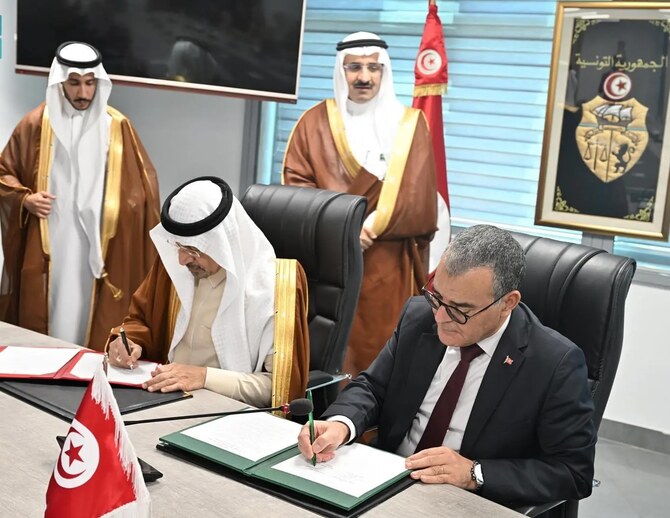
Saudi Arabia, Tunisia sign deal to boost bilateral investments

The deal, which was inked by Saudi Minister of Investment Khalid Al-Falih and Tunisian Minister of Economy and Planning Samir Abdel Hafeez in Tunis, focuses on sharing regulations and laws to enhance the investment environment in both countries. SPA
Short Url
Updated 17 November 2024
Follow

Saudi Arabia, Tunisia sign deal to boost bilateral investments

  • Deal focuses on sharing regulations and laws to enhance investment environment in both countries
  • Talks covered several sectors of mutual interest, including industry, transport, and logistics

RIYADH: Saudi Arabia and Tunisia have signed a memorandum of understanding to strengthen bilateral cooperation and promote direct investments between the two nations. 

The deal, which was inked by Saudi Minister of Investment Khalid Al-Falih and Tunisian Minister of Economy and Planning Samir Abdel Hafeez in Tunis, focuses on sharing regulations and laws to enhance the investment environment in both countries. 

The agreement, which also aims to improve investment opportunities, was discussed during a meeting attended by Saudi Ambassador to Tunisia Abdulaziz bin Ali Al-Saqr. The talks covered several sectors of mutual interest, including industry, transport, and logistics, with a focus on enhancing collaboration and facilitating joint ventures, the Saudi Press Agency reported. 

Tunisian President Kais Saied welcomed Al-Falih, where the Saudi minister conveyed greetings from King Salman and Crown Prince Mohammed bin Salman, expressing the Kingdom’s commitment to Tunisia’s ongoing progress and stability.  

Saied thanked Saudi Arabia for its leadership role in the Arab and Islamic worlds, praising the Kingdom’s efforts in fostering regional unity and development. 

He added that the agreement marked a significant step in strengthening economic ties between the two countries, with the MoU serving as a catalyst for joint development initiatives. 

The deal follows recent discussions on strengthening industrial and economic cooperation.  

In October, Saudi Vice Minister of Industry Affairs Khalil bin Salamah confirmed to Arab News that collaboration with Tunisia was imminent, noting that the two countries were in the process of selecting key sectors, such as pharmaceuticals and automotive components, for initial investments. 

He emphasized the need for common policies among Arab nations to serve as a foundation for regional collaboration across various industrial sectors. 

On the sidelines of the Multilateral Industrial Policy Forum in Riyadh las month, Tunisian Minister of Industry, Mines, and Energy Fatma Thabet Chiboub also pointed out that Tunisia’s distinctive mining resources presented significant opportunities for Saudi investors.  

She emphasized the automotive components and pharmaceutical industries as key areas for potential collaboration, while also expressing concern that the current level of investment from Saudi Arabia did not fully reflect the bilateral relationship’s potential. 

The MoU is seen as a crucial step in deepening the economic and industrial ties between Saudi Arabia and Tunisia, both of which are looking to diversify their economies and create new growth opportunities through strategic partnerships.


QatarEnergy secures offshore exploration license in Libya

Updated 11 sec ago
Follow

QatarEnergy secures offshore exploration license in Libya

RIYADH: QatarEnergy has secured a marine exploration license in Libya following the conclusion of the “Libya Bid Round,” marking its entry into the country’s energy sector.

In a statement, QatarEnergy said Libya’s National Oil Corp. announced the results of the competitive bidding process, the first licensing round held in the country since 2007.

Exploration and production rights for Block O1 were awarded to a consortium comprising QatarEnergy, which holds a 40 percent participating interest, and Italy’s Eni, the operator, with a 60 percent stake.

Commenting on the development, Qatar’s Minister of State for Energy Affairs and President and CEO of QatarEnergy, Saad Sherida Al-Kaabi, said: “We are pleased to have been awarded exploration rights in this area and are encouraged by the potential of Libya’s offshore sector and the opportunities to expand our footprint in North Africa.”

He added: “I would like to thank and congratulate the Libyan authorities on the success of this licensing round. We look forward to working closely with the Libyan authorities and Eni to ensure the successful execution of the exploration program.”

Block O1 is located in the offshore Sirte Basin and spans approximately 29,000 sq. km, with water depths reaching up to 2,000 meters.

Beyond Libya, QatarEnergy continues to expand its global presence, particularly in Asia. The company recently signed a 20-year sales and purchase agreement with Malaysia’s Petronas to supply 2 million tonnes per annum of liquefied natural gas starting in 2028.

The agreement, signed during the LNG2026 conference in Doha, represents the first long-term LNG deal between the two state-owned energy companies. QatarEnergy said the partnership reflects “continued confidence and trust between the two organizations” and underscores their shared vision for a sustainable energy future.

Al-Kaabi noted that the agreement “highlights our continued commitment to supporting Malaysia’s growing energy needs, as well as those of our customers worldwide.”

On the sidelines of the same conference, QatarEnergy also signed a memorandum of understanding with Japan’s Ministry of Economy, Trade and Industry and JERA to supply additional LNG volumes during emergencies, such as natural disasters.