Saudi Arabia, Tunisia sign deal to boost bilateral investments

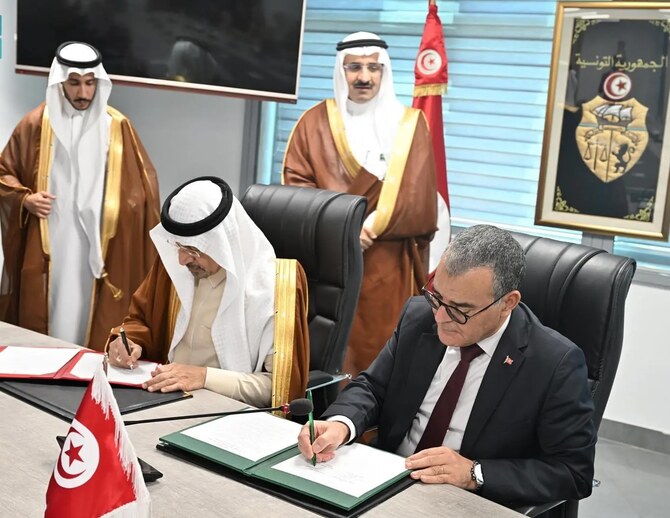
The deal, which was inked by Saudi Minister of Investment Khalid Al-Falih and Tunisian Minister of Economy and Planning Samir Abdel Hafeez in Tunis, focuses on sharing regulations and laws to enhance the investment environment in both countries. SPA
Short Url
Updated 17 November 2024
Follow

Saudi Arabia, Tunisia sign deal to boost bilateral investments

  • Deal focuses on sharing regulations and laws to enhance investment environment in both countries
  • Talks covered several sectors of mutual interest, including industry, transport, and logistics

RIYADH: Saudi Arabia and Tunisia have signed a memorandum of understanding to strengthen bilateral cooperation and promote direct investments between the two nations. 

The deal, which was inked by Saudi Minister of Investment Khalid Al-Falih and Tunisian Minister of Economy and Planning Samir Abdel Hafeez in Tunis, focuses on sharing regulations and laws to enhance the investment environment in both countries. 

The agreement, which also aims to improve investment opportunities, was discussed during a meeting attended by Saudi Ambassador to Tunisia Abdulaziz bin Ali Al-Saqr. The talks covered several sectors of mutual interest, including industry, transport, and logistics, with a focus on enhancing collaboration and facilitating joint ventures, the Saudi Press Agency reported. 

Tunisian President Kais Saied welcomed Al-Falih, where the Saudi minister conveyed greetings from King Salman and Crown Prince Mohammed bin Salman, expressing the Kingdom’s commitment to Tunisia’s ongoing progress and stability.  

Saied thanked Saudi Arabia for its leadership role in the Arab and Islamic worlds, praising the Kingdom’s efforts in fostering regional unity and development. 

He added that the agreement marked a significant step in strengthening economic ties between the two countries, with the MoU serving as a catalyst for joint development initiatives. 

The deal follows recent discussions on strengthening industrial and economic cooperation.  

In October, Saudi Vice Minister of Industry Affairs Khalil bin Salamah confirmed to Arab News that collaboration with Tunisia was imminent, noting that the two countries were in the process of selecting key sectors, such as pharmaceuticals and automotive components, for initial investments. 

He emphasized the need for common policies among Arab nations to serve as a foundation for regional collaboration across various industrial sectors. 

On the sidelines of the Multilateral Industrial Policy Forum in Riyadh las month, Tunisian Minister of Industry, Mines, and Energy Fatma Thabet Chiboub also pointed out that Tunisia’s distinctive mining resources presented significant opportunities for Saudi investors.  

She emphasized the automotive components and pharmaceutical industries as key areas for potential collaboration, while also expressing concern that the current level of investment from Saudi Arabia did not fully reflect the bilateral relationship’s potential. 

The MoU is seen as a crucial step in deepening the economic and industrial ties between Saudi Arabia and Tunisia, both of which are looking to diversify their economies and create new growth opportunities through strategic partnerships.


Saudi Arabia’s approach to AI transformation delivering business value: Publicis Sapient CEO

Updated 16 sec ago
Follow

Saudi Arabia’s approach to AI transformation delivering business value: Publicis Sapient CEO

  • Nigel Vaz: We’re reimagining how, in the case of tourism, we transform Saudi Arabia into a destination that is actually relevant and attractive for people to explore
  • Vaz: Our Slingshot platform handles everything from design to deployment, allowing legacy modernization and new digital apps to be built

DAVOS: As 2026 emerges as a tipping point for artificial intelligence, executives across the Middle East are moving from experimentation to scaling AI in ways that can deliver real business value, according to Nigel Vaz, CEO of Publicis Sapient.

Speaking to Arab News at the World Economic Forum in Davos, Vaz highlighted Saudi Arabia’s proactive approach to integrating technology into national and sectoral strategies.

“I was in meetings with the minister for tourism in Saudi Arabia (Ahmed Al-Khateeb), where we do a lot of work for them, and meetings with (Communications) Minister Abdullah Alswaha,” he said.

“What you realize is technology is incredibly critical, but it’s critical to the extent that we’re reimagining how, in the case of tourism, we transform Saudi Arabia into a destination that is actually relevant and attractive for people to explore.”

Vaz also highlighted applications of AI beyond tourism, including energy and healthcare.

“You’re thinking about how it can enable a greener approach to energy, which is a big goal for their government,” he said.

“And in healthcare, predictive and preventative approaches allow trends to be addressed before they occur, which is a significant cost saving for the government,” he added.

The shift in mindset around AI reflects a broader trend globally.

“Last year there was a lot of excitement about AI, but most work was at a proof-of-concept stage,” Vaz said. “What’s tipped this year is the recognition that AI is only valuable if it drives real business outcomes.”

This involves moving beyond automating individual tasks to enabling entire workflows or decision sets that produce superior results.

“Individual tasks being automated by AI don’t create business benefit,” he said. “Entire workflows or decision sets need to be enabled by AI, and they must deliver better outcomes than are currently possible today.”

Vaz underscored the importance of integrating people and AI rather than treating technology as a replacement, adding: “Unless you’re a technology nerd, you’re not really caring about the technology for its own sake.”

Geopolitical tensions further heighten the importance of AI for real-time, intelligent decision-making. Vaz explained that Publicis Sapient has developed platforms such as Slingshot, Bodhi and SustainAI to deliver enterprise-grade AI solutions with measurable business impact.

“Our Slingshot platform handles everything from design to deployment, allowing legacy modernization and new digital apps to be built two to three times faster and 30 to 40 percent cheaper,” he said.

Bodhi leverages industry expertise to create agentic capabilities for autonomous decision-making, while Sustain transforms IT service management, using AI to monitor systems, self-heal, and reduce manual workload, he explained

“All of this is not to sell software; it’s to deliver outcomes to clients. That’s what we care about,” Vaz added.

He offered guidance for leaders navigating the AI era.

“An AI North Star is focusing on an area of the business where untapped value can be unlocked,” he said. “Focus on how that value will drive growth, reduce costs, or improve experiences for customers or employees, and use AI to achieve those outcomes, rather than experimenting in small pockets.”

For Vaz, 2026 represents a year when enterprises, particularly in forward-looking Middle Eastern economies like Saudi Arabia, are moving from theory to practice, scaling AI to deliver tangible impact and measurable outcomes for businesses, governments, and citizens alike.