KYIV: Blasts rang out across Ukraine’s capital Kyiv and other cities early on Sunday, as Russia staged its biggest missile attack since August and targeted power facilities with the winter setting in, officials said.
Ukrainians have been bracing for a major attack on the hobbled power system for weeks, fearing crippling damage to the grid that would cause long blackouts and build psychological pressure at a critical moment in the war Russia launched in February 2022.
“Another massive attack on the power system is under way. The enemy is attacking electricity generation and transmission facilities throughout Ukraine,” Ukrainian Energy Minister German Galushchenko wrote on Facebook.
Air defenses could be heard engaging drones over the capital in the night, and a series of powerful blasts rang out across the city center as the missile attack was under way in the morning.
The scale of the damage was not immediately clear. Officials cut power supply to numerous city districts, including in Kyiv, the surrounding region and Dnipropetrovsk region, in what they said was a precaution to prevent a surge in case of damage.
Authorities in the Volyn region in northwestern Ukraine said energy infrastructure had sustained damage but did not elaborate. Officials often withhold information on the state of the power system because of the war.
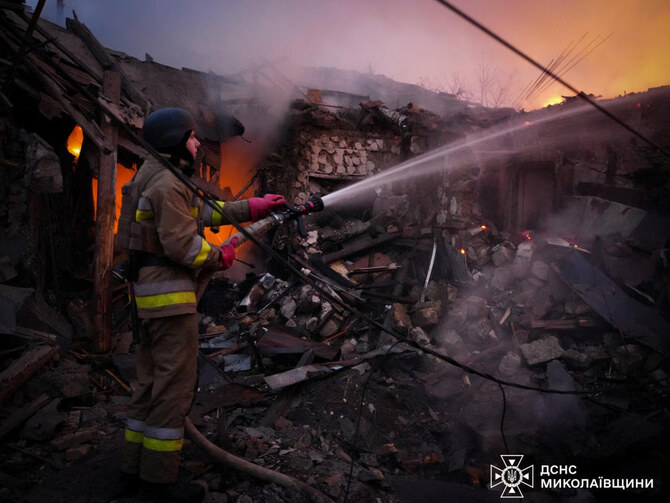
In Mykolaiv in the south, two people were killed in the overnight drone attack, the regional governor said. Blasts shook the southeastern city of Zaporizhzhia and the Black Sea port of Odesa, Reuters witnesses said. More blasts were reported in the regions of Kryvyi Rih in the south and Rivne in the west.
“Russia launched one of the largest air attacks: drones and missiles against peaceful cities, sleeping civilians, critical infrastructure,” said Foreign Minister Andrii Sybiha.
He described the strike as Moscow’s “true response” to leaders who had interacted with President Vladimir Putin, an apparent swipe at German Chancellor Olaf Scholz, who placed a phone call to the Russian leader on Friday for the first time since late 2022.
NATO member Poland, which borders Ukraine to the west, said it had scrambled its air force within its airspace as a security precaution due to the Russian attack, which it said used cruise missiles, ballistic missiles and drones.
Poland “activated all available forces and resources at his disposal, the on-duty fighter pairs were scrambled, and the ground-based air defense and radar reconnaissance systems reached the highest state of readiness,” the operational command of its armed forces posted on X.
Ukraine’s air force urged residents to take cover, providing regular updates on the progress of Russian cruise, ballistic and hypersonic missiles it said were hurtling through Ukrainian air space.
In Kyiv, the roof of a residential building caught fire due to falling debris and at least two people were hurt, city officials said on the Telegram messaging app.
“Emergency services were dispatched to the scene,” Kyiv’s Mayor Vitali Klitschko said.
Russia last conducted a major missile strike on Kyiv on Aug. 26, when officials said it fired a salvo of more than 200 drones and missiles across the country in an attack that attack killed seven people.

Russia targets Ukraine’s power grid in ‘massive’ missile strike, officials say
Short Url
https://arab.news/npvtb
Russia targets Ukraine’s power grid in ‘massive’ missile strike, officials say
- Ukrainians have been bracing for a major attack on the hobbled power system for weeks
- A crippling damage to the grid that would cause long blackouts and build psychological pressure
Portugal far-right hopeful enters vote as favorite
LISBON: A far-right candidate in Portugal’s presidential election, Andre Ventura, has emerged as the favorite for Sunday’s first round of voting, according to polls.
But regardless of whom the president of the Chega (“Enough“) party encounters in the second-round runoff in February, he has very little chance of carrying the day to succeed conservative incumbent Marcelo Rebelo de Sousa.
Some polls point to a second-round duel between Ventura and Socialist Antonio Jose Seguro, while others suggest that Luis Marques Mendes, who has the support of conservative Prime Minister Luis Montenegro, could make the run-off.
Among the 11 candidates, a record number, two others also stand a chance to win a spot in the second round. They are Henrique Gouveia e Melo, a retired admiral who led Portugal’s vaccination campaign during the Covid epidemic, and Joao Cotrim Figueiredo, a liberal member of the European Parliament.
While Ventura’s chances of moving past the first round are slim, the election marks an important step in his electoral fortunes that have improved at lightning pace since he founded Chega in 2019.
His party, highly centered on its leader, won 22.8 percent of the vote and 60 seats in a general election in May of last year, turning it into the biggest opposition party.
The head of state’s role in Portugal is mostly ceremonial, although the president has the power in times of crisis to dissolve parliament, call elections or dismiss the prime minister.
Ventura has expressed his desire to eventually run the country as prime minister, with experts saying that he sees Sunday’s vote mainly as a test of his popularity.
“Andre Ventura is running to keep his voter base,” said Antonio Costa Pinto, a political scientist at Lisbon University. “There could be a surprise increase,” he told AFP.
A stronger far right would add pressure on the minority government of Montenegro who relies on Chega for support for the implementation of some of his policies.
Portugal, a country of nearly 11 million inhabitants, is a member of the European Union and the eurozone. It accounts for around 1.6 percent of the EU’s gross domestic product (GDP).
But regardless of whom the president of the Chega (“Enough“) party encounters in the second-round runoff in February, he has very little chance of carrying the day to succeed conservative incumbent Marcelo Rebelo de Sousa.
Some polls point to a second-round duel between Ventura and Socialist Antonio Jose Seguro, while others suggest that Luis Marques Mendes, who has the support of conservative Prime Minister Luis Montenegro, could make the run-off.
Among the 11 candidates, a record number, two others also stand a chance to win a spot in the second round. They are Henrique Gouveia e Melo, a retired admiral who led Portugal’s vaccination campaign during the Covid epidemic, and Joao Cotrim Figueiredo, a liberal member of the European Parliament.
While Ventura’s chances of moving past the first round are slim, the election marks an important step in his electoral fortunes that have improved at lightning pace since he founded Chega in 2019.
His party, highly centered on its leader, won 22.8 percent of the vote and 60 seats in a general election in May of last year, turning it into the biggest opposition party.
The head of state’s role in Portugal is mostly ceremonial, although the president has the power in times of crisis to dissolve parliament, call elections or dismiss the prime minister.
Ventura has expressed his desire to eventually run the country as prime minister, with experts saying that he sees Sunday’s vote mainly as a test of his popularity.
“Andre Ventura is running to keep his voter base,” said Antonio Costa Pinto, a political scientist at Lisbon University. “There could be a surprise increase,” he told AFP.
A stronger far right would add pressure on the minority government of Montenegro who relies on Chega for support for the implementation of some of his policies.
Portugal, a country of nearly 11 million inhabitants, is a member of the European Union and the eurozone. It accounts for around 1.6 percent of the EU’s gross domestic product (GDP).
© 2026 SAUDI RESEARCH & PUBLISHING COMPANY, All Rights Reserved And subject to Terms of Use Agreement.


