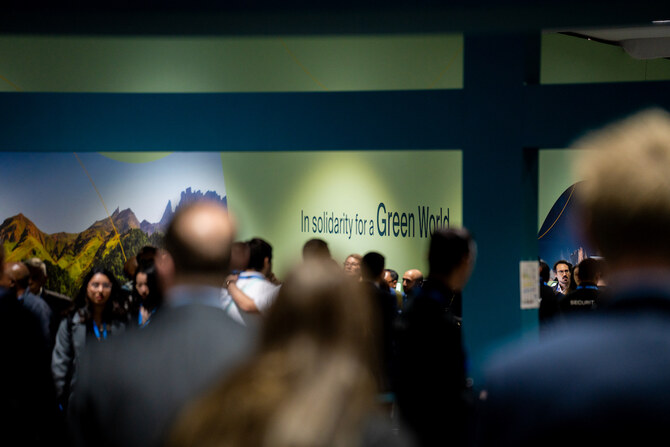

BAKU: Azerbaijan, an oil-producing country and host of the COP29 UN climate change conference, is focusing on green innovation and development, showcasing its efforts at the global gathering in Baku.
“We are collaborating with international companies and research institutions to ensure that COP29 showcases cutting-edge technologies in renewable energy, water management and carbon capture,” said Mukhtar Babayev, COP29 president.
Although Azerbaijan remains reliant on fossil fuels, it is working with international organizations and educational institutions to ensure that COP29 is not only about policies and funding, but also a platform for presenting environmental innovations.
“Our focus is on delivering a conference that fosters practical solutions, showcases Azerbaijan’s leadership in the energy transition, and reinforces our commitment to a sustainable and resilient future,” said Babayev.
According to an article by Elkhan Nuriyev, a global energy associate at the Brussels Energy Club and senior expert on Russia, Eastern Europe, and Central Asia at L&M Political Risk and Strategy Advisory in Vienna, published on the Ceeenergy News website: “The government has advocated for stronger commitments to enhancing financial mechanisms for green projects worldwide. A standout project is the ‘Green Energy Hub,’ a multi-faceted initiative focused on harnessing renewable energy sources. This hub includes large-scale solar farms, wind turbines and hydropower facilities, serving as a key export resource.”
In addition, an agreement was signed four years ago between Azerbaijan’s Ministry of Energy and Masdar, a UAE clean energy company, to establish the country’s first solar energy facility — the 230-megawatt Garadagh Solar Power Plant.

Saudi Arabia is one of the examples to prioritize sustainable development through its Vision 2030. (Abdulrhman Bin Shalhoub)
The project covers 550 hectares and features 570,000 bifacial photovoltaic panels, which capture both direct sunlight and the reflection of sunlight from the ground.
Masdar is not the only company involved in renewable energy technologies in Azerbaijan. Earlier this year, ACWA Power, a leader in the energy transition and a pioneer in green hydrogen, partnered with Azerbaijan’s national oil company, SOCAR, to develop projects that will accelerate renewable energy in the country.
According to ACWA Power’s website, the private company is “currently constructing Azerbaijan’s and the region’s largest 240 MW wind power plant in the Absheron-Khizi region at an investment cost of $345 million.”
As governments increasingly prioritize sustainability, the integration of innovative technologies is becoming a key demand for fostering both economic growth and environmental stewardship.
Saudi Arabia is also prioritizing sustainable development through its Vision 2030.
According to the Kingdom’s national source for government services and information, which outlines the Sustainable Development Goals of Saudi Vision 2030, “the Kingdom of Saudi Arabia endeavors to tackle the issues of poverty, inequality, climate change, prosperity, peace, justice, education, health, social protection and the availability of employment opportunities, and, recognizing the intersecting nature of these issues, ensures they are all included in its national strategy.”
In addition, many other technologies have been developed worldwide to combat climate change, including an innovative solution launched 2017 to develop renewable energy: solar-powered trains.
According to an article by Justyna Matuszak on the Know-How website, this type of green transportation can run for an entire day without needing to recharge. The railway also releases 75 percent of the energy it generates into the ground, as reported by the BBC.
Bladeless wind energy is another technology designed in 2012 by the Spanish startup Vortex Bladeless.
It features is an elastic rod that secures the company’s three-meter tall bladeless turbine vertically into the ground. According to the previously mentioned report, the turbine sways with the wind speed, generating energy from the resulting vibrations.
Due to its design, it is suitable for use in cities or residential areas as it does not require as much space as a traditional wind turbine.
Another new sustainable technology is 3D-printed solar energy trees. Developed by researchers at VTT Technical Research Centre of Finland, the technology, as described in the Know-How report by Matuszak, is a prototype tree that collects solar energy, heat and kinetic energy from its surroundings, whether indoors or outdoors, to generate electricity for small appliances.
By embracing modern sustainable innovations and fostering joint partnerships between the public and private sectors, tackling climate change may become more achievable.