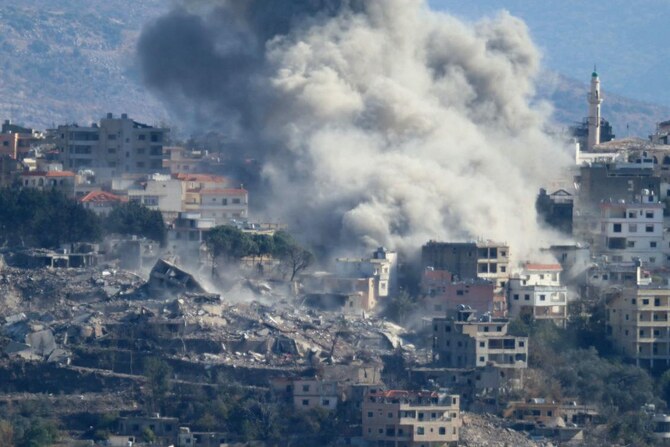
BEIRUT: Israeli ground forces reached their deepest point in Lebanon since they invaded six weeks ago, before pulling back early Saturday after fierce battles with Hezbollah militants, Lebanese state media reported.
Israeli troops captured a strategic hill in the southern Lebanese village of Chamaa, about 5 kilometers (3 miles) from the Israeli border early Saturday, the state-run National News Agency reported. It said Israeli troops were later pushed back from the hill.
It added that Israeli troops detonated the Shrine of Shimon the Prophet in Chamaa as well as several homes before they withdrew, but the claim could not be immediately verified.
Israel’s military said in a statement that its troops “continue their limited, localized, and targeted operational activity in southern Lebanon.” The military did not immediately respond to requests for comment on the Lebanese media reports.
The push on the ground came as Israeli warplanes pounded Beirut’s southern suburbs as well as several other areas in southern Lebanon including the port city of Tyre.
The morning strike in Beirut hit an area known as Dahiyeh, which the Israeli military called a Hezbollah stronghold, saying its planes had hit multiple sites used by the militant group. Residents were given advance warning by Israel, and it was not immediately clear whether there were any casualties.
The increase of violence came as Lebanese and Hezbollah officials are studying a draft proposal presented by the US earlier this week on ending the war.
Since late September, Israel dramatically escalated its bombardment of Lebanon, vowing to cripple Hezbollah and end its barrages in Israel. More than 3,400 people have been killed in Lebanon by Israeli fire – 80 percent of them in the eight weeks – according to Lebanon’s Health Ministry.
On Friday, Lebanon’s caretaker prime minister apparently urged Iran to try and convince Hezbollah to agree to a ceasefire deal with Israel, which would require the group to pull back from the Israel-Lebanon border. The proposal is based on UN Security Council resolution 1701, which ended the last Israel-Hezbollah war in the summer of 2006.
A copy of the draft proposal was handed over earlier this week by the US ambassador to Lebanon to Parliament Speaker Nabih Berri, who has been negotiating on behalf of Hezbollah, according to a Lebanese official. The official who spoke on condition of anonymity because he was not authorized to speak about the secret talks said Berri is expected to give Lebanon’s response on Monday.
Another Lebanese politician said Hezbollah officials had received the draft, were studying it and would express their opinion on it to Berri. The politician also spoke on condition of anonymity because he was not authorized to speak to the media about the ongoing talks.
Berri told the pan-Arab Asharq Al-Awsat daily newspaper that the draft does not include any item that allows Israel to act in Lebanon if the deal is violated.
“We will not accept any infringement of our sovereignty,” Berri was quoted as saying.
He added that one of the items mentioned in the draft that Lebanon does not accept is the proposal to form a committee to supervise the agreement that includes members from Western countries.
Berri added that talks are ongoing regarding this point as well as other details in the draft, adding that “the atmosphere is positive but all relies on how things will end.”
There is also a push to end the war between Israel and Hamas, which began after Palestinian militants stormed into Israel on Oct. 7, 2023, killing about 1,200 people – mostly civilians – and abducting 250 others.
The UN Security Council’s 10 elected members on Thursday circulated a draft resolution demanding “an immediate, unconditional and permanent ceasefire” in Gaza.
The US, Israel’s closest ally, holds the key to whether the UN Security Council adopts the resolution. The four other permanent members – Russia, China, Britain and France – are expected to support it or abstain.
Israel’s bombardment and ground offensives since the initial Hamas attack have killed more than 43,000 people in Gaza, Palestinian health officials say. The officials don’t distinguish between civilians and combatants but say more than half of those killed have been women and children.


![]()


Israeli troops reach deepest point in Lebanon since October 1 invasion
Short Url
https://arab.news/6vney
Israeli troops reach deepest point in Lebanon since October 1 invasion
- Media reports: Israeli ground forces pull back early Saturday after fierce battles with Hezbollah fighters
- Israeli troops earlier captured a strategic hill in the southern Lebanese village of Chamaa


Hamas official says group in final stage of choosing new chief
CAIRO: A senior Hamas official told AFP on Sunday that the Palestinian movement was in the final phase of selecting a new leader, with two prominent figures competing for the position.
Hamas recently completed the formation of a new Shoura Council, a consultative body largely composed of religious scholars, as well as a new political bureau.
Members of the council are elected every four years by representatives from Hamas’s three branches: the Gaza Strip, the occupied West Bank and the movement’s external leadership.
Hamas prisoners in Israeli jails are also eligible to vote.
The council subsequently elects the political bureau, which in turn selects the head of the movement.
“The movement has completed its internal elections in the three regions and has reached the final stage of selecting the head of the political bureau,” the official said, speaking on condition of anonymity as he was not authorized to speak publicly.
He added that the race for the group’s leadership is now between Khaled Meshaal and Khalil Al-Hayya.
A second Hamas source confirmed the development within the organization, which fought a devastating war with Israel following its October 7, 2023 attack.
Hayya, 65, a Gaza native and Hamas’s chief negotiator in ceasefire talks, has held senior roles since at least 2006, according to the US-based NGO the Counter Extremism Project (CEP).
Meshaal, who led the political bureau from 2004 to 2017, has never lived in Gaza. He was born in the West Bank in 1956.
He joined Hamas in Kuwait and later lived in Jordan, Syria and Qatar. The CEP says he oversaw Hamas’s evolution into a political-military hybrid.
He currently heads the movement’s diaspora office.
Last month, a Hamas source told AFP that Hayya enjoys backing from the group’s armed wing, the Ezzedine Al-Qassem Brigades.
After Israel killed former Hamas leader Ismail Haniyeh in Tehran in July 2024, the group chose its then-Gaza chief Yahya Sinwar as his successor.
Israel accused Sinwar of masterminding the October 7 attack.
He too was killed by Israeli forces in the southern Gaza city of Rafah, three months after Haniyeh’s assassination.
Hamas then opted for an interim five-member leadership committee based in Qatar, postponing the appointment of a single leader until elections, given the risk of the new chief being targeted by Israel.
Hamas recently completed the formation of a new Shoura Council, a consultative body largely composed of religious scholars, as well as a new political bureau.
Members of the council are elected every four years by representatives from Hamas’s three branches: the Gaza Strip, the occupied West Bank and the movement’s external leadership.
Hamas prisoners in Israeli jails are also eligible to vote.
The council subsequently elects the political bureau, which in turn selects the head of the movement.
“The movement has completed its internal elections in the three regions and has reached the final stage of selecting the head of the political bureau,” the official said, speaking on condition of anonymity as he was not authorized to speak publicly.
He added that the race for the group’s leadership is now between Khaled Meshaal and Khalil Al-Hayya.
A second Hamas source confirmed the development within the organization, which fought a devastating war with Israel following its October 7, 2023 attack.
Hayya, 65, a Gaza native and Hamas’s chief negotiator in ceasefire talks, has held senior roles since at least 2006, according to the US-based NGO the Counter Extremism Project (CEP).
Meshaal, who led the political bureau from 2004 to 2017, has never lived in Gaza. He was born in the West Bank in 1956.
He joined Hamas in Kuwait and later lived in Jordan, Syria and Qatar. The CEP says he oversaw Hamas’s evolution into a political-military hybrid.
He currently heads the movement’s diaspora office.
Last month, a Hamas source told AFP that Hayya enjoys backing from the group’s armed wing, the Ezzedine Al-Qassem Brigades.
After Israel killed former Hamas leader Ismail Haniyeh in Tehran in July 2024, the group chose its then-Gaza chief Yahya Sinwar as his successor.
Israel accused Sinwar of masterminding the October 7 attack.
He too was killed by Israeli forces in the southern Gaza city of Rafah, three months after Haniyeh’s assassination.
Hamas then opted for an interim five-member leadership committee based in Qatar, postponing the appointment of a single leader until elections, given the risk of the new chief being targeted by Israel.
Latest updates


© 2026 SAUDI RESEARCH & PUBLISHING COMPANY, All Rights Reserved And subject to Terms of Use Agreement.