At summit under Trump shadow, Xi and Biden signal turbulence ahead

1 / 2
China's President Xi Jinping arrives for the Asia-Pacific Economic Cooperation (APEC) Summit in Peru. (AFP)
2 / 2
Short Url
Updated 16 November 2024
Follow

At summit under Trump shadow, Xi and Biden signal turbulence ahead

  • Xi Jinping raises concerns about “spreading unilateralism and protectionism”
  • Biden says world had “reached a moment of significant political change”

LIMA: US President Joe Biden and Chinese counterpart Xi Jinping on Friday warned of turbulent times ahead, in remarks at an Asia-Pacific economic summit in Lima overshadowed by Donald Trump’s impending return to the White House.
The men, who will hold their last, official face-to-face Saturday, warned separately of choppy waters as the world braces for the prospect of fresh trade wars after Trump assumes the presidency in January.
Xi raised concerns about “spreading unilateralism and protectionism,” China’s state news agency Xinhua reported.
He also cautioned against “fragmentation of the world economy” in a written speech prepared for a meeting of CEOs on the sidelines of the Asia-Pacific Economic Cooperation (APEC) summit, Xinhua said.
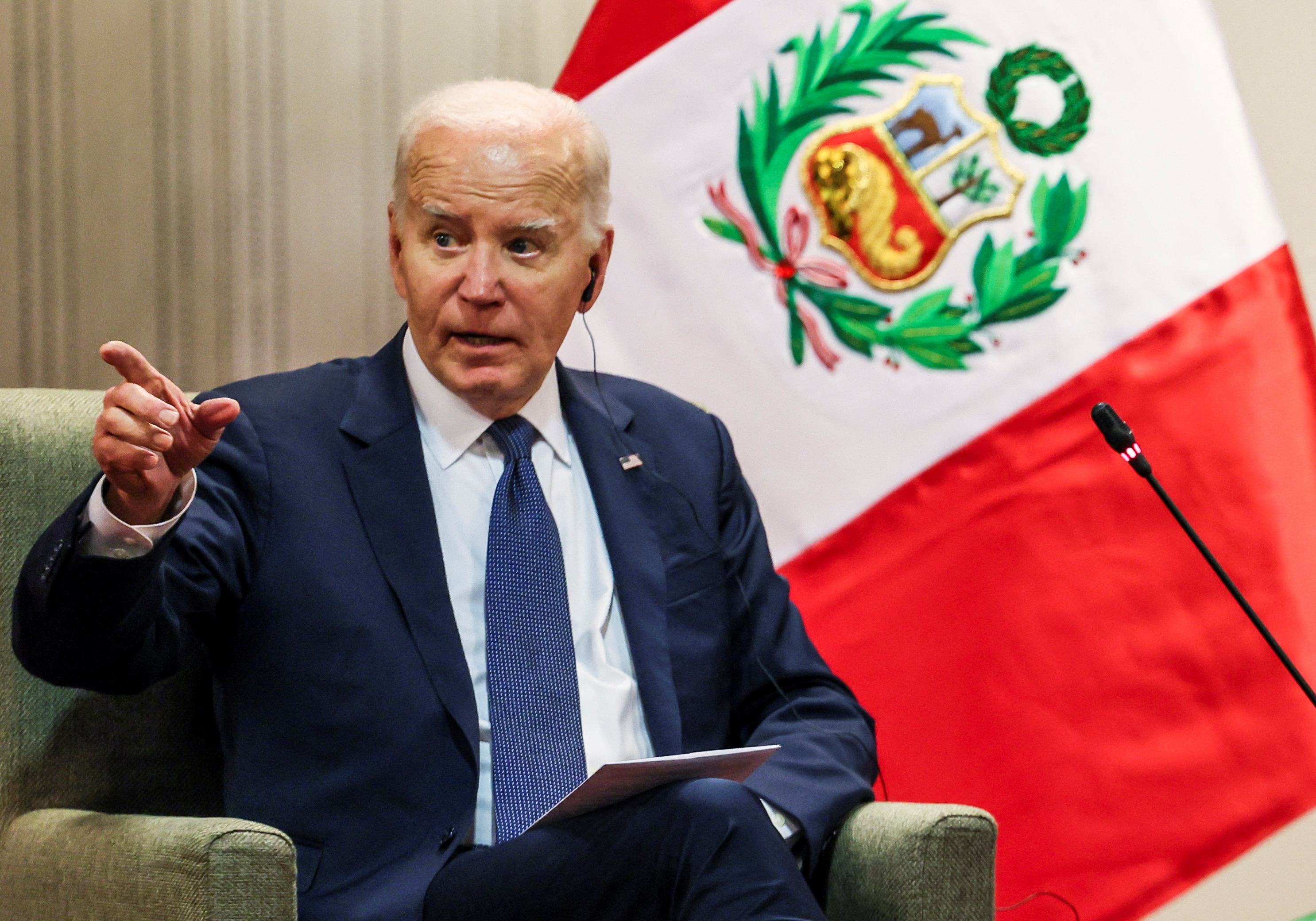


Joe Biden is in the Peruvian capital for a two-day meeting of heads of state of the 21-member APEC group. (Reuters)


Biden, for his part, said the world had “reached a moment of significant political change,” as he met the leaders of Japan and South Korea — key US allies in Asia.
The trilateral partnership, Biden said, was “built to last. That’s my hope and expectation.”
Xi and Biden are in the Peruvian capital for a two-day meeting of heads of state of the 21-member APEC group.
They separately met Friday with South Korean President Yoon Suk Yeol, who called for cooperation for the sake of “stability and peace in the region,” according to the Yonhap news agency.
China is an ally of North Korea, with which Seoul remains technically at war and whose leader Kim Jong Un has engaged in escalatory rhetoric and military posturing this year.
Biden, for his part, warned of North Korea’s “dangerous and destabilizing cooperation with Russia” amid growing concerns about nuclear-armed Pyongyang sending troops to fight in Ukraine.

APEC, created in 1989 with the goal of regional trade liberalization, represents about 60 percent of world GDP and more than 40 percent of global commerce.
The 2024 summit program was to focus on trade and investment for what proponents dubbed inclusive growth.
But uncertainty over Trump’s next moves clouds the agenda — as it does for the COP29 climate talks underway in Azerbaijan, and a G20 summit in Rio de Janeiro next week.
The Republican president-elect has signaled a confrontational approach to Beijing for his second term, threatening to impose tariffs of up to 60 percent on imports of Chinese goods to even out what he says is a trade imbalance.
Xi was not present for Friday’s summit opening, but Biden attended with US Secretary of State Antony Blinken — whom Trump has said he will seek to replace with Senator Marco Rubio, a China hawk.
US National Security Adviser Jake Sullivan said Saturday’s Xi-Biden meeting will be an opportunity to “mark the progress that we’ve made in the relationship and also to manage it through this delicate period of transition.”
Competition with China, he told reporters on Air Force One Thursday, must be managed “so it doesn’t veer into conflict.”

Trump’s “America First” agenda is based on protectionist trade policies, increased domestic fossil fuel extraction and avoiding foreign conflicts.
It threatens alliances Biden has built on issues ranging from the wars in Ukraine and the Middle East to climate change and trade.
Economists say Trump’s threat of punitive tariffs would harm not only China’s economy but also that of the United States and its trading partners.
It could also threaten geopolitical stability.
China is building up its military capacity while ramping up pressure on self-governed Taiwan, which it claims as part of its territory.
China isn’t the only APEC economy in Trump’s crosshairs.
The incoming US leader has threatened tariffs of 25 percent or more on goods coming from Mexico unless it stops an “onslaught of criminals and drugs” crossing the border.
The APEC summit is also attended by Chile, Canada, Australia and Indonesia, among others.
Russia is additionally part of APEC but President Vladimir Putin was absent.


New ‘superfood’ transforms livelihoods in India’s rural east

A farmer harvests makhana, or lotus seeds, in Kapchhahi village in India’s eastern state of Bihar. (Mahesh Mukhia)
Updated 08 December 2025
Follow

New ‘superfood’ transforms livelihoods in India’s rural east

  • Known as fox nut or lotus seed, makhana is rich in protein, dietary fiber, minerals
  • Most of the world’s makhana production is in Bihar, one of India’s poorest states

BIHAR: Wading through knee-deep, stagnant water, Mahesh Mukhia plunges his hands into the mud, pulling up handfuls of sludge that he and others toss into a large, partially submerged basket.

After a while, they shake the basket to drain away the water and debris. What remains is makhana — round black seeds that have lately gained popularity as India’s new superfood.

A regional Indian snack, also known as fox nut or lotus seed, makhana is the edible seed of the prickly waterlily. The plant grows in freshwater ponds and wetlands in southern and eastern Asia.

After makhana seeds are handpicked from pond beds, cleaned, and sun-dried, they are roasted at high heat so their hard black shells crack open and release the white, popcorn-like puffed kernels, which are eaten as snacks or used in dishes.

It has long been known for its nutritional value — high in plant-based protein and dietary fiber, the seeds are also rich in minerals and gluten-free — which over the past few years have helped it gain global attention and are transforming farmlands in Bihar, one of India’s poorest states.

“Earlier, people were not researching it but now, after research, makhana’s nutritional values have been highlighted. Now this is a superfood. That’s why demand is growing everywhere,” said Mahesh Mukhia, a farmer in Kapchhahi village in Bihar’s Darbhanga district, whose family has been harvesting the seeds for generations.

“The difference is that my forefathers did farming in a traditional way, but we’ve learnt to do it in a scientific way,” Mukhia told Arab News.

“There is Bhola Paswan Shastri Agricultural College in the neighboring Purnea district. I went there for training. After I started practicing farming the way I learnt, the yield increased by more than 30 percent.”

Makhana farming is highly labor-intensive, starting with the cultivation of water lilies in shallow ponds. The plants require constant monitoring as they are sensitive to water levels and pests.

Harvesting takes place between August and October. Workers pluck the seeds by hand and then dry them under the sun for several days before they can be processed.

The processing and roasting of makhana also require significant effort. The dried seeds are first de-shelled by manually cracking them, followed by multiple rounds of roasting to make them crisp.

Whole families are involved in the production, which has been expanding since 2020, when the state government introduced the Makhana Development Scheme.

Besides training in farming and processing, growers who cultivate fox nut receive $820 per hectare.

“The rate has also gone up. The makhana that we used to sell at 200-300 ($2-$3) rupees per kg is now selling at 1,000 ($12) or 1,500 rupees per kg,” Mukhia said.

“Makhana farmers are now making a profit. Those who are growing makhana are earning well, those who are popping it are also doing well, and those involved in trading are making profits too. We are getting good demand from everywhere. I just received an order for 25 tonnes recently.”

Bihar currently produces over 85 percent of India’s makhana and accounts for most of the world’s production, according to Ministry of Commerce and Industry estimates.

According to reports by the Indian Brand Equity Foundation and the Agricultural and Processed Food Products Export Development Authority, India accounts for roughly 85 to 90 percent of the world’s production.

Farmland where the crop is grown has increased many times over the past decade and can now be compared to the area covering half of New York City.

More than 600,000 people are involved in the makhana industry in Bihar, according to Niraj Kumar Jha, Darbhanga district’s horticulture officer.

“Earlier, we were cultivating 5,000 hectares in the Kosi and Mithlanchal regions. But now it has expanded to 35,000 hectares, and with many supportive schemes, farmers are increasingly encouraged to grow makhana,” he said.

“We are strengthening our marketing channels. We’ll reach the metro cities as well as world markets ... We can see that makhana is growing very popular, not only in India.”