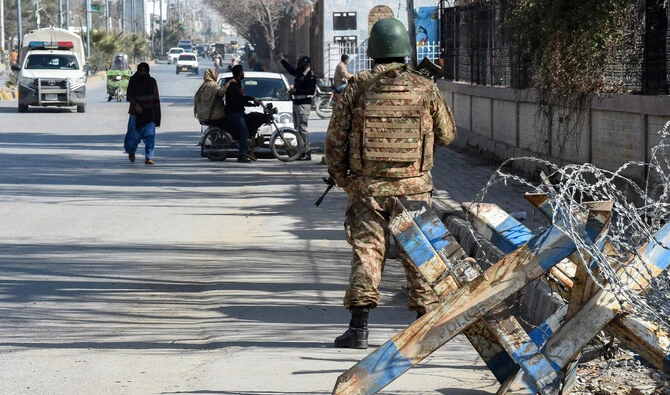
QUETTA: The Pakistan Telecommunications Authority (PTA) announced the suspension of mobile Internet services in various parts of the restive southwestern Balochistan province on Friday, saying the decision was taken to “ensure public safety” amid a surge in militant violence over the past several months.
The announcement follows a deadly suicide bombing at a crowded railway station in Quetta, the provincial capital, which killed at least 28 people, including Pakistani soldiers, and injured dozens of others.
The attack was claimed by the Balochistan Liberation Army (BLA), an outlawed separatist group that has targeted Chinese nationals in an effort to undermine the multibillion-dollar Pakistan-China Economic Corridor (CPEC) projects.
The BLA, the largest of several ethnic insurgent groups battling the Pakistani state, alleges that the province’s rich gas and mineral resources are unfairly exploited, a claim the government denies.
“The general public is hereby informed that, under the directives of authorized departments, mobile Internet services have been temporarily suspended in certain areas of Balochistan,” the PTA said in an official statement.
“This measure has been taken to ensure public safety, given the security situation in these areas,” it added.
The PTA statement did not specify the areas where mobile Internet services have been suspended, nor was there any clarification from other departments on whether the government was planning an operation against militants in these regions.
However, mobile Internet has already been down in the province’s Kech, Panjgur, Gwadar, Khuzdar, Loralai, Dukki, Ziarat, Harnai and Zhob districts for the last three days, causing significant hardships for students and the business community in these areas.
“Hundreds of students and businesses have been affected by the mobile Internet suspension,” Abdul Majid Dashti, a lawyer based in Turbat, told Arab News, adding that cellphone Internet had been down for nearly three days in the area.
Sadaqat Baloch, a journalist in Pakistan’s coastal town of Gwadar, which is central to CPEC, said authorities suspended mobile Internet in the area a day after the Quetta railway station bombing.
“People of the Makran region, including Khuzdar, are now deprived of mobile Internet, which has been creating problems for them,” he added.
The provincial government’s spokesperson was unavailable for comment on the recent mobile Internet suspension.
Pakistan suspends mobile internet in Balochistan, citing ‘public safety’ amid rising violence
https://arab.news/9ub4e
Pakistan suspends mobile internet in Balochistan, citing ‘public safety’ amid rising violence
- People in Balochistan say mobile Internet has been down for about three days in different areas
- PTA announcement comes days after a suicide bombing at a crowded railway station in Quetta
Pakistan, Iran leaders highlight mutual support after both engaged in short wars this year
- Prime Minister Sharif met Iranian President Pezeshkian in Ashgabat on the sidelines of an international forum
- Pakistani PM also had an informal interaction with President Putin, discussed regional issue with President Erdogan
ISLAMABAD: Prime Minister Shehbaz Sharif and Iranian President Masoud Pezeshkian on Friday praised the support their countries offered one another during episodes of external aggression this year, according to the state media, as they met on the sidelines of an international peace forum in Turkmenistan.
Pakistan fought a four-day war with India in May, when New Delhi fired missiles at its cities and Islamabad responded with retaliatory strikes. Nearly a month after the conflict, Iran waged its own war with Israel after Tel Aviv carried out attacks inside Iranian territory, prompting Tehran to launch a series of missile and drone barrages in response.
The meeting in Turkmenistan came as Pakistan and Iran seek to steady ties after a period of strained security relations, while also attempting to expand economic cooperation and strengthen border management. The two leaders reviewed regional developments, including Pakistan’s concerns over militant attacks it says originate from Afghanistan, and ongoing diplomatic efforts related to Gaza.
“Both leaders appreciated the strong support that their countries had provided to each other when they had faced external aggression earlier this year,” the state-owned Associated Press of Pakistan (APP) said.
Sharif highlighted the outcome of the 22nd Pakistan–Iran Joint Economic Commission held this year and urged closer coordination to increase bilateral trade, operationalize border markets, reinforce border security and revive transport links, including the Islamabad-Tehran-Istanbul rail network.
Pezeshkian, according to the report, said Iran wished to further strengthen ties and thanked Sharif for a “useful and timely exchange of views.”
Sharif also pressed for “meaningful action” from the Afghan Taliban administration to address Pakistan’s security concerns, APP added.
Separately, the Pakistani prime minister met other global leaders attending the forum marking the International Year of Peace and Trust 2025 and Turkmenistan’s Neutrality Day.
He held informal interactions with Russian President Vladimir Putin and discussed regional issues with Turkish President Tayyip Erdogan, Tajik President Emomali Rahmon and Kyrgyz President Sadyr Zhaparov.