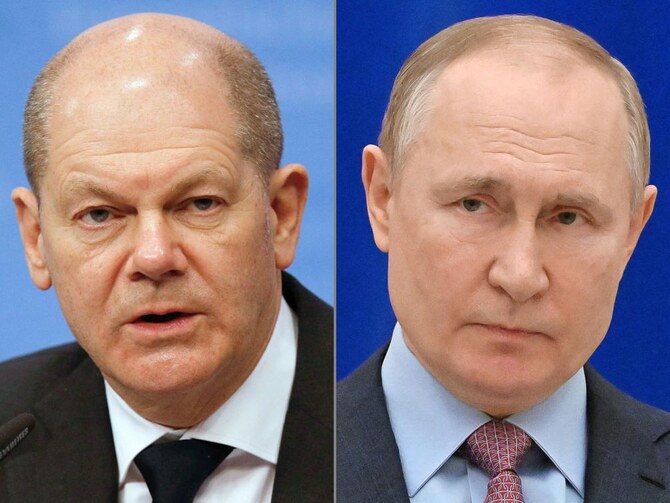
BERLIN: Ukrainian President Volodymyr Zelensky Friday accused Germany’s Olaf Scholz of playing into the hands of Russian President Vladimir Putin after the chancellor spoke by phone to the Kremlin chief for the first time in almost two years.
In the call, Scholz “condemned Russia’s war of aggression against Ukraine and called on President Putin to end it and withdraw troops,” the chancellor’s spokesman Steffen Hebestreit said.
The German leader “urged Russia to show willingness to negotiate with Ukraine with the aim of achieving a just and lasting peace,” Hebestreit added in a statement.
The Kremlin confirmed the call between Scholz and Putin, which it said was held at the invitation of the German side.
Putin had a “detailed and frank exchange of views over the situation in Ukraine” with Scholz, the Kremlin said.
Putin told the German leader that any agreement to end the war in Ukraine “should take into account the security interests of the Russian Federation,” the Kremlin added.
An accord should “proceed from the new territorial realities and, most importantly, address the root causes of the conflict.”
Russia has demanded Ukraine surrender four regions as a precondition for talks, which Kyiv has rejected.
Ukraine responded angrily to Berlin reviving its lines of communication with Moscow. The call had opened a “Pandora’s Box,” Zelensky said.
“This is exactly what Putin has been wanting for a long time: it is extremely important for him to weaken his isolation,” Zelensky said.
Scholz spoke with Zelensky before and after the call with Putin, the chancellor’s spokesman said, but the early warning failed to quell Kyiv’s concerns.
“What is needed are concrete, strong actions that will force him to peace, not persuasion and attempts at appeasement, which he sees as a sign of weakness and uses to his advantage,” Ukraine’s foreign ministry said.
As well as Ukraine, Scholz also notified the countries of the so-called Quad, which includes France, the United States and Britain, a source close to French President Emmanuel Macron said.
The chancellor’s message to Putin was not “coordinated” between the allies but the French side expected to be informed on the contents, the source said.
During the hour-long call, Scholz “condemned in particular Russian air strikes against civilian infrastructure in Ukraine,” a German government source said.
Scholz “made it clear that sending North Korean soldiers to Russia for combat missions against Ukraine would lead to a serious escalation and expansion of the conflict,” the source said.
The German and Russian leaders “agreed to remain in contact,” while Berlin would keep its allies updated, the source added.
Scholz will have an opportunity for discussions at a meeting of G20 leaders in Brazil next week, from which Putin will be notably absent.
Putin has spoken to few NATO and Western leaders since 2022, when the EU and the US imposed massive sanctions on Russia for launching its shock Ukraine offensive.
His last known phone call with the leader of a major Western country was his previous conversation with Scholz in December 2022.
Almost 1,000 days after Russia launched its full-scale invasion, Ukraine is bracing for what could be the most difficult winter of the war so far.
Much of Ukraine’s energy infrastructure has been destroyed by Russian bombardments and Kyiv’s troops are increasingly on the back foot.
Germany has been one of Ukraine’s biggest military supporters, second only to the United States in the aid it has sent to Kyiv.
But the election of Donald Trump, who has criticized aid to Ukraine, as the next US president, has called into question Washington’s continued support.
Trump said on the campaign trail that he could end the fighting within hours and has indicated he would talk directly with Putin.
The Kremlin has denied reports that Putin and the president-elect of the United States recently discussed the Ukraine conflict by phone.
Scholz, who did speak with Trump following his election win, told the German daily Sueddeutsche Zeitung on Friday that the incoming US leader had a “more nuanced” position on the conflict than was commonly assumed.
Following the Putin-Scholz call, Polish Prime Minister Donald Tusk said he had been updated by the German leader on the discussion.
Tusk was “satisfied” that Scholz had “reiterated the Polish position: ‘Nothing about Ukraine without Ukraine’,” he said on social media platform X.


![]()

Ukraine slams Scholz after first call with Putin in two years
Short Url
https://arab.news/64fsp
Ukraine slams Scholz after first call with Putin in two years
- “This is exactly what Putin has been wanting for a long time: it is extremely important for him to weaken his isolation,” Zelensky said
- Scholz spoke with Zelensky before and after the call with Putin, the chancellor’s spokesman said, but the early warning failed to quell Kyiv’s concerns.

Latest updates


Recommended


© 2026 SAUDI RESEARCH & PUBLISHING COMPANY, All Rights Reserved And subject to Terms of Use Agreement.