ISLAMABAD: Pakistan has unveiled its first-ever National Climate Finance Strategy (NCFS), aimed at mobilizing financial resources for climate mitigation and adaptation, Radio Pakistan reported on Friday.
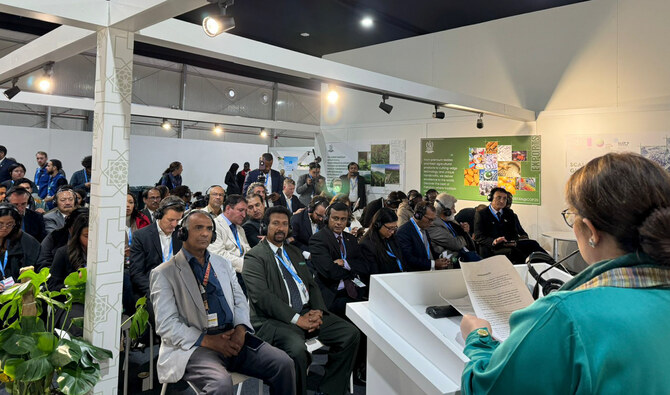
The strategy was launched by Federal Minister for Finance, Muhammad Aurangzeb, and the Prime Minister’s Coordinator on Climate Change, Romina Khurshid Alam, at the Pakistan Pavilion in Baku on the sidelines of the two-week UN-led global climate conference (COP29).
“[Strategy] outlines a comprehensive framework to scale up climate-related investments, attract international funding, and strengthen domestic financial systems,” Radio Pakistan reported.
“The strategy provides a roadmap for Pakistan to systematically access climate finance from a variety of domestic and international sources, reinforcing the country’s commitment to the Paris Agreement and its climate resilience goals.”
Speaking on the occasion, Aurangzeb said the strategy would enable Pakistan to leverage international, domestic, and private finance to support climate resilience efforts.
The strategy prioritizes sectoral resilience and the development of climate-smart policies across key sectors such as agriculture, infrastructure, and urban planning, the finance minister said, adding that NCFS identified key financial instruments and channels for climate action, aiming to close the estimated $348 billion climate finance gap facing the country by 2030.
The NCFS also incorporates a new National Climate Finance Portal that will track climate finance inflows and outflows, ensuring transparency and accountability.
Pakistani Prime Minister Shehbaz Sharif, who spoke at a number of events at COP29 earlier this week, used the forum to highlight the need to restore confidence in the pledging process and increase climate finance for vulnerable, developing countries.
The main task for nearly 200 countries at the COP29 summit from Nov. 11-22 is to broker a deal that ensures up to trillions of dollars in financing for climate projects worldwide.
Pakistan is ranked the 5th most vulnerable country to climate change, according to the Global Climate Risk Index. In 2022, devastating floods killed over 1,700 people and affected over 33 million, with economic losses exceeding $30 billion. International donors pledged over $9 billion last January to aid Pakistan’s flood recovery but officials say little of the promised funds have been received so far.
Speaking on the sidelines of the World Leaders’ Climate Action Summit on Tuesday, Sharif said developing countries would need an estimated $6.8 trillion by 2030 to implement less than half of their current nationally determined contributions (NDCs), or national action plans for reducing emissions and adapting to climate impacts defined by the Paris Agreement.
Most of the world’s climate-friendly spending so far has been skewed toward major economies such as China and the United States. Africa’s 54 countries received just 2 percent of global renewable energy investments over the last two decades.


![]()

Pakistan unveils first National Climate Finance Strategy on COP29 sidelines
Short Url
https://arab.news/8e2y4
Pakistan unveils first National Climate Finance Strategy on COP29 sidelines
- Strategy aimed at mobilizing financial resources and investments for climate mitigation and adaptation
- Pakistan is ranked 5th most vulnerable country to climate change, according to Global Climate Risk Index
Latest updates


© 2026 SAUDI RESEARCH & PUBLISHING COMPANY, All Rights Reserved And subject to Terms of Use Agreement.