RIO DE JANEIRO:G20 leaders gather in Brazil on Monday for a G20 summit set to be dominated by differences over wars in the Middle East and Ukraine, and implications of Donald Trump’s White House return.
Security considerations — always high at such meetings — were elevated further after a failed bomb attack late Wednesday outside Brazil’s Supreme Court in Brasilia.
Police were probing the two blasts as a possible “terrorist act” committed by a Brazilian perpetrator, whose death was the sole casualty.
The summit venue is in Rio de Janeiro, in the city’s stunning bayside museum of modern art, which is the epicenter of a massive police deployment designed to keep the public well away.
Brazil’s leftwing President Luiz Inacio Lula da Silva will be using the opportunity to highlight his position as a leader championing Global South issues while also being courted by the West.
That role will be tested in the months and years ahead as Latin America and other regions navigate “America First” policies promised by Donald Trump when he becomes US president in January.
At this G20, it will be outgoing President Joe Biden who will represent the world’s biggest economy, but as a lame duck the other leaders will be looking beyond.
Just before the Rio summit, on Sunday, Biden will make a stop in Brazil’s Amazon to underline the fight against climate change — another issue that Trump is hostile toward.
The G20 meet is happening at the same time as the UN’s COP29 climate conference in Azerbaijan — and as the world experiences dramatic climate phenomena, including in Brazil where flooding, drought and forest fires have taken heavy tolls.
At the last G20, in India, the leaders called for a tripling of renewable energy sources by the end of the decade, but without explicitly calling for an end to the use of fossil fuels.
One invited leader who declined to come to Rio is Russian President Vladimir Putin, who said his presence could “wreck” the gathering.
Putin denied an International Criminal Court warrant out against him, for Russia’s actions in Ukraine, was a factor in his decision. His foreign minister will represent Russia in Rio.
China’s President Xi Jinping, however, will be attending, and will even extend his stay after the summit to make an official visit to Brasilia on Wednesday.
China is Brazil’s biggest trading partner, and the two countries have been touting themselves as mediators to help end Russia’s war in Ukraine, so far without success.
That conflict, along with Israel’s offensives in Gaza and Lebanon, will loom large at the summit.
“We are negotiating with all the countries on the final declaration’s passages about geopolitics... so that we can reach consensual language on those two issues,” Brazil’s chief diplomatic official for the G20, Mauricio Lyrio, said.
Those conflicts will be “the elephant in the room,” Flavia Loss, international relations specialist at the School of Sociology and Politics of Sao Paulo (FESPSP), told AFP.
But that should not prevent Brazil from finding consensus on issues that it has made priorities under its G20 presidency, she said, such as the fight against hunger or taxing the world’s super-rich.
Lula, heading up Latin America’s biggest economy, set out his line in May when he said: “A lot of people insist on dividing the world between friends and enemies. But the more vulnerable are not interested in simplist dichotomies.”
The Rio G20 summit will open on Monday with Lula officially launching a “Global Alliance against Hunger and Poverty.”
The initiative aims to rally nations and international bodies to free up financing for that campaign, or to replicate programs that have previously had success.
And on the issue of taxing billionaires, the G20 countries already declared a desire to cooperate to bring that about, as set out by their finance ministers who met in Rio in June.
It remained to be seen, though, whether the leaders at the summit would pursue that goal, and on what terms.
Following the summit, Brazil hands over the G20 presidency to South Africa.

Wars, looming Trump reign set to dominate G20 summit
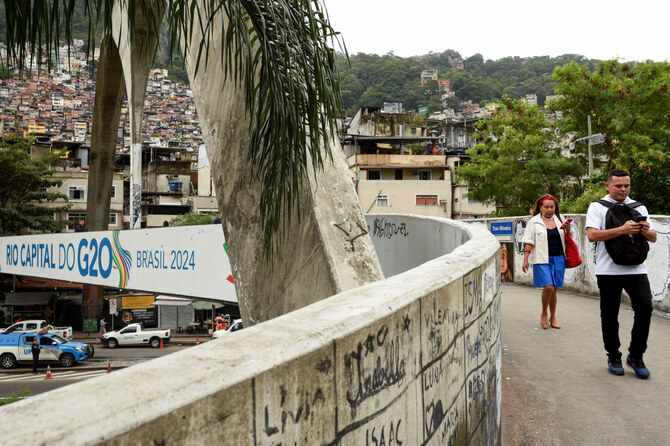
- G20 leaders gather in Brazil on Monday for a G20 summit set to be dominated by differences over wars in the Middle East and UkrainE
Reference to Trump’s impeachments is removed from the display of his Smithsonian photo portrait
- For now, references to Presidents Andrew Johnson and Bill Clinton being impeached in 1868 and 1998, respectively, remain as part of their portrait labels, as does President Richard Nixon’s 1974 resignation as a result of the Watergate scandal
WASHINGTON: President Donald Trump’s photo portrait display at the Smithsonian’s National Portrait Gallery has had references to his two impeachments removed, the latest apparent change at the collection of museums he has accused of bias as he asserts his influence over how official presentations document US history.
The wall text, which summarized Trump’s first presidency and noted his 2024 comeback victory, was part of the museum’s “American Presidents” exhibition. The description had been placed alongside a photograph of Trump taken during his first term. Now, a different photo appears without any accompanying text block, though the text was available online. Trump was the only president whose display in the gallery, as seen Sunday, did not include any extended text.
The White House did not say whether it sought any changes. Nor did a Smithsonian statement in response to Associated Press questions. But Trump ordered in August that Smithsonian officials review all exhibits before the nation celebrates the 250th anniversary of the Declaration of Independence on July 4. The Republican administration said the effort would “ensure alignment with the president’s directive to celebrate American exceptionalism, remove divisive or partisan narratives, and restore confidence in our shared cultural institutions.”
Trump’s original “portrait label,” as the Smithsonian calls it, notes Trump’s Supreme Court nominations and his administration’s development of COVID-19 vaccines. That section concludes: “Impeached twice, on charges of abuse of power and incitement of insurrection after supporters attacked the US Capitol on January 6, 2021, he was acquitted by the Senate in both trials.”
Then the text continues: “After losing to Joe Biden in 2020, Trump mounted a historic comeback in the 2024 election. He is the only president aside from Grover Cleveland (1837– 1908) to have won a nonconsecutive second term.”
Asked about the display, White House spokesman Davis Ingle celebrated the new photograph, which shows Trump, brow furrowed, leaning over his Oval Office desk. Ingle said it ensures Trump’s “unmatched aura ... will be felt throughout the halls of the National Portrait Gallery.”
The portrait was taken by White House photographer Daniel Torok, who is credited in the display that includes medallions noting Trump is the 45th and 47th president. Similar numerical medallions appear alongside other presidents’ painted portraits that also include the more extended biographical summaries such as what had been part of Trump’s display.
Sitting presidents are represented by photographs until their official paintings are commissioned and completed.
Ingle did not answer questions about whether Trump or a White House aide, on his behalf, asked for anything related to the portrait label.
The gallery said in a statement that it had previously rotated two photographs of Trump from its collection before putting up Torok’s work.
“The museum is beginning its planned update of the America’s Presidents gallery which will undergo a larger refresh this Spring,” the gallery statement said. “For some new exhibitions and displays, the museum has been exploring quotes or tombstone labels, which provide only general information, such as the artist’s name.”
For now, references to Presidents Andrew Johnson and Bill Clinton being impeached in 1868 and 1998, respectively, remain as part of their portrait labels, as does President Richard Nixon’s 1974 resignation as a result of the Watergate scandal.
And, the gallery statement noted, “The history of Presidential impeachments continues to be represented in our museums, including the National Museum of American History.”
Trump has made clear his intentions to shape how the federal government documents US history and culture. He has offered an especially harsh assessment of how the Smithsonian and other museums have featured chattel slavery as a seminal variable in the nation’s development but also taken steps to reshape how he and his contemporary rivals are depicted.
In the months before his order for a Smithsonian review, he fired the head archivist of the National Archives and said he was firing the National Portrait Gallery’s director, Kim Sajet, as part of his overhaul. Sajet maintained the backing of the Smithsonian’s governing board, but she ultimately resigned.
At the White House, Trump has designed a notably partisan and subjective “Presidential Walk of Fame” featuring gilded photographs of himself and his predecessors — with the exception of Biden, who is represented by an autopen — along with plaques describing their presidencies.
The White House said at the time that Trump himself was a primary author of the plaques. Notably, Trump’s two plaques praise the 45th and 47th president as a historically successful figure while those under Biden’s autopen stand-in describe the 46th executive as “by far, the worst President in American History” who “brought our Nation to the brink of destruction.”


