

Sri Lankan president’s leftist coalition secures landslide election win

1 / 3
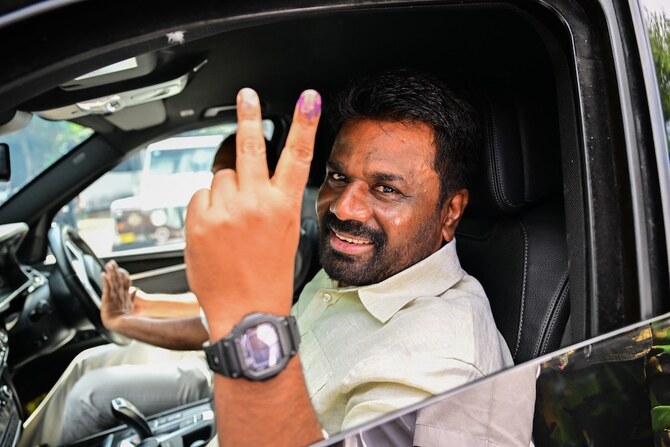
Sri Lankan President Anura Kumara Dissanayake shows his inked finger as he leaves a polling station after casting his ballot to vote in Sri Lanka's parliamentary election in Colombo on Nov. 14, 2024. (AFP)
2 / 3
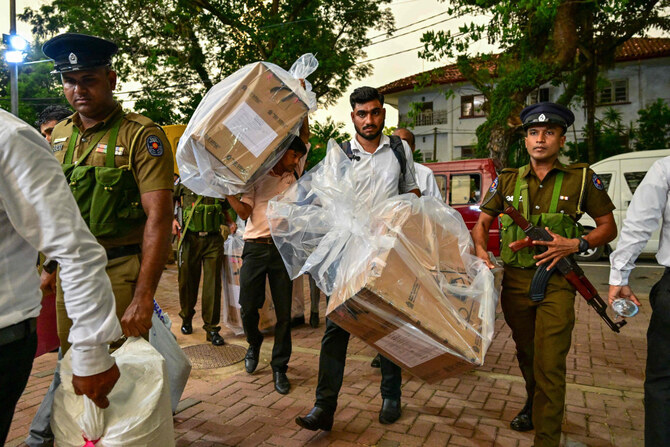
Election officials and security personnel transport sealed ballot boxes to a counting center at the end of voting in Sri Lanka's legislative elections in Colombo on Nov. 14, 2024.(AFP)
3 / 3
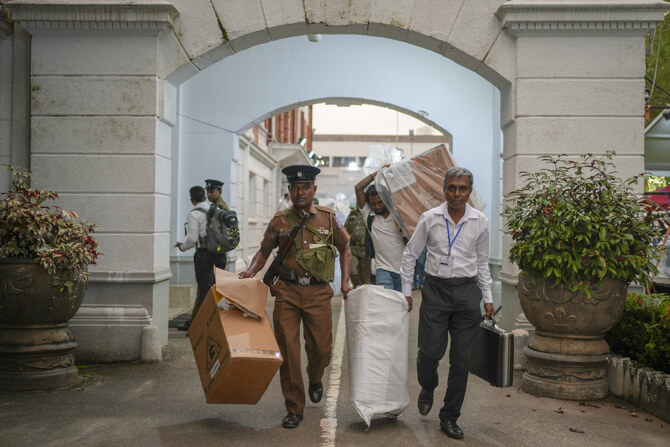
Election workers return to a counting center with a ballot box at the end of the polling in the parliamentary election in Colombo, Sri Lanka, on Nov. 14, 2024. (AP)
Short Url
Updated 15 November 2024
Follow

Sri Lankan president’s leftist coalition secures landslide election win

  • National People’s Power alliance wins 159 seats in the 225-member parliament
  • First time in history, election is won by representatives of Sri Lanka’s poor

COLOMBO: The coalition of Sri Lanka’s new President Anura Kumara Dissanayake won a landslide victory in a snap parliamentary vote, results from the election body showed on Friday, giving the left-leaning leader a mandate to fight poverty and corruption in the crisis-hit island nation.

Dissanayake’s alliance, the National People’s Power, secured 159 seats in the 225-member assembly, according to the results released by the Election Commission.

The United People’s Power of Sajith Premadasa retained its role from the previous parliament as the largest opposition party, winning 40 seats.

When Dissanayake won the presidential vote in September, he had only three members of his party in parliament, which limited his ability to realize his campaign promises.

To boost the NPP’s representation — as government ministers can be appointed only from among lawmakers — he dissolved the parliament and cleared the way for the polls that took place on Thursday, a year ahead of schedule.

While ahead of the poll, the president expressed optimism that the 42 percent of the vote he received in the presidential election showed the NPP was “a winning party,” the landslide win came with a surprise.

“It’s a historic election,” Lakshman Gunasekara, a political analyst in Colombo, told Arab News. “The result has gone far beyond the expectations of analysts ... I did not expect them to win a total majority, but they have done so.”

Dissanayake and his coalition took over control of Sri Lanka as the nation continued to reel from the 2022 economic crisis — its worst since independence in 1948. The austerity measures imposed by his predecessor, Ranil Wickremesinghe — part of a bailout deal with the International Monetary Fund — led to price hikes in food and fuel and caused hardship to millions of Sri Lankans.

Dissanayake said during his campaign that he planned to renegotiate the targets set in the IMF deal, as it placed too much burden on the ordinary people.

More than half of former lawmakers chose not to run for re-election. No contenders were seen from the powerful Rajapaksa family, including former president Mahinda Rajapaksa and his brother, also former president, Gotabaya — who was ousted in 2022 and largely blamed for the crisis.

Sri Lanka People’s Front, the party loyal to the Rajapaksa family, secured only three seats in the new parliament.

Sri Lankans decided to choose the NPP, a movement that until now would never win more than 4 percent, as there was a general “anti-incumbency kind of mood, but also tiredness among the voters of the same old parties alternating and doing political mismanagement, whipping up ethnic chauvinism, encouraging attacks on minorities to cover up for their own corruption,” Gunasekara said.

He explained that even more voted for the NPP than for Dissanayake in the presidential vote, as during slightly over one month of his and his three-member cabinet’s rule, they “realized that this new leadership is very fresh in their style of governance, very collective ... not personality-oriented, and also did not resort to violence or bullying or thuggery.”

Both Dissanayake and most of his party members come from the poorest segments of Sri Lankan society.

“He’s a son of a farmer, benefited from free education ... He’s an educated person, but coming from the lowest classes, not from the urban elite, not the urban middle class, the Westernized people, fashionable people, not at all,” Gunasekara said.

“It will be a new entrant into the South Asian political arena ... For the first time, we have subalterns who have arrived in power. And they have arrived with a huge majority.”


World welcomes 2026 with fireworks after year of turmoil

Updated 01 January 2026
Follow

World welcomes 2026 with fireworks after year of turmoil

  • Australia holds defiant celebrations after its worst mass shooting in nearly 30 years
  • Hong Kong holds a subdued event after a deadly fire in tower blocks

PARIS, France: People around the globe toasted the end of 2025 on Wednesday, bidding farewell to one of the hottest years on record, packed with Trump tariffs, a Gaza truce and vain hopes for peace in Ukraine.
Russian President Vladimir Putin used his traditional New Year address to tell his compatriots their military “heroes” would deliver victory in Europe’s deadliest conflict since World War II, while his Ukrainian counterpart Volodymyr Zelensky said his country was “10 percent” away from a deal to end the fighting.
Earlier, New Year celebrations took on a somber tone in Sydney as revellers held a minute of silence for victims of the Bondi Beach shooting before nine tons of fireworks lit up the harbor city at the stroke of midnight.
Seeing in the New Year in Moscow, Natalia Spirina, a pensioner from the central city of Ulyanovsk, said that in 2026 she hoped for “our military operation to end as soon as possible, for the guys to come home and for peace and stability to finally be established in Russia.”
Over the border in Vyshgorod, Ukrainian beauty salon manager Daria Lushchyk said the war had made her work “hell” — but that her clients were still coming regardless.
“Nothing can stop our Ukrainian girls from coming in and getting themselves glam,” Lushchyk said.
Back in Sydney, heavily armed police patrolled among hundreds of thousands of people lining the shore barely two weeks after a father and son allegedly opened fire on a Jewish festival at Bondi Beach, killing 15 people in Australia’s deadliest mass shooting for almost 30 years.
Parties paused for a minute of silence an hour before midnight, with the famed Sydney Harbor Bridge bathed in white light to symbolize peace.
Pacific nations including Kiribati and New Zealand were the first to see in 2026, with Seoul and Tokyo following Sydney in celebrations that will stretch to glitzy New York via Scotland’s Hogmanay festival.
More than two million people are expected to pack Rio de Janeiro’s Copacabana Beach for what authorities have called the world’s biggest New Year’s Eve party.
In Hong Kong, a major New Year fireworks display planned for Victoria Harbor was canceled in homage to 161 people killed in a fire in November that engulfed several apartment blocks.

Truce and tariffs 

This year has brought a mix of stress and excitement for many, war for others still — and offbeat trends, with Labubu dolls becoming a worldwide craze.
Thieves plundered the Louvre in a daring heist, and K-pop heartthrobs BTS made their long-awaited return.
The world lost pioneering zoologist Jane Goodall, the Vatican chose a new, American, pope and the assassination of right-wing activist Charlie Kirk laid bare America’s deep political divisions.
Donald Trump returned as US president in January, launching a tariff blitz that sent global markets into meltdown.
Trump used his Truth Social platform to lash out at his sliding approval ratings ahead of midterm elections to be held in November.
“Isn’t it nice to have a STRONG BORDER, No Inflation, a powerful Military, and great Economy??? Happy New Year!” he wrote.
After two years of war that left much of the Gaza Strip in ruins, US pressure helped land a fragile ceasefire between Israel and Hamas in October — though both sides have accused each other of flagrant violations.
“We bid farewell to 2025 with deep sorrow and grief,” said Gaza City resident Shireen Al-Kayali. “We lost a lot of people and our possessions. We lived a difficult and harsh life, displaced from one city to another, under bombardment and in terror.”
In contrast, there was optimism despite abiding internal challenges in Syria, where residents of the capital Damascus celebrated a full year since the fall of Bashar Assad.
“There is no fear, the people are happy, all of Syria is one and united, and God willing ... it will be a good year for the people and the wise leadership,” marketing manager Sahar Al-Said, 33, told AFP against a backdrop of ringing bells near Damascus’s Bab Touma neighborhood.
“I hope, God willing, that we will love each other. Loving each other is enough,” said Bashar Al-Qaderi, 28.

Sports, space and AI

In Dubai, thousands of revellers queued for up to nine hours for a spectacular fireworks and laser display at the Burj Khalifa, the world’s tallest building.
After a build-up featuring jet skis and floating pianos on an adjacent lake, a 10-minute burst of pyrotechnics and LED effects lit up the needle-shaped, 828-meter tall (2,717-feet) tower.
The coming 12 months promise to be full of sports, space and questions over artificial intelligence.
NASA’s Artemis II mission, backed by tech titan Elon Musk, will launch a crewed spacecraft to circle the moon during a 10-day flight, more than 50 years since the last Apollo lunar mission.
After years of unbridled enthusiasm, AI is facing scrutiny and nervous investors are questioning whether the boom might now resemble a market bubble.
Athletes will gather in Italy in February for the Milano Cortina Winter Olympics.
And for a few weeks in June and July, 48 nations will compete in the biggest football World Cup in history in the United States, Mexico and Canada.