

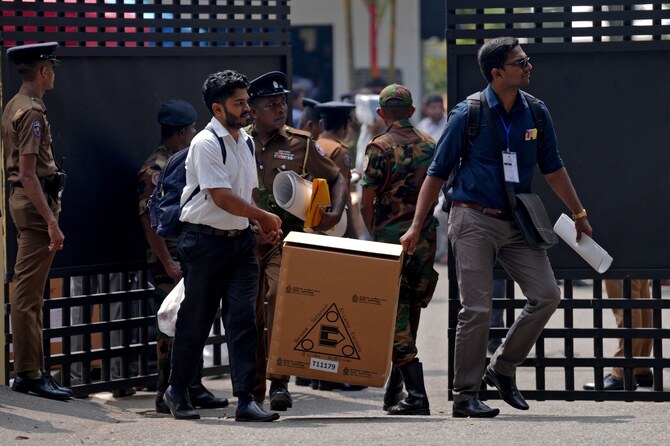

COLOMBO: Sri Lanka is set to choose a new parliament on Thursday in a vote expected to bring new faces to the political stage amid widespread dissatisfaction with established political parties following the island nation’s worst-ever economic crisis.
The election was announced in late September, days after the country’s new leader, Anura Kumara Dissanayake, won the presidential vote and appointed his three-member government.
Sri Lankan ministers are appointed from among members of parliament, in which Dissanayake’s left-leaning National People’s Power coalition had only three seats, limiting his ability to realize his campaign promises.
To boost the NPP’s representation, the president dissolved the parliament and cleared the way for the polls a year ahead of schedule.
During a campaign rally on Sunday, he expressed optimism that the 42 percent of the vote he received in the presidential election showed the NPP was “a winning party” which would also translate to a parliamentary victory.
To push through his promised reforms to address corruption, maladministration and the fragile economic situation, Dissanayake needs a two-thirds parliamentary majority. While the 55-year-old leader’s party has never won more than 4 percent, success this time seems likely.
“I would expect at least a simple majority which would be a working majority,” Lakshman Gunasekara, a political analyst in Colombo, told Arab News. “One thing many analysts are arguing is that it is better for the NPP not to have an absolute majority and to be compelled to rely on other parties as well, in order to ensure greater political consensus in governance.”
Dissanayake took over Sri Lanka’s top job as the nation continued to reel from the 2022 economic crisis. The austerity measures imposed by his predecessor, Ranil Wickremesinghe, part of a bailout deal with the International Monetary Fund, led to price hikes in food and fuel and caused hardship to millions of Sri Lankans.
During his presidential campaign, Dissanayake said he planned to renegotiate the targets set in the IMF deal, as it placed too much burden on the ordinary people.
“That is the number one motivator in this current election. The economic difficulties ... The elite don’t feel it so much but the masses, nearly one-third of people, are known to be losing at least one meal a day,” Gunasekara said.
“And the next issue is ... the injection of fresh people into the governance system — in parliament and also in the presidency.”
More than half of former lawmakers chose not to run for re-election. No contenders were seen from the powerful Rajapaksa family, including former president Mahinda Rajapaksa and his brother, also former president, Gotabaya — who was ousted in 2022 and largely blamed for the crisis.
Dissanayake is an outsider to the political dynasties that have dominated Sri Lankan politics for decades.
“We have already a completely new person as the president, coming from a social class never before represented in the presidency level — the rural poor,” Gunasekara said.
“The people want new people in parliament as well ... I think two-thirds of the previous parliamentarians are not contesting.”
Prof. Prathiba Mahanamahewa, lawyer and rector of the University of Colombo, said Sri Lankans — 17 million of whom are expected to vote on Thursday — were “frustrated with the old faces” and this would be reflected in their voting preferences.
The injection of new ones, however, is likely to delay the parliament’s work for some time.
“We have to give one year for the new parliament to study the standing orders, to study the laws, to study the bills,” said Mahanamahewa. “I believe in all the parties, new people will come.”


