



Ancient organic farming practices in Taif feed growing industry

1 / 3
Since tim immemorial, farmers in Taif's mountain villages had been practicing a closed-loop system in which animal and plant waste is recycled into natural fertilizers. (SPA)
2 / 3
Since tim immemorial, farmers in Taif's mountain villages had been practicing a closed-loop system in which animal and plant waste is recycled into natural fertilizers. (SPA)
3 / 3
Since tim immemorial, farmers in Taif's mountain villages had been practicing a closed-loop system in which animal and plant waste is recycled into natural fertilizers. (SPA)
Short Url
Updated 15 November 2024
Follow

Ancient organic farming practices in Taif feed growing industry

  • Closed-loop farming supports environment
  • Rising Saudi demand for organic products

RIYADH: Organic farming in Taif province’s villages and its serene mountain and valley farms represents a continuation of an ancient tradition.

This approach avoids synthetic fertilizers and pesticides, ensuring that farms do not damage their surrounding environment, according to the Saudi Press Agency.

Inherited organic farming wisdom from previous generations boosts the health of consumers and the vitality of soil, water, plants, and wildlife.

The farming methods practiced in Taif involve a closed-loop system in which animal and plant waste is recycled into natural fertilizers.
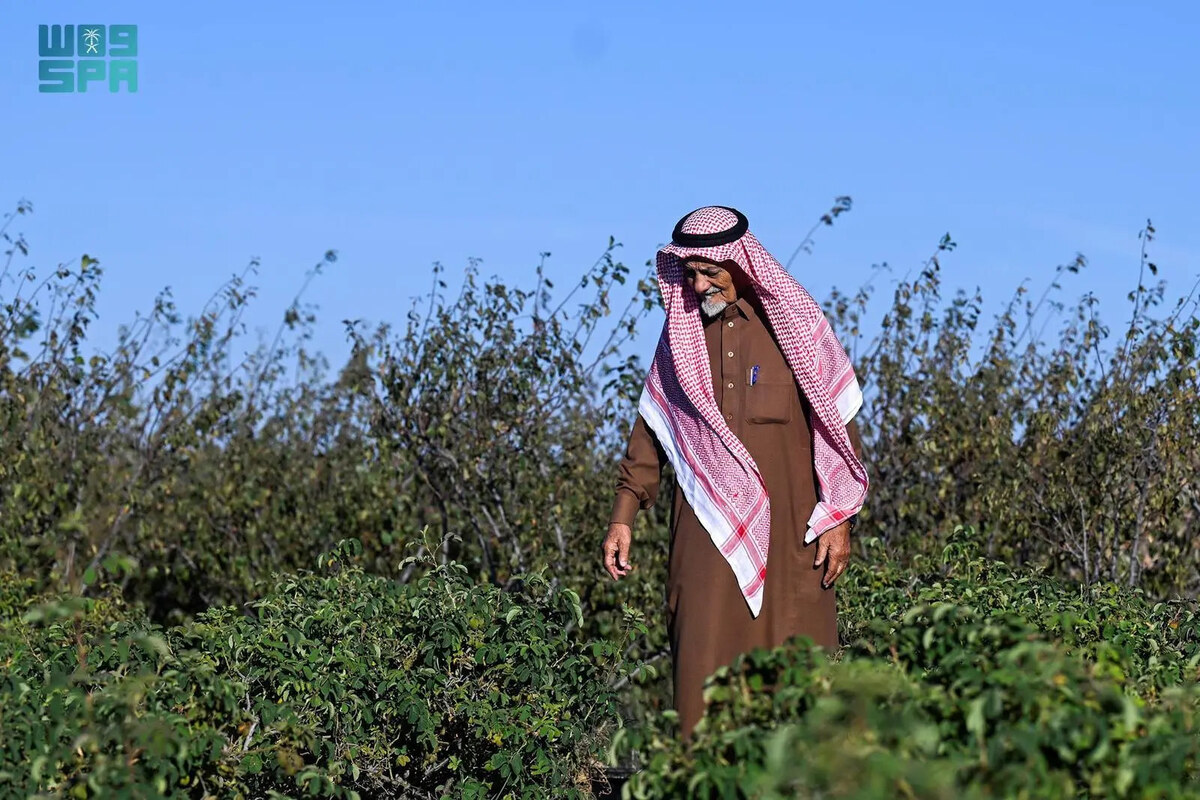


Abdullah Saed Al-Talhi, an 80-year-old Saudi farmer, has been farming in terraced fields in Taif's in the Al-Shafa mountains since he was young. (SPA)

This approach supports crop cultivation and animal husbandry, aligning with Saudi Arabia’s Vision 2030’s food security and sustainability objectives.

Drawing upon his years of experience tending terraced fields in the Al-Shafa mountains, 80-year-old farmer Abdullah Saed Al-Talhi told the SPA that organic agriculture is a fast-growing industry.

“Consumer demand for nutritious organic products is reshaping our industry,” he explained.

“Working these mountain terraces has taught me that organic farming is more than a cultivation method — it is our legacy to future generations, ensuring sustainable food production for years to come.”

“Organic farming operates through two distinct approaches,” Al-Talhi said. “We have protected greenhouse cultivation and open-field farming, but both share the same fundamental principle: producing pure food without chemical interventions.”

He emphasized that this natural approach encompasses every aspect of farming — from soil enhancement and seed selection to pest control methods.

“The Ministry of Environment, Water and Agriculture has spearheaded remarkable efforts to advance organic farming in Taif,” he added.

The ministry offers instructional programs to budding organic farmers, supporting the establishment of new farms, increased production from existing farms, and the import and export of organic products.

Other support from the ministry includes securing certification to ensure the credibility of products in Saudi and international markets.

Speaking at a recent organic market event in Taif, Al-Talhi said: “The market for organic products is experiencing remarkable growth.”


Saudi watchdog warns of possible health risk from Nestle baby formula

Updated 8 min 51 sec ago
Follow

Saudi watchdog warns of possible health risk from Nestle baby formula

  • Company voluntarily recalls its Nan, Alfamino, S-26 Gold and S-26 Ultima products over concerns they might be contaminated with cereulide, a toxin produced by bacteria
  • Saudi Food and Drug Authority says recall is precautionary and no related illnesses have been reported, but advises consumers to dispose of recalled products immediately

RIYADH: The Saudi Food and Drug Authority on Tuesday warned the public not to consume certain Nestle infant formula products, after the company issued a voluntary recall over concerns about possible contamination.

The advisory covers products marketed under the Nan, Alfamino, S-26 Gold and S-26 Ultima brands. They might be contaminated with cereulide, a toxin produced by the Bacillus cereus bacteria, which can pose a risk to infant health, the Saudi Press Agency reported.

The Saudi authority said the recall was a precautionary measure and no related illnesses have been reported. Possible symptoms of exposure can include nausea, repeated vomiting and abdominal pain.

It advised consumers to dispose of the recalled products immediately, and said it was coordinating with Nestle to ensure they are removed from stores and is monitoring the process.

Full details of the affected products, including batch numbers, are available at the Saudi Food and Drug Authority website. The organization said consumers can report any food safety concerns by calling 19999.