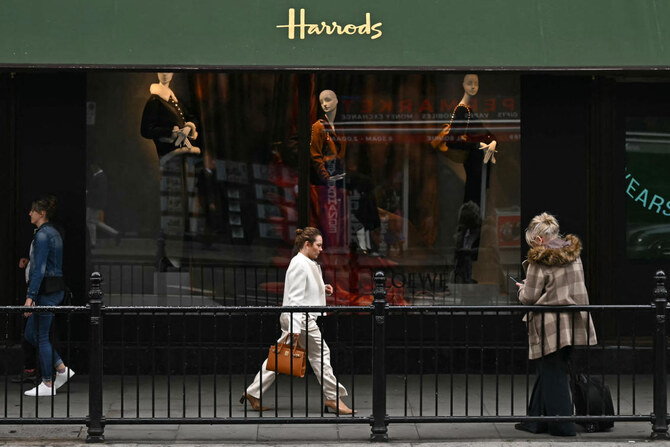
Brother of late Harrods owner Mohamed Al-Fayed also accused of sexual violence: BBC

Justice for Harrods Survivors group said it had received more than 420 inquiries, mainly related to the store but also regarding Fulham Football Club, the Ritz Hotel in Paris and other Fayed entities. (File/AFP)
Short Url
Updated 14 November 2024
Follow

Brother of late Harrods owner Mohamed Al-Fayed also accused of sexual violence: BBC

  • Three women say the late Salah Fayed assaulted them during the period when he jointly owned the department store with his brother, the broadcaster said

LONDON: Three women formerly employed by Harrods have accused the brother of its late boss Mohamed Al-Fayed of sexual violence, following hundreds of similar claims against the former owner of the luxury London store, the BBC reported Thursday.
They say the late Salah Fayed assaulted them during the period when he jointly owned the department store with his brother, the broadcaster said.
The women alleged they were abused in London, the south of France and Monaco between 1989 and 1997.
The report follows a slew of claims in recent weeks by hundreds of women against the Egyptian former Harrods and Fulham Football Club owner Mohamed Al-Fayed of sexual assault including rape.
Salah Fayed died in 2010 and Mohamed Al-Fayed died last year aged 94.
One of the three women behind the most recent accusations, named Helen, who waived her right to anonymity, told the BBC that she had been working for the retailer for two years when Mohamed Al-Fayed raped her in 1989 during a business trip in Dubai.
He then offered her a personal assistant job with his brother Salah, who she said went on to drug her and rape her while she was unconscious.
Mohamed Al-Fayed “shared me with his brother,” she said.
She said she had stayed silent about the experience, having signed a non-disclosure agreement, a document the BBC reported having seen.
The second woman said Salah Fayed abused her during a trip to Monaco, while the third woman, who was hired at the age of 19 in 1997, said she was sexually assaulted in his Monaco apartment.
Contacted by AFP, Harrods said it “supports the bravery of these women in coming forward” and encourages survivors “to come forward and make their claims” to the company, which is offering compensation and counselling support.
“We also hope that they are looking at every appropriate avenue to them in their pursuit of justice, whether that be Harrods, the police or the Fayed family and estate,” the company said.
On Tuesday, the New York Times published the claims of a victim accusing another brother of Mohamed Al-Fayed, Ali, aged 80, of knowing about the “trafficking” of women.
Allegations have mounted since the airing of a BBC documentary in September that detailed multiple claims of rape and sexual assault by Mohamed Al-Fayed.
The Justice for Harrods Survivors group said it had received more than 420 inquiries, mainly related to the store but also regarding Fulham Football Club, the Ritz Hotel in Paris and other Fayed entities.
London’s Metropolitan Police said earlier this month that it was “actively reviewing 21 allegations reported to the Metropolitan Police prior to Mohamed Al-Fayed’s passing... to determine if any additional investigative steps are available or there are things we could have done better.”


In Bangladesh’s mangrove forest, villagers brave tigers to collect rare honey

Updated 4 sec ago
Follow

In Bangladesh’s mangrove forest, villagers brave tigers to collect rare honey

  • Honey is gathered from wild bee colonies deep in the Sundarbans
  • Producers made a debut at the biggest food fair in Jeddah this month


Dhaka

When the harvest begins, Mizanur Rahman gathers a few hundred men and sets out into the mangrove forest along the Bay of Bengal, where for months they climb trees to collect by hand a wild natural honey whose unique properties are only starting to attract global attention.

The honey is collected from wild bee colonies deep within the Sundarbans, the world’s largest mangrove reserve spanning parts of India and southwestern Bangladesh.

“Honey collection from this forest is mostly done in the Bangladesh part,” Rahman said. “All plants, trees, and the overall environment of this forest are natural. There is no human touch.”

Sundarban honey comes from an ecosystem where trees grow and bloom naturally, without the use of fertilizers or pesticides. Its collectors, known as mawalis, begin work in March for about three and a half months.

Rahman estimates there are about 4,000 mawalis in the local community. To enter the forest, they require special passes from the forest department.

“It’s a very risky job for the people who enter the forest,” he told Arab News. “It’s the only honey in the world where collectors risk their lives in the den of the mighty Bengal tiger to gather it. Sometimes, they also face the danger of poisonous snake bites.”

During the season, his team reaches up to 1,200 members who together manage to collect about 400 tons of honey.

“One hundred small boats start sailing together, each carrying eight to 10 people,” Rahman said. “Despite the dangers, it is a matter of pride to be part of these challenging tasks.”

Collected from a humid environment, Sundarban honey is thinner than other types. Its greenish-amber shade comes from the nectar of mangrove flowers, and the taste is less sweet than most commercial honeys, with a subtle citrus-like tanginess. The scent is mild.

Being raw and unprocessed, the honey retains more enzymes, antioxidants, and pollen.

“Some people can feel acidity similar to orange juice,” Rahman said. “It has a unique taste. If someone tastes this honey once, she or he will definitely love to taste it again and again.”

Well known locally in Bangladesh and parts of eastern India, where it has been harvested and consumed for generations, Sundarban honey is only starting to gain attention in organic and specialty food markets.

Earlier this month, it debuted at AgroFood Jeddah, Saudi Arabia’s leading international exhibition for the agriculture, food, and agritech industries.

The organic honey from the Sundarbans received an encouraging reception, according to Mohammed Saleh Uddin Bhuyan, chief category officer at Ghorer Bazar, one of the companies participating in the expo.

“We have been receiving good responses from the local buyers,” he said. “Saudi Arabia is a very promising market for us.”

Bangladeshi authorities recognize the honey’s export potential but also the fact that production still needs to be standardized to enter global markets.

Mahmudul Hasan, director of Bangladesh’s Export Promotion Bureau, told Arab News that there are plans to promote the organic practices behind the honey during future food fairs in the Gulf region.

“There is huge export potential for our mangrove honey in the Gulf countries, as Arab consumers are fond of honey. They just need to be assured of the quality in the production process,” he said.

“Our mangrove honey is undoubtedly an organic product. It has unique value, but the world is not very aware of it yet.”