Pakistani security forces kill eight militants in restive northwest

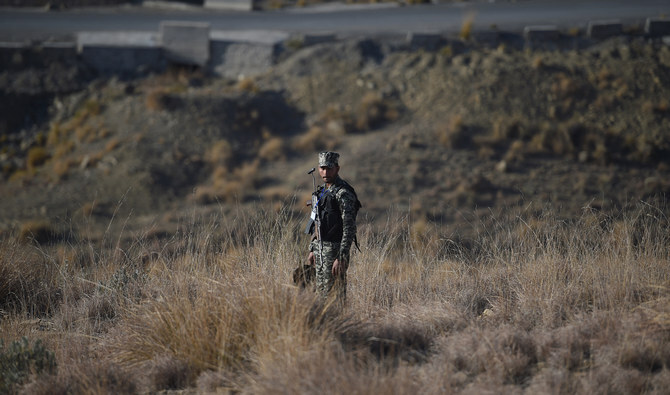
A Pakistani army soldier stands guard near a border terminal in Ghulam Khan, a town in North Waziristan, on the border between Pakistan and Afghanistan, on January 27, 2019. (AFP/File)
Short Url
Updated 14 November 2024
Follow

Pakistani security forces kill eight militants in restive northwest

  • Army says six militants also injured during operation in Miran Shah area of North Waziristan
  • South Asian nation blames surge in militancy on TTP fighters operating out of Afghanistan

ISLAMABAD: Security forces killed eight militants while six others sustained injuries during an intelligence-based operation in Pakistan’s restive northwestern Khyber Pakhtunkhwa province, the military’s media wing said on Wednesday.
According to Inter-Services Public Relations (ISPR), the operation was conducted in the Miran Shah area of North Waziristan district.
Khyber Pakhtunkhwa, which borders Afghanistan, has witnessed several attacks by Tehreek-e-Taliban Pakistan (TTP) militants who have targeted security forces’ convoys and check posts, besides killing and kidnapping officials and civilians in recent months.
“Security forces conducted an intelligence-based operation in general area Miran Shah, North Waziristan District on the reported presence of khwarij [militants],” the ISPR said.
“During the conduct of the operation, own troops effectively engaged khwarij’s location, as a result of which, eight khwarij were sent to hell, while six khwarij got injured.”
A “sanitization operation” was also conducted in the area to eliminate any other militants, it added.
Earlier this month on Nov. 10, Pakistani security forces killed four militants in two separate encounters in Khyber Pakhtunkhwa. Prior to that, four Pakistani soldiers and five militants lost their lives in a gunbattle in South Waziristan’s Karama area.
The TTP leadership is said to be based in neighboring Afghanistan, affecting the ties between Kabul and Islamabad since the Pakistani officials have accused the Afghan Taliban of “facilitating” cross-border militant attacks.
Afghanistan denies the allegation and has urged Pakistan to resolve its security challenges internally.



Pakistan PM approves framework for National Energy Plan aimed at cutting power costs

Updated 4 sec ago
Follow

Pakistan PM approves framework for National Energy Plan aimed at cutting power costs

  • Electricity costs in Pakistan have been a major concern for both industries and domestic consumers
  • PM Shehbaz Sharif instructs authorities to expedite privatization of power distribution companies

ISLAMABAD: Prime Minister Shehbaz Sharif on Wednesday approved the framework for a National Energy Plan aimed at ensuring low electricity costs for industries and facilitating domestic consumers, Pakistani state broadcaster reported. 

The development took place during a meeting of the Cabinet Committee on Energy in Islamabad presided over by Sharif. The Pakistani prime minister directed all ministries and provincial governments to present a “workable and coordinated” strategy under the proposed plan.

Electricity costs in Pakistan have been a major concern for both industries and domestic consumers. Industrial users often face high tariffs that increase production cost while residential consumers struggle with rising bills that impact household budgets. 

“Prime Minister Shehbaz Sharif has given in-principle approval for the formulation of a comprehensive National Energy Plan in consultation with relevant ministries and provincial governments,” Radio Pakistan said in a report.

“He emphasized that the government’s top priorities include ensuring electricity supply to industries at the lowest possible cost and providing facilitation for domestic consumers.”

Sharif also approved the establishment of a dedicated secretariat for the National Energy Plan and gave approval to the framework guidelines for auctioning wheeling charges, it added.

Wheeling charges are fees paid for using another company’s power grid to transmit electricity from a generator to a consumer, covering the cost of transporting electricity over someone else’s network.

The report said Sharif instructed authorities to include the recommendations of the climate change, finance, industries and petroleum ministries into the plan. 

Sharif also gave instructions to expedite the privatization of power distribution companies (DISCOs) and urged competitive tariffs for industries to boost production capacity.

Fluctuations in fuel prices, inefficiencies in the power sector, and reliance on imported energy have contributed to high electricity costs in Pakistan in recent years, making energy affordability and stability a key focus for government policies and reforms.

Pakistan has pushed energy sector reforms to tackle long-standing issues like circular debt, power theft, and transmission losses, which have caused blackouts and high electricity costs. 

In February, Pakistan developed a new energy policy that it says will help the country attract $5 billion in investment through public-private partnerships.