

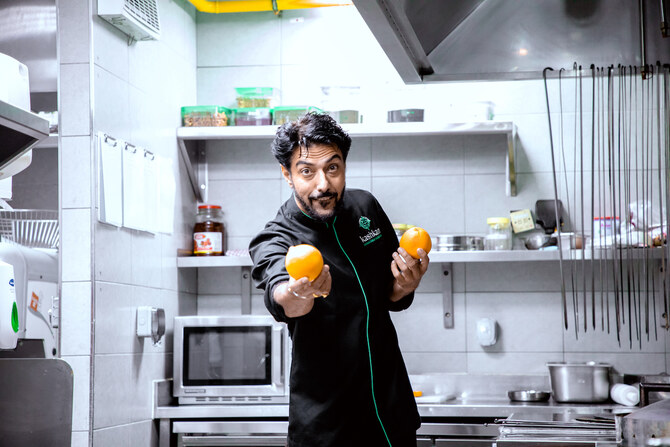

DUBAI: Celebrity chef, painter and actor Ranveer Brar was born in Lucknow, northern India, and fell in love with cooking at a very young age. While accompanying his grandfather to the local gurudwara (Sikh place of worship), he remembers sneaking into the community kitchen — known as a langar — excited by all the activity there.
“A few years later, when I was a pre-teen, the priest called me aside and asked me to prepare the rice dish, as his wife was unwell that day. I had no list of ingredients, nor the recipe, but, recalling what I’d observed, I prepared the dish and it turned out quite well. That was my first experience of instant gratification with food,” Brar tells Arab News. “After my debut at the gurudwara, my next attempt at cooking was when my mother fell ill and I made rajma — again, without any recipe, I just made it from my memory of watching my mother make it. I overheard my dad complimenting the attempt and, at that moment, I realized that food was my calling.”
Brar opened his first restaurant in the Gulf in Dubai late last year.

Brar opened his first restaurant in the Gulf in Dubai late last year. (Supplied)
“Kashkan means ‘From Kashmir to Kanyakumari,’” he says. “The UAE, and Dubai in particular, seemed like the perfect venue because it is a melting pot of both cultures and cuisines, so what better place to celebrate Kashkan’s melange of flavours?”
Here, Brar discusses his favorite ingredient, the toughest dish to perfect, and advice for amateurs.
When you started out, what was the most common mistake you made?
Trying to do too much and over-express myself. As a result, I was losing myself — the idea I was trying to express was getting lost. With age I understood that not everything one knows needs to be expressed in a single dish. Wisdom lies in choosing the right moment for the right expression.
What’s your top tip for amateurs?
Stick to the basics. If you get the fundamentals right, you can rarely go wrong with cooking. They can then become the basis for innovation as one evolves.
What one ingredient can instantly improve any dish?
That would be coriander for me, adding a lot of freshness. From the stalks to the leaves, every element of the herb is fascinating. Also olive oil, which adds richness.
When you go out to eat, do you find yourself critiquing the food?
I don’t really. I view food as food. The reason I am who I am is because food has always made me happy, so I don’t want to take that role away from food in my life. When eating out, I try to feel, understand and appreciate the intent of the person who’s cooking. But when it’s my cooking, I tend to be quite harsh and critical of myself, because every time you cook, it’s an opportunity to improve yourself.
What’s your favorite cuisine?
It’s usually the local food of the place I am travelling to. Also, the simpler the restaurant, the more likely I am to end up there. I believe the essence of good food is its simplicity. What better than street food and age-old places to understand the true culture and cuisine of any place?

(Supplied)
What’s your go-to dish if you have to cook something quickly at home?
Has to be khichdi. It’s the perfect one-pot meal that has everything your appetite needs. Add in vegetables and you get a good proportion of all nutrients on your plate. And don’t forget the ghee!
What customer request most annoys you?
Strangely, it’s when they ask for salt! Salt is such an important element of any dish. A little too much salt can subdue other flavors and too little can fail to elevate them. I feel it’s the chef’s judgment of the amount of salt that allows us to experience the dish as intended. So when customers ask for salt it disappoints me, because the true nature of the dish might get spoiled.
What’s your favorite dish to cook and why?
My special chicken curry. Be it family or friends, I always get asked for that. It’s now a signature dish at Kashkan too.
What’s the most difficult dish for you to get right?
Biryani is something I would love to keep perfecting. You have to cook many layers of rice at the same time, giving it minimum water, minimum heat over a long period of time, with every grain of rice being the same, every layer of flavor equally coating the rice. I think biryani is the perfect test for anyone who is a student of Salt-Fat-Acid-Heat.
As a head chef, what are you like? Are you a disciplinarian? Or are you more laid back?
I used to be a disciplinarian believing that cooking was all about control; the heat, environment, ingredients and cooking itself. Now I’m more relaxed; it’s more collaborative, it’s more about letting the team express themselves and my role is to guide them through that expression.
RECIPE: SAAG MEAT

(Supplied)
Preparation time: 10 minutes
Cooking time: 35-40 minutes
Serves 2-4
INGREDIENTS:
For the marination:
4 medium Onions, sliced
¼ cup fresh Fenugreek leaves
¾ cup Curd, beaten
Salt to taste
½ tsp Turmeric powder
½ tsp Degi red chili powder
½ tsp Coriander powder
1 kg Mutton (with bones)
½ tbsp Ginger Garlic paste
For the mutton:
3-4 tbsp Oil
3 Bay leaf
2 Black cardamom
2 Cloves
¼ tsp Cumin seeds
Marinated Mutton
Salt to taste
few fresh Fenugreek leaves
Little water
For the saag meat:
1 tbsp Oil
1 tbsp Ghee
1 inch Ginger (peeled & chopped)
4-5 Garlic cloves, chopped
2 medium Onions, chopped
2-3 Green chillies
2 Dry red chillies
2-3 medium bunch fresh Spinach leaves, chopped
¼ cup Amaranth (Bathua)
Salt to taste
Little water
1 tbsp Butter, cubed
Pressure Cooked Mutton
½ tbsp unsalted Butter or white butter, cubed (optional)
½ tsp Mustard oil
For garnish:
Coriander sprig
INSTRUCTIONS
For marination:
In a bowl, add onions, fresh fenugreek leaves, curd, salt to taste, turmeric powder, deg red chili powder, coriander powder, mutton, ginger garlic paste and mix it well.
Keep it aside for further use.
For the mutton:
In a pressure cooker, add oil, once it's hot, add bay leaf, black cardamom, cloves, cumin seeds and let it splutter.
Add marinated mutton and saute it for 6-7 minutes. Add salt to taste and cook for a while.
Add a few fenugreek leaves and mix well. Add water, close the lid and cook it for 5-6 whistles or until the mutton is tender.
Keep it aside for further use.
For the saag meat:
In a kadai (Indian wok), add oil, ghee, once it's hot, ginger, garlic, onion, green chillies and saute for a minute.
Add dry red chillies and saute well. Add spinach, amaranth leaves, salt to taste, water and saute well.
Add butter, close the lid and cook it for 3-4 minutes.
Add cooked mutton and let it simmer for a while.
To finish, add unsalted butter or white butter, mustard oil and stir it well.
Transfer it to a serving dish and garnish it with coriander sprig.
Serve hot with roti.


