

PM launches prevention program as over 33 million Pakistanis found to have diabetes

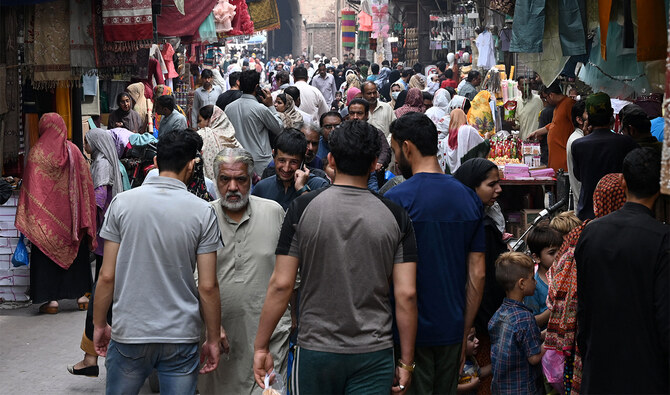
In this picture taken on April 16, 2023, people throng a market area during shopping ahead of the upcoming festival of Eid al-Fitr in Lahore. (AFP/File)
Short Url
Updated 14 November 2024
Follow

PM launches prevention program as over 33 million Pakistanis found to have diabetes

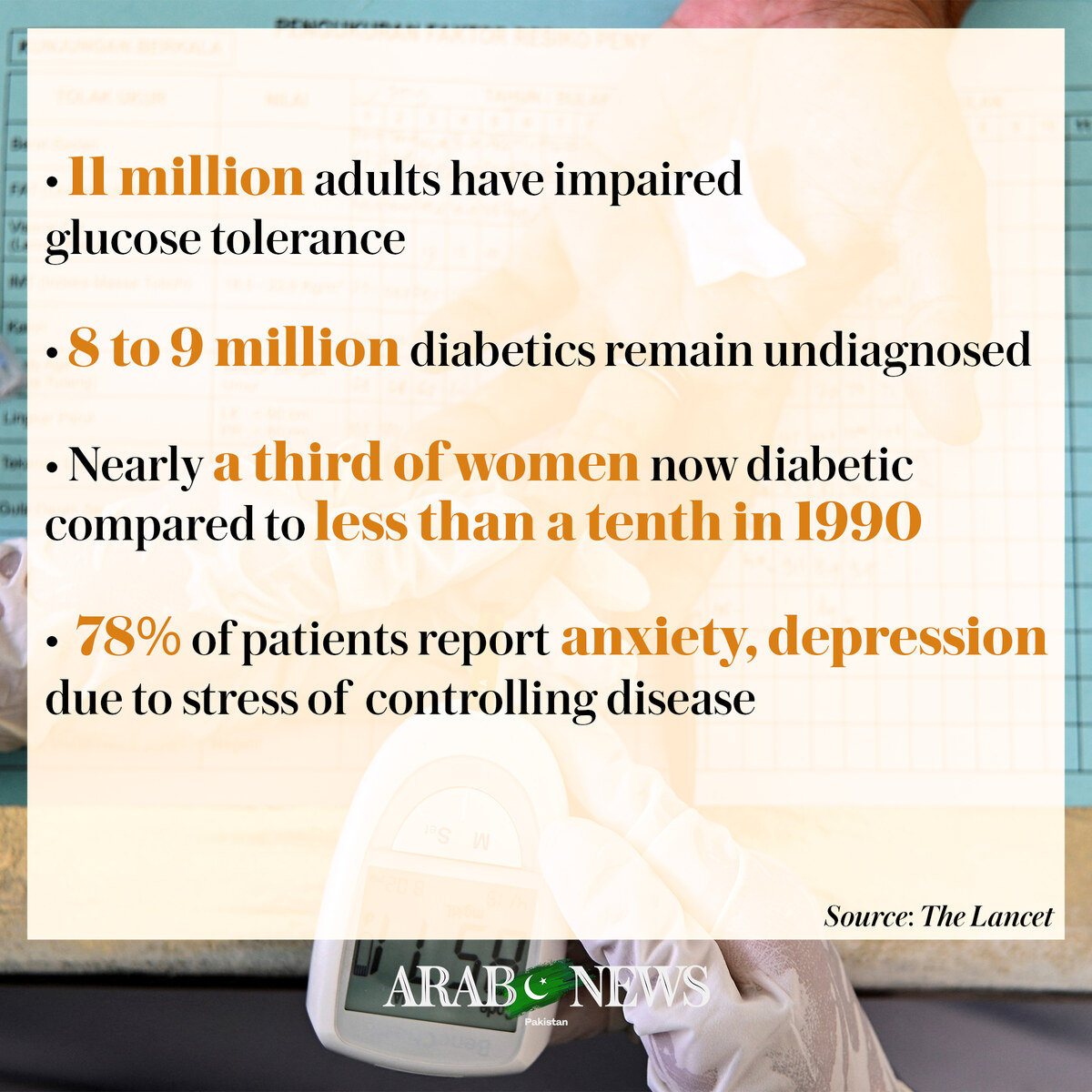
  • Additional 11 million adults in Pakistan have impaired glucose tolerance
  • Pakistan is on the list of countries with the largest diabetic populations

ISLAMABAD: Pakistani Prime Minister Shehbaz Sharif said on Thursday, National Diabetes Day, his government was launching a new program for the control and prevention of diabetes in a country where over 33 million people had the chronic disease. 

According to a new analysis in The Lancet journal released this week, the percentage of adults suffering from diabetes across the world has doubled over the past three decades, with the biggest rises coming in developing countries. 

The serious health condition affected around 14 percent of all adults worldwide in 2022, compared to seven percent in 1990, the Lancet study said. Taking into account the growing global population, the team of researchers estimated that more than 800 million people are now diabetic, compared to less than 200 million in 1990.

“At the Federal level, we will be launching the ‘Prime Minister’s Program for Prevention and Control of Diabetes Mellitus’ under the Ministry of National Health Services, Regulations & Coordination,” Sharif said in a statement. 

“Objective of this program is controlling the disease in federal areas and improving capacities in all provinces for providing universal health coverage, diagnosis, and treatment for diabetic patients, along with raising awareness and behavioral change.”

With 33 million of its citizens having diabetes, Pakistan is on the list of countries with the largest diabetic populations. An additional 11 million adults in Pakistan have impaired glucose tolerance, while approximately 8 to 9 million with diabetes remain undiagnosed. 
“The major risk factors leading to diabetes in Pakistan are environmental and geographical reasons in addition to genetic variants, dietary, as well as inactive lifestyle,” Sharif said. 

“The Government of Pakistan is fully committed in controlling this escalation and delivering wellbeing to diabetic population.”

Diabetes is a chronic disease that occurs either when the pancreas does not produce enough insulin or when the body cannot effectively use the insulin it produces. Insulin is a hormone that regulates blood glucose.

Type 1 diabetes affects patients from a young age and is more difficult to treat because it is caused by an insulin deficiency. Type 2 mainly affects middle-aged or older people who lose their sensitivity to insulin.


At UNSC, Pakistan warns competition for critical minerals could fuel global conflict

Updated 54 min 58 sec ago
Follow

At UNSC, Pakistan warns competition for critical minerals could fuel global conflict

  • The demand for critical minerals has surged worldwide due to rapid expansion of electric vehicles, advanced electronics and clean energy technologies
  • Pakistan’s representative says all partnerships in critical minerals sector must be ‘cooperative and not exploitative’ and respect national ownership

ISLAMABAD: Ambassador Asim Iftikhar Ahmad, Pakistan’s permanent representative to the United Nations (UN), has warned that intensifying global competition over critical minerals could become a new driver of global conflict, urging stronger international cooperation and equitable access to resources vital for the world’s energy transition.

The warning comes as demand for critical minerals and rare earth elements surges worldwide due to the rapid expansion of electric vehicles, advanced electronics and clean energy technologies, with governments and companies increasingly competing to secure supply chains while raising concerns that this may lead to geopolitical rivalries in the coming years.

Speaking at a Security Council briefing on ‘Energy, Critical Minerals, and Security,’ Ahmad said experience showed that the risks of instability increased where mineral wealth intersected with weak governance, entrenched poverty and external interference.

“Access to affordable, reliable and sustainable energy is essential for development, stability and prosperity. The global transition toward renewable energy, electric mobility, battery storage and digital infrastructure has sharply increased the demand for critical minerals,” he said.

“This upsurge has generated new geopolitical and geo-economic pressures. If not managed responsibly, competition over natural resources can affect supply chains, aggravate tensions, undermine sovereignty and contribute to instability.”

In several conflict-affected settings, he noted, illicit extraction, trafficking networks and opaque financial flows have fueled armed conflict and violence, weakened state institutions and deprived populations of legitimate revenues.

“The scramble for natural resources and its linkage to conflict and instability is therefore not new,” Ahmad told UNSC members at the briefing. “Pakistan believes that natural resources must serve as instruments of economic development and shared prosperity, and not coercion or conflict.”

He urged the world to reaffirm the right of peoples to permanent sovereignty over their natural resources, saying all partnerships in the critical minerals sector must be cooperative and not exploitative, respect national ownership, ensure transparent contractual arrangements and align with host countries’ development strategies.

“In order to prevent the exploitation of mineral-producing countries and regions, particularly in fragile and conflict-affected settings, support their capacity-building for strengthening domestic regulatory institutions, combating illicit financial flows, ensuring environmental safeguards, and promoting equitable benefit-sharing with local communities,” he asked member states.

“Promote equitable participation in global value chains. Developing countries must be enabled to move beyond extraction toward processing, refining and downstream manufacturing. Technology transfer, skills development and responsible investment are essential to avoid perpetuating structural imbalances.”