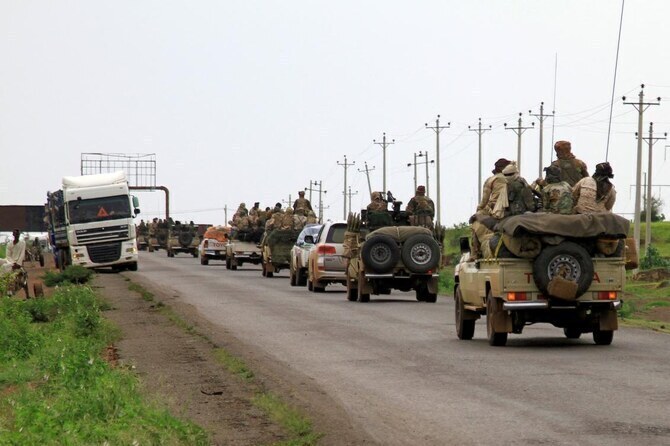
CAIRO: Sudan has seen a surge in extreme violence in recent weeks as the warring military and paramilitary push for a decisive victory, with no political solution in sight.
Fighting between the Sudanese army and the Rapid Support Forces (RSF) has intensified since late October, with reports of attacks on civilians including sexual violence against women and girls raising alarm.
The war that erupted in April 2023 has created what the UN calls the world’s worst displacement crises, with more than 11 million people forced from their homes.
It has put the country on the brink of famine, and sparked warnings of intensifying violence in a war that has already killed tens of thousands.
“Over the last two weeks, the situation in the country has been marked by some of the most extreme violence since the start of the conflict,” according to Rosemary DiCarlo, UN Under-Secretary-General for Political and Peacebuilding Affairs.
“Let me stress that both warring parties bear responsibility for this violence,” she said, adding that both sides “seem convinced they can prevail on the battlefield.”
Since October 20, at least 124 civilians have been killed in central Al-Jazira state and another 135,000 have fled to other states, according to the UN.
With global attention focused on other wars, chiefly in Ukraine and the Middle East, civilians in Sudan are paying a steep price for the escalation.
“All indicators so far show that both sides are committed to military solutions, with no genuine interest in political resolutions or even easing the suffering of civilians,” according to Mohamed Osman of Human Rights Watch.
Amani Al-Taweel, director of the Africa program at the Al-Ahram Center for Political and Strategic Studies in Cairo, agreed.
“There is no political solution on the horizon,” she told AFP, adding that both sides were seeking a “decisive military solution.”
The war in Sudan has pitted army chief Abdel Fattah Al-Burhan against his erstwhile ally Mohamed Hamdan Dagalo, leader of the RSF.
The country is split into zones of control, with the army holding the north and east, and the government based in Port Sudan on the Red Sea coast.
The RSF controls much of the capital Khartoum, the Darfur region in the west and parts of Kordofan in the south, while the center is split.
With no mandatory military conscription, the Sudanese army includes Islamist-leaning forces as well as other factions.
The RSF is primarily made up of tribal militias from Darfur’s Arab communities.
According to local reports, the army has about 120,000 troops while the RSF has 100,000.
On the battlefield, Sudan’s air force gives the military an advantage.
Rights groups have accused both sides of committing atrocities.
The UN population agency published on Tuesday horrific accounts of women and girls fleeing the violence, including one who said she was urged to kill herself with a knife rather than be raped.
Successive rounds of talks have been held in Saudi Arabia, but the negotiations have yet to produce a ceasefire.
In August, the Sudanese military opted out of US-brokered negotiations in Switzerland and an African Union-led mediation has also stalled.
“The deadlock in peaceful channels, whether regionally or internationally, is exacerbating the violence,” said Mahmud Zakaria, a professor of political science at Cairo University’s Faculty of African Postgraduate Studies.
Since October, the RSF escalated its attacks in Al-Jazira state, south of Khartoum, following what the military said was the defection of one of its commanders to the army.
Before the war, Al-Jazira was known as Sudan’s breadbasket, hosting Africa’s largest agricultural project, yielding 65 percent of the country’s cotton, according to Zakaria.
Some areas have been scarred by conflict before.
Darfur saw a major war two decades ago, during which the then-government’s allies in the Janjaweed militia faced accusations of ethnic cleansing and genocide.
With roots in the Janjaweed, the RSF became a force in its own right in 2013.
Sudan’s conflict has increasingly drawn in regional powers, prompting the United States to urge all countries to stop arming rival generals.
Former Egyptian deputy foreign minister for African affairs Ali el-Hefny said progress will require global willpower.


![]()

No end in sight to Sudan war as both sides seek ‘decisive’ win
Short Url
https://arab.news/nqxms
No end in sight to Sudan war as both sides seek ‘decisive’ win
- Rosemary DiCarlo, UN Under-Secretary-General for Political and Peacebuilding Affairs said: “Let me stress that both warring parties bear responsibility for this violence“
- “All indicators so far show that both sides are committed to military solutions, with no genuine interest in political resolutions,” said Mohamed Osman of HRW


Latest updates


© 2026 SAUDI RESEARCH & PUBLISHING COMPANY, All Rights Reserved And subject to Terms of Use Agreement.