

Saudi Arabia, India eye new cooperation areas as FMs meet in Delhi

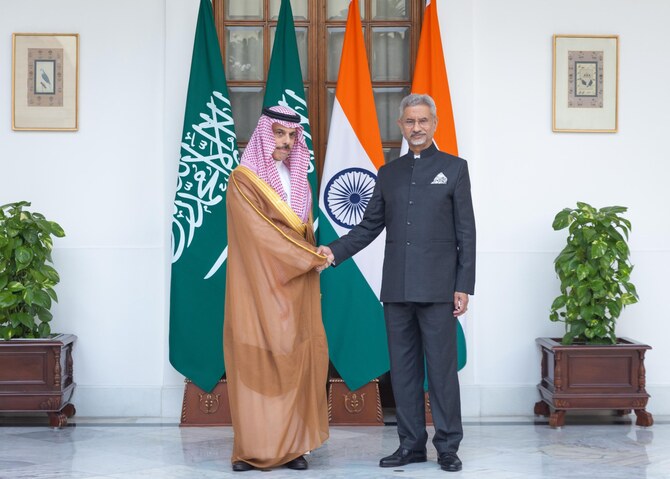
Saudi Foreign Minister Prince Faisal bin Farhan and his Indian counterpart, S. Jaishankar, pose for a photo during their meeting in New Delhi on Nov. 13, 2024. (Saudi Foreign Ministry)
Short Url
Updated 13 November 2024
Follow

Saudi Arabia, India eye new cooperation areas as FMs meet in Delhi

  • Last September, about 50 agreements were signed under Saudi-India Strategic Partnership Council
  • Saudi Vision 2030, India’s Viksit Bharat 2047 are complementary for new partnerships, Jaishankar says

NEW DELHI: Saudi Arabia and India held talks on Wednesday in New Delhi, led by their foreign ministers, aimed at identifying new partnerships.

Saudi Arabia’s Prince Faisal bin Farhan and India’s S. Jaishankar co-chaired the second meeting of the Ministerial Committee on Political, Security, Cultural and Social Affairs, which falls under the Saudi-India Strategic Partnership Council.

Their talks follow the council’s first leaders’ meeting last September, during which Crown Prince Mohammed bin Salman and India’s Prime Minister Narendra Modi presided over the signing of about 50 initial pacts.

They had also agreed to form a joint task force to enable a $100 billion Saudi investment in India.

In a livestreamed video of his opening remarks, Prince Faisal said: “The inaugural meeting of the Saudi-India Strategic Partnership Council … has set the stage for a new era of cooperation across various fields and we look forward to further enhancing the council’s capabilities and efficiency in achieving our shared objectives.”

He added: “We are confident that advancing cooperation serves our mutual interests as well as benefits the region more broadly, and I look forward to exploring the diverse aspects of our cooperation.”

Saudi Arabia is home to about 2.6 million Indian nationals, making it the third-largest host country for the diaspora, after the UAE and the US.

The Kingdom is also India’s fifth-largest trading partner, with bilateral trade between the two countries at around $43 billion in 2023-2024.

Trade and investments are “important pillars” in Saudi-India relations, Jaishankar said during the meeting as he highlighted recent efforts to boost cooperation, including in technology and renewable energy.

“Saudi’s Vision 2030 and Viksit Bharat 2047 hold complementarities for our industries to build new partnerships. I am glad to note that our businesses are collaborating intensively,” he said, referring to the Kingdom’s transformation plan and India’s goal to become a developed nation.

“While we may be time-tested friends, but our partnership is premised on progress and focused on the future.”


Prabowo, Trump expected to sign Indonesia-US tariff deal in January 2026

Updated 23 December 2025
Follow

Prabowo, Trump expected to sign Indonesia-US tariff deal in January 2026

  • Deal will mean US tariffs on Indonesian products are cut from a threatened 32 percent to 19 percent
  • Jakarta committed to scrap tariffs on more than 99 percent of US goods

JAKARTA: Indonesia expects to sign a tariff deal with the US in early 2026 after reaching an agreement on “all substantive issues,” Jakarta's chief negotiator said on Tuesday.

Indonesia’s Coordinating Minister for Economic Affairs Airlangga Hartarto met with US trade representative Jamieson Greer in Washington this week to finalize an Indonesia-US trade deal, following a series of discussions that took place after the two countries agreed on a framework for negotiations in July.

“All substantive issues laid out in the Agreement on Reciprocal Trade have been agreed upon by the two sides, including both the main and technical issues,” Hartarto said in an online briefing.

Officials from both countries are now working to set up a meeting between Indonesian President Prabowo Subianto and US President Donald Trump. 

It will take place after Indonesian and US technical teams meet in the second week of January for a legal scrubbing, or a final clean-up of an agreement text.

“We are expecting that the upcoming technical process will wrap up in time as scheduled, so that at the end of January 2026 President Prabowo and President Trump can sign the Agreement on Reciprocal Trade,” Hartarto said.  

Indonesian trade negotiators have been in “intensive” talks with their Washington counterparts since Trump threatened to levy a 32 percent duty on Indonesian exports. 

Under the July framework, US tariffs on Indonesian imports were lowered to 19 percent, with Jakarta committing to measures to balance trade with Washington, including removing tariffs on more than 99 percent of American imports and scrapping all non-tariff barriers facing American companies. 

Jakarta also pledged to import $15 billion worth of energy products and $4.5 billion worth of agricultural products such as soybeans, wheat and cotton, from the US. 

“Indonesia will also get tariff exemptions on top Indonesian goods, such as palm oil, coffee, cocoa,” Hartarto said. 

“This is certainly good news, especially for Indonesian industries directly impacted by the tariff policy, especially labor-intensive sectors that employ around 5 million workers.” 

In the past decade, Indonesia has consistently posted trade surpluses with the US, its second-largest export market after China. 

From January to October, data from the Indonesian trade ministry showed two-way trade valued at nearly $36.2 billion, with Jakarta posting a $14.9 billion surplus.