

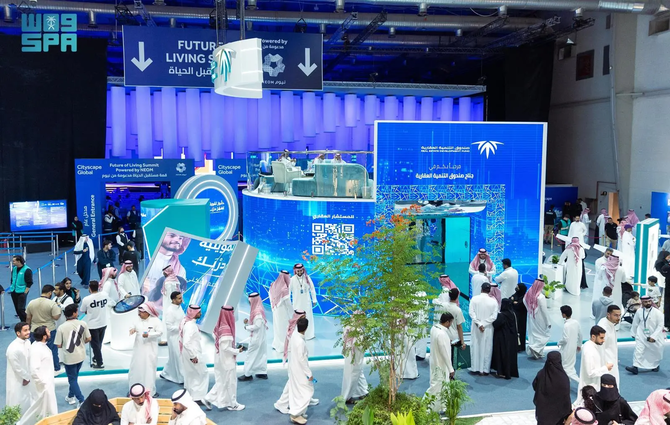
Saudi National Housing Co. signs 21 new deals on Cityscape’s 2nd day

Cityscape Global 2024 is a testament to Saudi Arabia’s rapid development and commitment to excellence. SPA
Short Url
Updated 13 November 2024
Follow

Saudi National Housing Co. signs 21 new deals on Cityscape’s 2nd day

  • Agreements also included partnerships with leading global companies in the manufacture of electrical appliances
  • REDF signed four MoUs at the event to strengthen partnerships in real-estate financing and investment

RIYADH: Saudi Arabia’s National Housing Co. secured 21 new agreements and partnerships with various local and international companies on the second day of Cityscape, expanding its investment momentum.

This brings the value of the total deals signed by the firm on the first and second day of the event to over SR5 billion (1.33 billion), according to a statement.

The deals aim to enhance the quality of infrastructure and services provided within its urban destinations and include the fields of supply, logistics, and interior design, the Saudi Press Agency reported.   

The agreements contribute to achieving NHC’s aspirations to build integrated and sustainable destinations that meet global ambitions.  

The Kingdom’s real estate is vital to the country’s economy, contributing around 7 percent of gross domestic product and supporting numerous additional sectors.   

Among the most prominent of these agreements that support the solutions division, NHC signed a strategic partnership with “Solutions by stc” to develop technical services for the “Sakani” and “Balady” platforms.  

It also signed a deal with Sakani Foundation to inspect buildings, with local real estate developer Ardara to assess sustainability, with LX and K-water companies to transfer knowledge, and with 2GIS to provide technical services.   

The firm inked a pact with the Public Investment Fund’s ROSHN real estate company to benefit from Sakani services and assess sustainability.   

NHC also signed an agreement with Takamol in the professional accreditation program to achieve an integrated residential environment that meets the needs of individuals and society.   

The deal comes within the framework of the two companies’ strategy to improve the quality of the residential landscape and enhance constructive cooperation between organizations in the housing sector. This aligns with national efforts to promote sustainable development and deliver suitable housing.  

The company also agreed to cooperate with the General Authority for Roads in implementing new routes and their mechanisms in NHC destinations to enhance sustainability.   

NHC also saw a cooperation with Al-Fahhad Co. to develop the cleaning and maintenance system for its destinations.  

Additionally, NHC signed a group of investment agreements to implement residential projects and build community centers in its urban destinations with Dar Wa Emaar, Ajdan Real Estate Development, Maya Real Estate Development and Investment, Rashed Abdul Rahman Al-Rashed & Sons Group, and Mohammed Al-Habib Real Estate Co.    

In the supply chain sector, the company signed agreements with local and international companies, including Bahra Electric Co., to provide cables and wires, and Al-Nasser Group to deliver lighting products that are characterized by efficiency and high quality, which enhances energy consumption efficiency.  

The agreements also included partnerships with leading global companies in the manufacture of electrical appliances, including Legrand, Panasonic, and Siemens to ensure the provision of high-quality equipment according to the highest technical standards.   

To enhance the efficiency of privacy and security in NHC destinations, the company signed an agreement with Al-Kuhaimi Metal Industries Ltd. to supply metal doors. The step improves the reliability of the destinations and meets the safety and security requirements of residents.   

The partnerships also included an agreement with Al-Hayat Building Materials Co. to supply sanitary ware to improve the quality of interior finishes and provide a distinctive living experience.   

The housing organization also signed a memorandum of understanding with Mask to invest in developing areas and logistics services, which contributes to improving the efficiency of construction and supply operations and enhancing the flexibility of the supply chain.   

Another MoU was also concluded with Madar to provide innovative interior designs that meet the tastes of residents and reflect a distinctive architectural identity that adds a unique character to NHC destinations.   

During the gathering, which kicked off on Nov. 11 in Riyadh and runs until Nov. 14, the Real Estate Development Fund reported that the housing support program and the various financing solutions and advantages it provides in partnership with financing entities recorded a 190 percent growth in financing contracts provided to Sakani beneficiaries.  

In comparison, the total value of real estate financing recorded an increase of 225 percent compared to the same period last month, during the first and second days of the exhibition.   

Sakani is a program that facilitates the process of owning a home, offers affordable housing options and helps with financing.  

The housing support programs provide a competitive opportunity on the sidelines of Cityscape to enable beneficiaries to sign financing contracts with solutions and advantages, including the lowest profit margin of up to 2.59 percent, in addition to housing support packages that provide immediate non-refundable support of up to SR150,000.   

The results achieved on the first two days of Cityscape in empowering housing support beneficiaries embody the effectiveness of strategic partnerships with financing entities and property development companies.   

The results also reflect the pioneering role of REDF in partnership with financing entities and the movement witnessed by the real estate funding and development sector, which resulted in the diversity of housing products and monetary solutions that achieve the aspirations of support beneficiaries.   

REDF signed four MoUs at the event to strengthen partnerships in real-estate financing and investment.  

The MOUs, inked with Jadwa Investment, Value Capital, ANB Capital, and the Knowledge Economic City, aim to support the fund’s strategic goals of helping beneficiaries acquire suitable housing.  

REDF’s Chief Executive Mansour bin Madi said the partnerships will explore opportunities and create investment funds to stimulate real-estate investment and finance housing projects.   

He highlighted REDF’s commitment to working with financial institutions to enable the development of high-quality, affordable housing.  

Also happening on the sidelines of the exhibition, Kuwait’s Minister of Municipality and Housing Abdullatif Al-Mishari discussed with Saudi Arabia’s Minister of Municipal and Rural Affairs and Housing Majid Al-Hojail cooperation in the real estate sector.   

The meeting touched on housing experiences and the ministry’s programs, such as housing support, guarantees, and property development, in addition to exchanging visions on expanding construction and supporting real estate developers, said the Saudi minister in a post on X.  

He also said they agreed to form a joint working team between the two countries to transfer experiences in several tracks that serve the real estate sector and enhance the integration of efforts to achieve sustainable development in this field.  

Also taking place at the event, the Real Estate Registry concluded seven memoranda of cooperation and agreements as part of its efforts to strengthen the relationship and communication with the public and private sectors, establish strategic partnerships with actors in the housing system, and enable technology companies to access property registry data.  

The first pact was with the REDF to enhance cooperation and partnership between the fund and the Real Estate Registry to facilitate the journey of the former’s beneficiaries from the latter’s services.  

It also signed a memorandum of cooperation with the Hail Region Development Authority to support and accelerate the real estate registration process, and three memoranda of cooperation with Talaat Moustafa Group-Saudi, Al-Majdiah Residence, and Sijil to facilitate the property registration process and improve the beneficiaries’ journey and direct linking with the registry services.  

At the level of real estate technology companies, the entity further signed agreements with two property platforms, Nuzul and ReInvest, to enable them to link with registry services, access data, and benefit from it in developing innovative products and services that enrich the sector.   

Cityscape Global 2024 is a testament to Saudi Arabia’s rapid development and commitment to excellence. As the Kingdom positions itself as a global leader in real estate, the global forum will drive the sector to new heights, aligned with the country’s Vision 2030 and its pursuit of creating thriving, sustainable communities.


Saudi Arabia pulls in most of Partners for Growth $450m capital push

Updated 07 February 2026
Follow

Saudi Arabia pulls in most of Partners for Growth $450m capital push

  • Global private credit fund leans into region’s largest market for growth-stage technology financing

RIYADH: Saudi Arabia has captured the vast majority of Partners for Growth’s capital deployed in the Gulf Cooperation Council, as the global private credit fund leans into what it sees as the region’s largest market for growth-stage technology financing. 

The San Francisco-based firm has deployed about $450 million in commitments in the GCC, and “the vast majority of that is in Saudi,” said Armineh Baghoomian, managing director at the firm who also serves as head of Europe, the Middle East and Africa and co-head of global fintech. 

The company was one of the earliest lenders to Saudi fintech unicorn Tabby, and it’s clear the Kingdom is providing fertile territory for ongoing investments.

“We don’t target a specific country because of some other mandate. It’s just a larger market in the region, so in the types of deals we’re doing, it ends up weighing heavily to Saudi Arabia,” Baghoomian said. 

Partners for Growth, which Baghoomian described as a global private credit fund focused on “growth debt solutions,” lends to emerging tech and innovation companies, particularly those that struggle to access traditional credit. 

“We’re going into our 22nd year,” she said, tracing the strategy back to its roots in a Bay Area investment bank debt practice in the mid-1980s. 

Today, the firm lends globally, she said, deploying capital where it sees fit across markets including Australia, New Zealand, and Southeast Asia, as well as Latin America and the GCC, where it has been active for about six years. 

Shariah structures dominate PFG’s Gulf deals 

In the Gulf, the firm’s structures are often shaped by local expectations. “Most of the deals we’ve done in the region are Shariah-compliant,” Baghoomian said. 

“In terms of dollars we’ve deployed, they’re Shariah-structured,” she added. 

“Usually it’s the entrepreneur who requires that, or requests it, and we’re happy to structure it,” Baghoomian said, adding that the firm also views Shariah structures as “a better security position in certain regions.” 

Growth debt steps in where banks cannot 

Baghoomian framed growth debt as a practical complement to equity for companies that have moved beyond the earliest stage but are not yet “bankable.” 

She said: “The lower-cost bank type facilities don’t exist. There’s that gap.”

Baghoomian added that companies want to grow, “but they don’t want to keep selling big chunks of equity. That implies giving up control and ownership.” 

For businesses with the fundamentals private credit providers look for, she said, debt can extend runway while limiting dilution. 

“As long as they have predictable revenue, clear unit economics, and the right assets that can be financed, this is a nice solution to continue their path,” she added. 

That role becomes more pronounced as equity becomes harder to raise at later stages, Baghoomian believes. 

She pointed to a gap that “might be widening” around “series B-plus” fundraising, as later-stage investors become “more discriminating” about which deals they back. 

Asset-heavy fintechs cannot scale on equity alone 

For asset-heavy technology businesses, Baghoomian argued, debt is not just an option but a necessity. 

She pointed to buy-now-pay-later platform Tabby as an example of a model built on funding working capital at scale. 

“Tabby is an asset-heavy business,” she said. “They’re providing installment plans to consumers, but they still need to pay the merchant on day one. That’s capital-intensive. You need a lot of cash to do that.” 

Equity alone, she added, would be structurally inefficient. “You would not want to just raise equity. The founders, employees, everyone would own nothing and lose a lot of control.” 

We don’t target a specific country because of some other mandate. It’s just a larger market in the region, so in the types of deals we’re doing, it ends up weighing heavily to Saudi Arabia.

Armineh Baghoomian, PFG managing director and head of Europe, the Middle East and Africa and co-head of global fintech

Baghoomian said those dynamics are common across other asset-intensive models, including lending platforms and businesses that trade in large inventories such as vehicles or property. “Those are businesses that inherently end up having to raise quite a bit of credit,” she said. Partners for Growth’s relationship with Tabby also reflects how early the firm can deploy capital when the structure is asset-backed. “We started with Tabby with $10 million after their seed round, and then we grew, and we continue to be a lender to them,” Baghoomian said. 

“On the asset-backed side, we can go in quite early,” she said. “Most of the fintechs we work with are very early stage, post-seed, and then we’ll grow with them for as long as possible.” 

As the market for private credit expands in the Gulf, Baghoomian emphasized discipline — both for lenders and borrowers. 

For investors assessing startups seeking debt, she said the key is revenue quality and predictability, not just topline growth. “Revenue is one thing, but how predictable is it? How consistent is it? Is it growing?” she said. “This credit is not permanent capital. You have to pay it back. There’s a servicing element to it.” 

Her advice to founders was more blunt: stress-test the downside before taking leverage. 

“You have to do a stress test and ask: if growth slows by 30 to 40 percent, can I still service the debt? Can I still pay back what I’ve taken?” she said. 

Baghoomian warned against chasing the biggest facility on offer. “Sometimes companies compete on how much a lender is providing them,” she said. “We try to teach founders: take as much as you need, but not as much as you can. You have to pay that back.” 

Partners for Growth positions itself as an alternative to banks not only because many growth-stage companies cannot access bank financing, but because it can tailor structures to each business. 

HIGHLIGHTS

• Partners for Growth positions itself as an alternative to banks not only because many growth-stage companies cannot access bank financing, but because it can tailor structures to each business.

• The firm lends globally deploying capital where it sees fit across markets including Australia, New Zealand, and Southeast Asia, as well as Latin America and the GCC, where it has been active for about six years.

One of Partners for Growth’s differentiators, Baghoomian said, is how bespoke its financing is compared with bank products. 

“These facilities are very bespoke. They’re custom to each company and how they need to use the money,” she said, adding that the fund is not offering founders a rigid menu of standardized options. 

“No two deals of ours look alike,” she said, framing that flexibility as especially important at the growth stage, when business needs can shift quickly. 

That customization, she added, extends beyond signing. Baghoomian said the firm aims to structure facilities so companies can actually deploy capital without being constrained, adding: “We don’t want to handcuff you. We don’t want to constrain you in any way.” 

As a company evolves, she said the financing can evolve too, because what works on day one often won’t fit nine months later. 

“We’ll revise structures,” she said, describing flexibility as core to how private credit can serve fast-moving tech businesses. 

She added that a global lender can also bring operating support and market pattern recognition, while still accounting for local nuance. 

Baghoomian expects demand for private credit in the Gulf to keep rising. “They are going to require credit, for sure,” she said, pointing to the scale of new platforms and projects. 

“I don’t see it shrinking,” she said, adding that Partners for Growth is seeing more demand and is in late-stage discussions with several companies, though she declined to name them. 

PFG to stay selective despite rising competition 

Competition among lenders has increased since the firm began deploying in the region, Baghoomian said, calling that “very healthy for the ecosystem.” 

Most of what the firm does in the region is asset-backed, Baghoomian said, often through first warehouse facilities for businesses financing receivables or other tangible exposures, “almost always Shariah.” 

Keeping Egypt on its watchlist 

Beyond the Gulf, Baghoomian said the firm is monitoring Egypt closely, though macroeconomic volatility has delayed deployments. 

“We looked at Egypt very aggressively a few years ago, and then the macro issues changed,” she said, adding that the firm continues to speak with companies in the country and track conditions. 

Even as private credit becomes more common in the region, Baghoomian underscored that debt is not universally appropriate. 

“Not every company should take a loan or credit,” she said. “You don’t take it just to take it. It should be getting you to the next milestone.”