

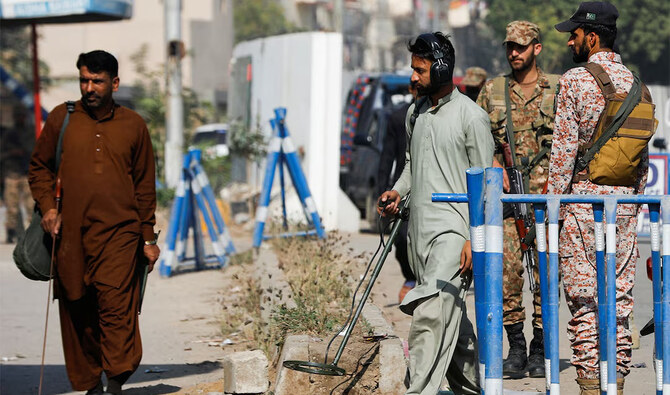

ISLAMABAD: Beijing is pushing Pakistan to allow its own security staff to provide protection to thousands of Chinese citizens working in the South Asian nation, during talks after a car bombing in Karachi that was seen as a major security breach, sources said.
Last month’s airport bombing in the southern port city that killed two Chinese engineers returning to work on a project after a holiday in Thailand was the latest in a string of attacks on Beijing’s interests in Pakistan.
The attacks, and Islamabad’s failure to deter them, have angered China, which has pushed Pakistan to begin formal negotiations for a joint security management system.
Five Pakistani security and government sources with direct knowledge of the previously unreported negotiations and demands spoke to Reuters on condition of anonymity, as the talks are sensitive.
“They (Chinese) want to bring in their own security,” said one official, who sat in on a recent meeting, adding that Pakistan had not so far agreed to such a step.
It was not clear whether Beijing wants to bring in state or private security personnel for the task.
Neither Beijing nor Islamabad confirmed the talks officially.
The source, and two other officials, said there was a consensus on setting up a joint security management system, and that Pakistan was amenable to Chinese officials sitting in on security meetings and co-ordination.
But there was no agreement on their participating in security arrangements on the ground.
The first official said Pakistan had asked China for help in improving its intelligence and surveillance capabilities instead of direct involvement.
A spokesman for China’s foreign ministry told Reuters it was not familiar with talks on a joint security scheme, but added, “China will continue to strengthen co-operation with Pakistan and make joint efforts to do its utmost to maintain the security of Chinese personnel, projects and institutions.”
Inter-Services Public Relations, the information wing of the Pakistan army, declined to comment. The interior and planning ministries did not respond to repeated requests for comment.
In a statement last week, Pakistan’s interior ministry said both sides agreed to develop a joint strategy to prevent similar incidents in the future.
'GRAVE SECURITY BREACH'
The nature of the Karachi bombing has angered Beijing, which is now pushing harder to achieve a long standing demand to control security arrangements for its citizens.
A pick-up truck rigged with nearly 100 kg (220 lbs) of explosives waited unchecked for about 40 minutes near the outermost security cordon of the heavily guarded airport before its driver rammed it into a vehicle carrying Chinese engineers, officials said.
“It was a grave security breach,” admitted one of the officials investigating the bombing, which came just a week before Chinese Premier Li Qiang’s visit to Islamabad, the first such trip in a decade.
The official said investigators believe the attackers had “inside help” in securing details of the itinerary and route of the engineers, who had returned from a month off in Thailand.
They were to be escorted back to a power plant set up as part of plans for the China-Pakistan Economic Corridor (CPEC).
Longtime Pakistan ally China has thousands of nationals working on projects grouped under the CPEC, a $65-billion investment in President Xi Jinping’s Belt and Road Initiative, which seeks to expand China’s global reach by road, rail and sea.
'CHINESE FRUSTRATIONS'
Publicly China has mostly backed Pakistan’s arrangements, even as it calls for enhanced security.
Privately, Beijing has expressed frustration. At one recent meeting, the Chinese side provided evidence that Pakistan had failed to follow security protocols agreed on twice in recent months, three officials said.
Such protocols usually feature high standards for deployment and movement of Chinese officials.
Chinese nationals have been in the crosshairs of separatist militants who see Beijing as helping Pakistan exploit minerals in the underdeveloped southwestern province of Balochistan, where China has a strategic port and mining interests.
Thousands of Pakistani security officers from the army, police and a dedicated force called the Special Protection Unit are posted to guard Chinese nationals.
Only China’s embassy in Islamabad and its consulates are allowed Chinese official security personnel, the Pakistani officials said.


