DHAKA: Rivals of former Prime Minister Sheikh Hasina on Sunday thwarted a plan by her Awami League party to hold a rally in Bangladesh’s capital, seen as a potential first effort to make a comeback on the streets since she fled the country in August amid a mass uprising.
The rally in Dhaka by Hasina’s party was to commemorate the death of a party activist on Nov. 10, 1987, which had sparked a mass protest against former military dictator H.M. Ershad. He was eventually ousted from office, ending his nine-year rule in 1990.
The day is commemorated as “democracy day.” In 1991, Bangladesh switched to a parliamentary democracy from a presidential form of government, and since then Hasina and her rival, former Prime Minister Khaleda Zia from the Bangladesh Nationalist Party, became the most powerful political figures in the country.
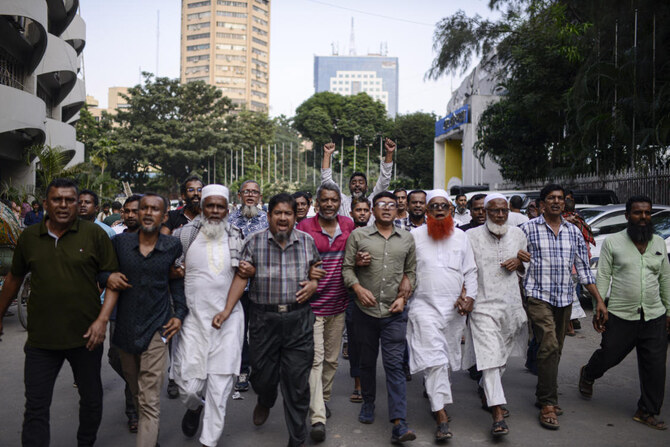
On Sunday, activists of the party headed by Zia, Hasina’s main rival, and also members of the conservative Jamaat-e-Islami party took to the streets of Dhaka, filling up much of the area where the rally was scheduled to take place.
Others, including hundreds of student protesters, also announced that they wouldn’t allow Hasina’s supporters to stand on the streets and hold the rally. The protesters said that they think Hasina’s party was trying to make a comeback by holding a rally on the streets on Sunday. The protesters from the Anti-discrimination Student Movement, a group that led the mass uprising in July-August, aggressively hunted for supporters of Hasina.
Groups of people surrounded the Awami League party’s headquarters near the Noor Hossain Square in Dhaka where Hasina’s supporters were supposed to gather to hold the rally.
Security was tight in the area, but witnesses and local media said that the protesters attacked several supporters of Hasina when they attempted to reach there and chanted slogans in favor of the fallen leader.
The Awami League party said that many of their activists were detained by police as they came under attacks.
Tensions ran high throughout Sunday with the anti-Hasina protesters saying that they wouldn’t allow the party to hold any public rally under any circumstances. The Awami League party questioned the notion, saying it is against the spirit of democracy and the constitutional right to assembly.
The Awami League party posted a number of videos on Facebook on Sunday showing its supporters being manhandled. Its party headquarters had earlier been vandalized following Hasina’s fall on Aug. 5, and on Sunday it was empty and there were signs of destruction. Outside, control was in the hands of Hasina’s opponents.
The political chaos in the South Asian nation went on as Zia’s party was seeking quick reforms and a new election from an interim government headed by Nobel Peace laureate Muhammad Yunus. The party believes it will be able to form the new government in the absence of Hasina’s party, while its other allies are also struggling.
As the interim government ends its three months in office, people remain concerned over high commodity prices, law and order, mob justice and the rise of Islamist forces once suppressed by Hasina’s regime. The international community also remains wary about alleged attacks on minority groups, especially Hindus that make up about 8 percent of the country’s 170 million people.
The Yunus-led government said it would seek extradition of Hasina and her close associates as they face charges of crimes against humanity involving deaths of hundreds of protesters during the uprising.
On Sunday, Bangladesh’s Law Adviser Asif Nazrul said the interim government would ask Interpol to issue red notices seeking the arrest and repatriation of fugitives allegedly responsible for the deaths of people during the mass uprising.
“We will … prioritize bringing them back from wherever they are hiding,” he told reporters in Dhaka.


![]()

Rivals of ousted Bangladesh leader Sheikh Hasina foil her party’s attempt to hold a rally
Short Url
https://arab.news/6t2g9
Rivals of ousted Bangladesh leader Sheikh Hasina foil her party’s attempt to hold a rally
- The rally in Dhaka by Hasina’s party was to commemorate the death of a party activist on Nov. 10, 1987
- On Sunday, rival party activists filled up much of the area where the rally was scheduled to take place


Latest updates


© 2026 SAUDI RESEARCH & PUBLISHING COMPANY, All Rights Reserved And subject to Terms of Use Agreement.